

Outdoor wind chimes need two kinds of suitability: an appealing place to hear them and a safe installation that can withstand the intended conditions. A well-made metal tube may survive ordinary rain while its upper loop, suspension cords, wooden cap or hook deteriorates. A sheltered balcony can still experience wind-driven rain and sudden gusts, and a chime that rings pleasantly in a garden may strike a wall or disturb neighbours when mounted beside an apartment window.
This guide explains how to choose between covered and exposed locations, inspect the complete hanging, select appropriate mounting hardware, understand moving loads, plan for Indian monsoon weather and maintain different materials. It also separates traditional Vastu-inspired decoration from practical safety requirements: no symbolic placement should justify an unsafe overhead fitting.
1. Start by classifying the outdoor location
“Outdoor” is not one uniform condition. A covered veranda, an open balcony, a garden pergola and a branch beneath dense foliage have different exposure to rain, sunlight, temperature changes, airborne dust and wind. Even under a roof, rain may travel sideways. An uncovered roof terrace may be subject to stronger gusts than a sheltered courtyard, particularly around building corners or parapets.
Look at the proposed site in ordinary weather and consider what can happen during seasonal changes. Where does rainwater run? Could a gust drive the tubes against a window, railing or wall? Is the support directly exposed to sun for long periods? Can the owner reach the chime safely without leaning outside a balcony or climbing unstable furniture? These details often matter more than the metal colour or decorative motif.
| Location | Main exposure | What to prioritise |
|---|---|---|
| Covered veranda or porch | Intermittent breeze, shade and possible sideways rain | Secure overhead support, comfortable sound, door clearance and moisture checks |
| Open balcony or high-rise sit-out | Variable and sometimes channelled wind, rain and nearby hard surfaces | Mounting strength, controlled movement, safe removal and neighbour comfort |
| Garden pergola or suitable structural beam | Sun, rain, branches and moving foliage | Verified beam and fixing, tree clearance and full-assembly weather suitability |
| Fully exposed terrace | Prolonged rain, intense sun and potentially severe gusts | Explicit complete-product exposure rating; sheltered alternative often preferable |
| Coastal or salt-air location | Salt deposits, moisture and corrosion of exposed fittings | Supplier-declared component materials, grade, cleaning and inspection frequency |
Major wind-chime makers commonly recommend a covered or protected outdoor position, avoiding prolonged exposure to severe wind and weather where appropriate. Their guidance is model-specific; it does not prove that every product from another maker has the same outdoor rating.
2. A weather-resistant tube does not make a weatherproof chime
Inspect the assembly as a system. The sounding tubes, upper frame, top ring, cords or wires, striker, wind sail, beads and decorative motifs can all be made from different materials. Aluminium and suitable stainless alloys may resist some atmospheric exposure, but the whole hanging still depends on the durability of its load-bearing connections. A robust tube is of little use if the cord suspending it can fray through a sharp hole.
A trustworthy outdoor claim should describe the exact supplied model and the conditions it is intended to tolerate. “For garden décor” may describe appearance or use; it is not necessarily a quantified guarantee of strong-wind performance, corrosion resistance or an all-season rating. A photograph beside a flowering plant cannot replace the maker's material details and care instructions.
When the product materials are not documented, ask for actual tube composition, support material, cord type, top-hook design, complete dimensions and weight, coating information and limitations on moisture and high wind. Do not call unspecified material “marine grade,” “304,” “316,” solid brass or natural crystal based solely on appearance.
3. Choosing a secure hook and structural mounting point
The upper attachment carries the complete chime. Depending on the design, this can include sounding elements at several levels, a central striker, a wind sail and glass or stone ornaments. Movement changes the forces acting on the fixing over time. A chime hung from a hook in moving air should not be assessed only as a stationary decoration of similar weight.
Select a support appropriate to the actual substrate: structural wood, sound masonry or concrete may need different types of approved hardware and installation methods. An ordinary picture hook, loose screw in weak plaster, thin ceiling trim, drainage pipe or decorative electrical fitting should not be assumed capable of carrying a swinging chime. Unsupported tree branches may flex, shed limbs or abrade cords; a tree-specific hanging solution needs its own assessment.
There is no one universal hook size or weight rating suitable for every chime and building. Check the complete assembled weight, expected movement, fixing manufacturer's instructions, substrate condition and any building restrictions. Where the mounting surface or anchor design is uncertain, consult a qualified installer rather than guessing a drill depth or hook capacity.
Use a connection that cannot casually slip off during normal permitted movement. A closed ring or properly secured attachment may reduce accidental disengagement, but do not assume a clip or carabiner is structural hardware merely because it looks substantial. All components in the load path must be appropriate for the actual installation.
4. Leave enough swing and walking clearance
Measure the complete top-hook-to-lowest-piece drop and the widest horizontal dimension. The longest tube is only part of the overall length; the wind sail or suspended ornament may extend lower. In a breeze, the assembly can swing laterally beyond the diameter shown in a photograph. Keep it away from glass panels, windows, railings, hard edges, plant stems and another hanging that it could strike.
Check a doorway with the door fully open. An outward-moving door can catch a suspended chime unexpectedly. Avoid placing heavy or breakable parts above occupied areas, walking routes, stairs, children’s play areas or public passages where a falling component could injure someone. Follow relevant building rules for external attachments and common areas.
Where the chime contains a glass prism, ceramic bell, shell or heavy gemstone hanging, ensure fragile components cannot collide with the wall or fall onto people below. Do not place the wind sail or hanging cords where they can catch in a fan, railing latch, clothesline or nearby vegetation.
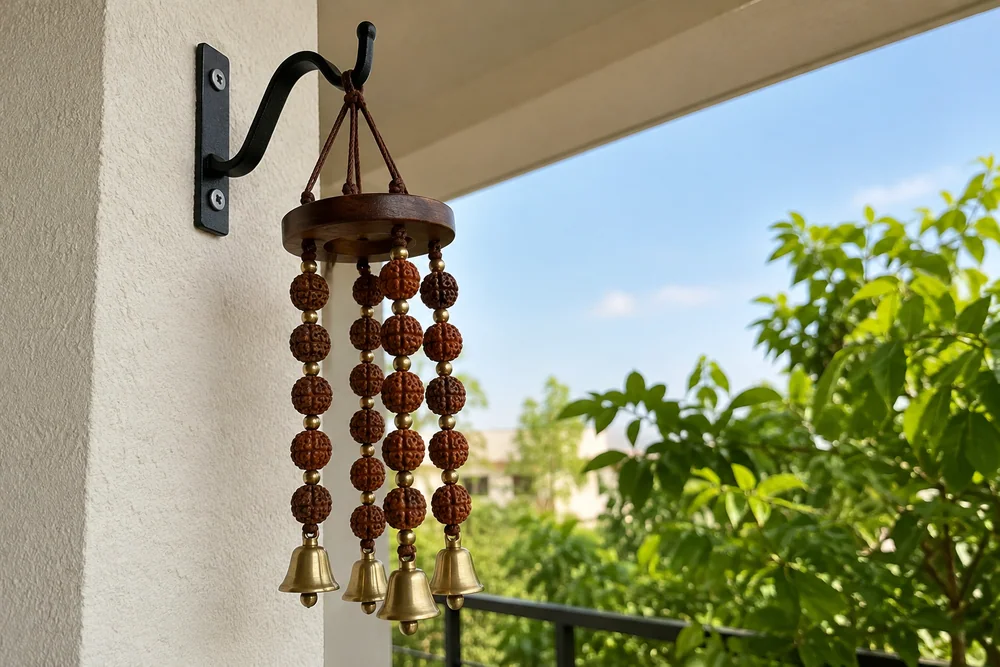
5. Wind exposure: gentle movement versus strong gusts
In a conventional tubular chime, a wind sail receives airflow and helps move a central striker into contact with sounding tubes. The sail's size and location affect how active the chime becomes. The amount of movement can increase with gusts, but more motion is not necessarily better: repeated hard contact can strain cords, produce unwanted clanging or cause the whole hanging to collide with nearby surfaces.
Wind River's care guidance specifically warns against hanging chimes too close to walls or poles, because those contacts can damage them in windy conditions. Woodstock's product-care guidance also recommends protection from prolonged strong winds for its products. These recommendations support the general principle of generous clearance and realistic exposure assessment.
Do not attach improvised stones, extra metal weights or restraints to force the object to remain still in strong wind. Added mass can change the load on the fixing; tight restraints can abrade suspension lines or create unpredictable impacts. Where the actual manufacturer provides an approved mute, removable windcatcher or sail adjustment, follow its instructions exactly. Otherwise, relocation or bringing the chime inside is usually a simpler and more controllable response.
6. Monsoon preparation in Indian homes
In India, pre-monsoon checks are especially important for exposed verandas, garden hangings and apartment balconies. Inspect the top hook, supporting material, knots, frame, wind sail and every moving element before the season. Make sure the installation is accessible for planned removal and that an indoor storage location is available.
Government disaster-preparedness guidance recommends securing loose outdoor items before severe storms. A hanging wind chime is one such object to consider when evaluating an exposed home. Remove or move vulnerable hangings before severe weather begins, while conditions are safe. Do not climb ladders, lean over balcony railings or work outside during thunder, lightning, high winds or heavy rain to rescue an ornament.
Rain, humidity and repeated drying can affect coatings, wooden supports, fabric strings, bamboo and connections. A manufacturer may rate some metal models for regular outdoor exposure while recommending sheltered placement for delicate glass, shell, bamboo or coconut components. Apply the limits of the whole mixed-material item, not those of its toughest individual tube.
After an event, wait until conditions are safe before checking the chime. If a fixing is loose, the suspension is frayed or a part is cracked, keep people clear of the fall zone. Have the object safely removed before reuse; use suitable access, support the assembly, and seek qualified help when the fixing or access is uncertain.
7. Coastal salt air, stainless steel and other metals
Coastal environments can be demanding for metallic hangings and hardware. Sea-salt deposits promote corrosion of unsuitable fittings and can contribute to brown tea staining on some stainless-steel surfaces. The Australian Stainless Steel Development Association explains that grade, surface finish, salt deposition, sheltered crevices and cleaning practices influence the risk. Stainless steel is corrosion resistant under suitable conditions, not universally rust-proof. Tea staining itself is generally cosmetic; pitting, crevice corrosion or weakened connectors require a separate safety assessment.
Grades such as 304 and 316 are familiar in many architectural contexts, and grade 316 generally offers better resistance to some chloride conditions. But the correct selection depends on the environment and design, and a shiny surface does not verify the grade of a particular chime. Manufacturer documentation is necessary for an exact material claim.
Copper and brass may darken or develop natural patina, with behaviour influenced by air chemistry, coatings and exposure. Aluminium may be anodised or painted and can experience surface or coating wear. None of these materials can be judged safely from colour alone. Striker parts, suspension cords, screws, plating and connecting rings can deteriorate differently from the main sounding tubes.
For material-family comparisons, browse Metal Wind Chimes and related designs such as the Stainless Steel Tube Wind Chime, Copper Tube Wind Chime and Aluminium Tube Wind Chime. Confirm the specific model’s materials and exposure limits before choosing it for coastal use.
8. Bamboo, wood, shell, glass and gemstone hangings outdoors
Outdoor hanging decorations are not always metal wind chimes. Bamboo tubes can split or show changes under moisture; wooden caps and wind sails can swell, crack or lose coatings; shells and ceramic pieces may chip in collisions; and a glass prism may break if it hits a wall. Decorative gemstones may withstand some exposure while their cords, holes, wires or other mounts do not.
Even materials with a durable-looking surface have different maintenance needs. Not every glass pendant is a natural crystal, and not every coloured stone bead tolerates soaking or strong cleaners. An unspecified mixed-material hanging should be kept in a protected position until the maker confirms its exposure conditions.
For an entrance where sound is not needed, a securely mounted fabric toran or other stationary ornament may suit the setting better than a chime exposed to repeated wind. A stationary object is not automatically weatherproof either; fabric colour, thread, adhesive and attachment must still suit the location.
9. Inspect the complete assembly after weather exposure
Weather inspection should follow the load path from the ceiling or beam to the lowest piece. A metal tube may look almost unchanged while its line is worn thin around a suspension hole. If a chime has been moving strongly, also check for damage from contact with the wall, rail or an adjacent object.
| Component | Potential weather or impact issue | Action |
|---|---|---|
| Structural fixing and top hook | Looseness, bending, corrosion, weak substrate | Take down safely if uncertain; use appropriately specified installation or repair |
| Main support or cap | Cracking, warping, rotting, chipped coating or sharp holes | Inspect load-bearing surfaces before rehanging |
| Cords, wires, knots, rings | Fraying, brittleness, slipped knots, corrosion and abrasion | Replace only with suitable maker-approved parts or methods |
| Tubes, rods and bells | Collision dents, pitting, sharp edges, finish damage | Separate cosmetic patina from damage affecting strength or sound |
| Striker and wind sail | Tangles, loose fasteners, unintended wall contact | Restore correct movement and spacing; avoid arbitrary weights |
| Glass, ceramic, shell or stone motifs | Cracks, chips, loosened attachments | Remove unsafe fragments and repair before reuse |
10. Cleaning and storing after rain or salt exposure
Begin with a gentle dry inspection and cleaning method suitable for the actual materials. For a confirmed stainless-steel finish, maker-approved mild cleaning and proper drying may help remove deposits; harsh chloride-based cleaners and contaminated steel wool can worsen corrosion. For copper, brass, plated metal or anodised aluminium, identify the finish before polishing, because abrasive techniques may remove a protective coating or valued patina.
Do not soak a completed mixed-material chime. Cords, wood, adhesives and decorative components can trap moisture, and some mineral or painted finishes require particular care. Allow permitted damp-cleaned parts to dry completely, including hidden knots and holes, before packing.
Store tubes and fragile pieces with soft separation so they cannot knock together. Preserve the original suspension arrangement, particularly for tuned or spiral constructions. Do not compress the wind sail beneath a heavy object or knot all lines together tightly. Reinspect the hook and supports before bringing the chime back outdoors.
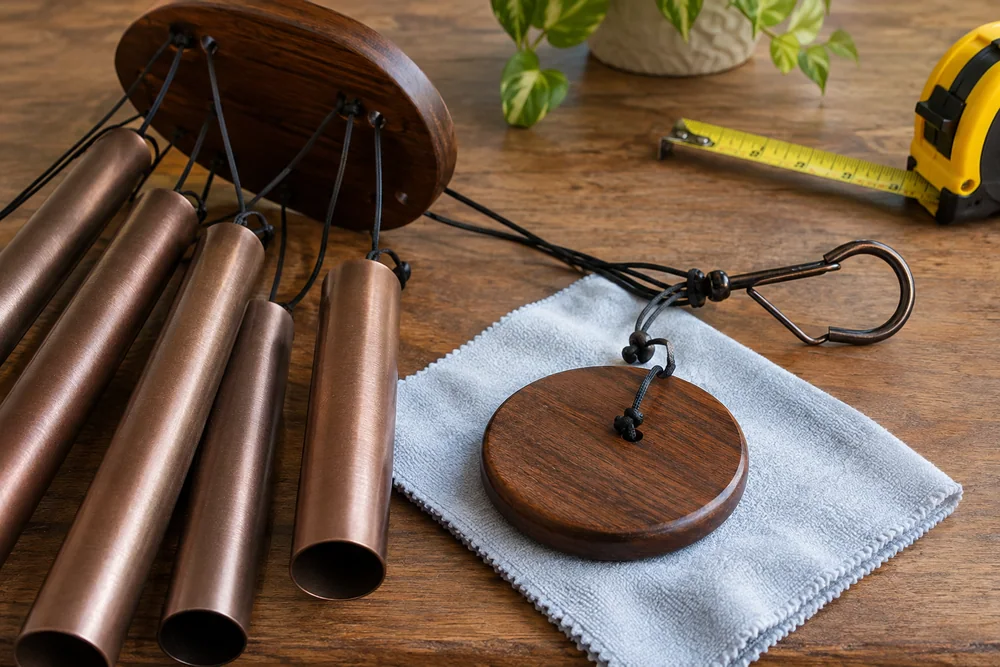
11. Sound and neighbours: outdoor placement has an acoustic side
Outdoor placement determines how frequently a chime is activated and how sound travels. A position along an exposed corner may produce nearly continuous ringing, while a sheltered side location may give occasional notes. Nearby hard surfaces can reflect sound into rooms or neighbouring balconies. A large, sustained tone can be enjoyable to the owner but unwelcome beside another household's bedroom.
Choose a model based on an authentic demonstration rather than assuming metal type, tube count or a “soft sound” label determines volume. Check the sound during ordinary airflow and after dark. Where a model supports a genuine manufacturer-approved quieting adjustment, follow those instructions; otherwise choose a less windy location or remove the chime during sensitive hours.
For a shared-building balcony, read the building's requirements for external fixtures and avoid blocking common passageways. A silent hanging may be a more considerate alternative where neighbours prefer uninterrupted quiet.
12. Outdoor chimes, Vastu Shastra and Feng Shui
Vastu Shastra is concerned with the orientation and organisation of built spaces, including entrances, light, ventilation, circulation, proportions and cosmological ideas such as the Vastu Purusha Mandala and Pancha Mahabhuta. Modern decorative explanations may associate wind-driven movement with Vayu (air) and audible sound with Akasha (space). A contemporary wind chime is therefore sometimes selected for Vastu-inspired homes, but it is not a universal classical requirement or a substitute for safe architectural decisions.
In Chinese Feng Shui, metal belongs to a distinct five-phase system, and certain modern approaches recommend metal chimes in west or northwest sectors. Such advice should not be presented as identical to classical Sanskrit Vastu. A directional preference never justifies hanging an object from an unsuitable bracket or exposing fragile materials to severe weather.
Indian devotional use of the ghanta and traditions of nada provide rich cultural contexts for sound, but a freely ringing household chime is not itself a consecrated ritual bell or automatic mantra. If the household values quiet worship or meditation, a protected stationary ornament can be preferable.
For broader spatial and cultural context, explore Vastu Shastra or the Vastu collection.
13. Outdoor wind chime buying and installation checklist
- Verify actual merchandise: Confirm the specific model, actual photographs, sounding material, dimensions, weight, hardware and manufacturer instructions.
- Match the environment: Decide whether the position is sheltered, open, coastal, dusty, humid or subject to strong gusts.
- Check the complete weather rating: Include cap, cords, striker, sail, rings, coatings and any fragile decorative parts.
- Use a suitable fixing: Select approved hardware for the actual structural substrate and moving load; obtain professional help when uncertain.
- Allow clearance: Check full door movement, headroom, walls, glass, rails and wind-swing span.
- Plan safe access: Ensure the hanging can be removed before severe conditions without leaning over a balcony or climbing dangerously.
- Check sound comfort: Consider sleep, shared corridors, neighbours and the chime's activity in typical breezes.
- Set an inspection routine: Check cords, hooks, cracks, corrosion and tangles after strong wind or rain and before rehanging.
- Keep storage ready: Use a clean, dry, padded place rather than leaving the wet hanging tangled in a closed container.
Frequently asked questions
Can every metal wind chime remain outdoors all year?
No. Suitability depends on the actual alloy, coating, cords, frame, fasteners, local weather and the complete manufacturer's exposure guidance. A weather-resistant tube does not certify all other parts.
Where is the safest place to hang an outdoor chime?
A securely supported, appropriately sheltered spot with sufficient swing and walking clearance is generally preferable. The precise mounting point depends on structural material, the chime's moving weight and the site's conditions.
Can I mount a wind chime on any balcony railing?
Not automatically. Check the property's rules and whether the specific railing and fixing can safely support the moving object. Avoid locations where the chime can fall onto people below or collide with glass.
Should I leave wind chimes outside during strong monsoon winds?
Follow the maker's weather limits. If the item may be damaged or become loose, bring it indoors before severe weather while access is safe. Do not attempt retrieval from an exposed balcony during a storm.
Is a 316 stainless-steel chime rust-proof at the coast?
No steel grade makes an entire mixed-material hanging completely immune to weather. Salt exposure, finish, crevices, cleaning and non-steel components still matter; the actual grade must be verified.
Can copper or brass patina be left in place?
Sometimes. Natural surface ageing may be acceptable or preferred, but the material, coating and structural condition should be identified before deciding whether to clean or polish.
Does a larger wind sail help in outdoor wind?
It may make some designs more active in the breeze, but can also increase ringing and movement. Use only manufacturer-supported changes; a bigger sail is not a universal improvement.
What if the suspension cord has begun to fray?
Take the chime down safely. Replace the line only with appropriate parts and instructions; do not trust a surface-polish treatment or an improvised knot to restore a weak load-bearing connection.
Is a certain Vastu direction more important than mounting safety?
No. Traditional Vastu and contemporary Feng Shui advice should be understood in their proper contexts. Neither overrides secure installation, weather suitability, household comfort or building requirements.
Explore related OmmRudraksha wind chimes and outdoor hangings
Browse Metal Wind Chimes, compare material families including Aluminium Tube Wind Chime, and explore the wider Hangings & Chimes collection for sounding and primarily decorative options. Before ordering, verify the actual material, finish, dimensions, outdoor suitability and availability of the particular model.


