

The Mukhi count of a Rudraksha hanging must belong to the actual natural bead being sold—not to a generic catalogue picture, a carved line or an attractive certificate graphic. Rudraksha has profound significance in Śaiva tradition, and the number of natural faces is a meaningful distinction in its traditional classification. But assessing a physical specimen requires clear views, knowledgeable examination and appropriately interpreted evidence; authentic bead identity, geographical origin and secure mounting are separate questions.
This OmmRudraksha guide explains the fruit-stone anatomy behind Mukhi terminology, common and specialist classifications, the proper inspection of longitudinal grooves, unusual joined forms, potential alterations, non-destructive imaging, report verification, misleading home tests and truthful presentation of a finished wall hanging. It also discusses traditional meanings without turning a Mukhi name into a medical, financial or mechanical-performance guarantee.
1. Start with the actual Rudraksha fruit stone
A Rudraksha bead is a hard, lignified fruit endocarp associated with Elaeocarpus trees. Botanical references frequently use the name Elaeocarpus ganitrus; Kew's current taxonomy places it as a synonym of accepted Elaeocarpus sphaericus. The commercial bead is not a mined gemstone and should not be described as natural quartz, dyed wood or an ordinary loose seed without recognising its fruit-stone structure.
Published pharmacognostic research describes a stony endocarp with lignified cells and internal seed structures. Morphometric studies have examined endocarps and their locules, including natural variation and abnormal fruits. Those findings give a botanical foundation for understanding the physical divisions, but do not automatically authenticate an individual bead photographed on a website.
Every purchased specimen has its own dimensions, outer texture, natural colour variation, grooves and possibly drilling or wear. A listing that groups multiple beads under a single image should state whether it depicts the exact item or representative stock. That distinction becomes especially important when a specific Mukhi count, natural joined form or stated origin carries a premium price.
2. What does Mukhi mean?
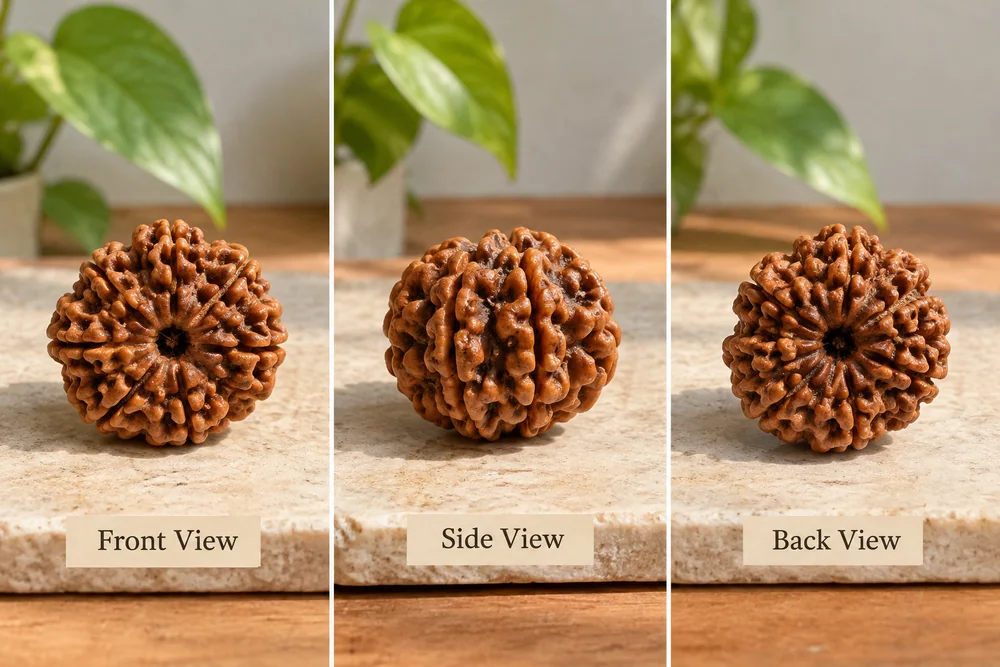
The Sanskrit words mukha and mukhī refer to a face or faced form. In Rudraksha trade, the Mukhi count describes natural longitudinal divisions on the fruit stone, commonly recognised through grooves extending between the two poles. The external surface is three-dimensional, so a photograph of only the front cannot show the complete number of divisions.
Count natural structures rather than all marks that happen to resemble lines. An actual bead can also display shallow wrinkles, ridges, pits, scratches and changes near a drill hole. A decorative groove deliberately cut after harvesting is not a naturally developed Mukhi, and an ordinary scratch should not be counted as a new face because it happens to follow part of the bead's length.
The internal endocarp may show locules or partitioning associated with development. The relationship between surface lines and internal anatomy is useful to examine, but very unusual beads, deformed growth and incomplete imaging require careful interpretation. Avoid promising that every visible external mark always matches one perfectly distinct X-ray chamber in every specimen.
For accurate terminology, distinguish a longitudinal Mukhi line from a stringing hole, which may be naturally formed or prepared to accommodate cord. The presence of a pierced channel is neither a new face nor, by itself, proof of imitation.
3. Understanding common, specialist and rare claims
Five-Mukhi Rudraksha is familiar in many everyday beads, prayer strands and hanging ornaments. Forestry and botanical descriptions recognise the common five-loculed fruit stone. Other natural variants and abnormal endocarp forms have been documented, although their occurrence, market prices and authentication needs differ by type and source.
Contemporary specialist catalogues sometimes offer products labelled from one through twenty-one Mukhi, including higher-numbered specimens that require especially careful assessment. A catalogue listing is not independent proof that every claimed count is naturally formed or commercially available in a particular batch. Do not infer a specimen's rarity solely from a seller's adjectives or the visual complexity of the surface.
Traditional references do not all provide identical lists. The Śiva Purāṇa discusses different Rudraksha face types and their religious significance, while material in other Purāṇic and Śaiva traditions may enumerate variants differently. Higher-numbered modern commercial classifications should be attributed honestly rather than represented as a single universally identical ancient scripture.
A responsible site may present a verified common five-Mukhi option and separate specialist high-Mukhi pieces with specimen-specific documentation. An unavailable option should remain unavailable; substituting a different bead and silently keeping the premium Mukhi title is not acceptable product practice.
4. A practical framework for Mukhi product descriptions
The following table is a buyer’s verification framework. It distinguishes widely used terms from the stronger evidence needed for unusual or specialist claims; it does not establish the authenticity of any individual bead.
| Description category | How it is commonly presented | Evidence and editorial priority |
|---|---|---|
| One-Mukhi | Single-face specialist classification; market examples vary considerably in form | Examine exact species and natural structure; investigate lookalikes, altered pieces and the exact scope of a competent report |
| Two–four Mukhi | Lower numbered natural-faced types in traditional and specialist commerce | Show complete natural lines and poles; verify the actual item and any rarity or origin claim |
| Five-Mukhi | Widely used in everyday Rudraksha strands and decorative hangings | Check genuine fruit-stone identity, natural grooves, component count and secure stringing |
| Six–nine Mukhi | Named specialist options sometimes used as focal beads | Document which bead carries the count, natural line continuity and specimen-specific support |
| Ten–fourteen Mukhi | Specialist classifications with references in certain textual or commercial traditions | Use careful magnified morphology, suitable imaging where justified, and explicit report limitations |
| Fifteen–twenty-one Mukhi | Higher numbered options in contemporary specialist catalogues | Do not rely on marketing title alone; require clear specimen identity, high-quality examination and traceable documentation |
| Joined and named forms | Gauri Shankar, Ganesh and other special configurations | Examine natural joining or projection separately from Mukhi count, attachment and any altered areas |
The higher the commercial significance of a claim, the greater the value of careful evidence and independent review. But even a five-Mukhi decorative bead should be described accurately; a lower price does not make misleading material or Mukhi labelling acceptable.
5. Photograph the whole bead, not a flattering side
Ask for images showing the bead all around its circumference, its two poles, the side most likely to be covered by the mounting and any natural junction or protrusion. A rotating video can make the geometry easier to understand, but the rotation itself does not constitute a laboratory test. Every photograph should correspond to the same identifiable physical bead.
Use neutral, even illumination and enough resolution to show the surface without heavy enhancement. A dramatic black shadow inside a groove may make it look artificially deep; an overexposed pale photograph can hide shallow divisions. Captions should identify educational illustrations versus exact-stock photographs. Do not present a generated view as if it were an individually examined gemstone report.
Photograph the bead before assembly when it will later be covered by tight caps, wires or a frame. After assembly, capture the final hanging and note which areas are obscured. If a high-value bead's important evidence is hidden by permanent ornamentation, choose a mounting that allows inspection or explain the limitation clearly to the customer.
Maintain a consistent specimen identifier across pre-assembly photographs, laboratory documentation, order records and the finished item. A polished hero shot of a different example is not sufficient if the buyer pays for a specific unusual Mukhi bead.
6. Natural grooves, scratches and possible altered lines
Surface inspection should look for the developmentally coherent paths of natural divisions and for signs of subsequent changes. Abruptly sharp tool-like marks, suspiciously uniform deep channels, inconsistent surfaces, unusual fillings or an apparent seam may call for closer examination. None of these observations should be treated as a fully conclusive diagnosis in isolation; genuine natural forms can be irregular.
A bead may also have ordinary ageing marks, harmless nicks or areas where a cord has abraded the surface. Those should be distinguished from deliberate line modification. Adding one or more cuts to make an ordinary bead resemble a specialist higher-Mukhi variety changes the commercial claim; similarly, filling over an existing line can make a different type appear to have fewer divisions.
Magnification can help trace the surface but cannot necessarily reveal everything inside the endocarp. Appropriate specimen orientation and an examiner experienced with normal botanical variability are important. A seller should be prepared to describe uncertainty rather than presenting every ambiguous mark as a newly discovered natural Mukhi.
Do not apply a knife, acid, flame, heavy sanding or fresh deep scratching as a “verification test.” Those methods can irreversibly damage a genuine bead, spoil evidence and create unnecessary risk. Authentication should preserve the specimen where possible.
7. Examine internal anatomy with appropriate caution
Radiography can provide additional information about the internal structure of an intact endocarp. In suitable circumstances, an examiner may use X-rays or more detailed imaging to visualise partitions or locules and compare them with the exterior morphology. This is particularly relevant when an unusual number of faces or an altered bead is suspected.
However, an image is not an automatic answer. Resolution, angle, overlap, drilled holes, irregular development, damaged internal material and the examiner's expertise can affect interpretation. In a complex specimen, a single projection may not clearly separate every internal feature; more than one view or a different technique may be necessary.
An X-ray does not itself establish the region in which a fruit grew, a particular spiritual power, the age of the tree or the commercial price of the bead. Nor does it replace external inspection for carved marks, added coatings, glue or a suspicious junction. A strong assessment combines the appropriate available methods and states what each can or cannot establish.
The research record on Rudraksha anatomy—including published studies of endocarp structure, morphometric variation and unusual jointed fruits—supports a careful evidence-based approach. It does not support treating every radiographic shadow as a rigid universal one-to-one Mukhi formula without considering the specimen.
8. Read a laboratory report for its actual scope
A report can be useful if it is genuine, current and clearly associated with the bead purchased. Look for the issuing organisation, report identifier, date, specimen photographs or distinguishing marks, recorded dimensions, observed features and the conclusion. Some reports address natural identification and visible Mukhi; others include imaging, treatment observations or a general description. Not all laboratories perform the same methods on every item.
The words identified, observed, consistent with and origin determined are not interchangeable. If a report contains a radiograph, the buyer should know which bead was scanned and what was interpreted. A lab badge in a website footer does not prove that the individual hanging contains tested stones, and the presence of an X-ray on a sample page does not prove every item receives X-ray testing.
Where the document provides a verification number or QR code, check that it resolves to an actual corresponding laboratory record and that the material, photograph and reference agree. A QR graphic linking only to the seller's homepage is not sufficient evidence of a specific examination. Verification links also need to remain accessible to the customer when the item is sold.
OmmRudraksha's existing authenticity verification policy explains that the testing method must be tied to the relevant product record rather than assumed for every item. An editor should apply that principle to decorative hangings and avoid broad all-stock certification statements without individual evidence.
9. Match the actual bead to its certificate
The central question is not simply whether a certificate looks professional. It is whether that document belongs to the specific bead currently mounted in the purchased hanging. Verify dimensions and identifying features, compare clear views and maintain a traceable item or lot reference. A loose bead assessed before assembly should remain identifiable after it is enclosed in a frame.
Serial-number formats, holograms, seals and QR codes can help trace documentation, but they are not substitutes for an authentic matched record. Ask whether the lab description covers one bead, a multi-bead strand or only a representative sample. If only the focal bead is tested, do not imply that the remaining twelve beads have identical certification.
A general invoice may list a Rudraksha hanging without proving that every natural division was verified. Conversely, a properly issued report can answer narrower questions without making it invalid. Accurate retail communication makes the report's scope explicit and does not overstate its conclusion.
10. Natural joined Rudraksha forms need their own assessment
Gauri Shankar is a traditional name commonly associated with a naturally joined two-part Rudraksha formation and with Śiva–Pārvatī symbolism. A physical specimen should be assessed for the natural character of its junction rather than merely counted as two beads held together by string. Published forestry research on abnormal Elaeocarpus fruits records naturally jointed forms, making the botanical possibility real while leaving any individual authenticity claim open to examination.
Artificially connected pieces can resemble a twin form through glue, filler, carved junctions or a covering. A competent examiner should inspect the actual joining region and relevant internal structure when appropriate. Even if an ornament visibly contains two authentic separate Rudraksha beads, it should not be described as one naturally developed Gauri Shankar unless that joined formation is established.
Ganesh Rudraksha is a name used for particular protruding forms associated symbolically with Gaṇeśa. A natural-looking projection is not automatically authentic, and an unusual bump must not be sold as an individually verified specialist piece without examination. A protrusion also needs protection from accidental impacts and over-tight wire wrapping.
A genuine joined bead may require a specially fitted cradle so the junction is not placed under constant tension. Material authenticity and mechanical retention are both essential; a rare shape makes an unsafe fitting more consequential, not less.
11. Why home tests do not establish authenticity
Popular advice sometimes says an authentic Rudraksha must sink in water, turn between copper coins, maintain milk freshness, warm or cool a surface or respond to a ritual test. These are not reliable universal tests of botanical identity or natural Mukhi formation. Floating and sinking depend on physical factors such as density, trapped air, moisture and any alteration. A different natural seed or a manufactured imitation may also sink.
Copper-coin rotation can be influenced by tiny movements, friction, contact pressure and the irregular surface. Such demonstrations do not independently reveal the endocarp's natural divisions. Claims that a bead changes milk chemistry or displays a special electrical response under casual household conditions are not substitutes for controlled material examination.
Boiling, drilling, burning or cutting a premium specimen as a “test” may destroy the very natural structure the owner wants to preserve. Even a floating test may introduce unnecessary moisture to an already mounted organic bead and its cord or metal hardware. An authentic bead should not lose its identity because it fails an unsupported internet ritual.
Use photographs, traceable stock records and competent non-destructive examination instead. When a listing makes an unusually expensive identity claim, the appropriate response is stronger evidence—not a more dramatic home demonstration.
12. Nepal, Indonesia and India: distinguish identity from provenance
Trade descriptions often refer to Nepal-origin, Indonesia/Java-origin or India-origin Rudraksha. Such claims are relevant to sourcing and customer preference, but geographical origin is not equivalent to Mukhi count or botanical authenticity. Bead diameter, texture, depth of grooves and colour vary among specimens and can be affected by preparation or age.
A photograph alone cannot reliably prove Nepal or Indonesian provenance. Nor can an X-ray of an endocarp normally identify the exact farm or harvesting location. Country claims require a sufficiently trustworthy supplier trail, documented sourcing or relevant specialised evidence appropriate to the assertion.
A hanging may contain beads from more than one source, and that is not necessarily a defect. If a product promises all Nepal beads or an exact Nepal–Indonesia mix, however, the claim should correspond to actual inventory records and count, not to the appearance of one focal bead.
Price differences can also reflect size, workmanship, testing, distribution and unusual shapes. A premium geographic label alone should not become a guaranteed quality, scarcity or religious-effect statement.
13. Authentication of one bead is not authentication of an entire hanging
A decorated hanging can include a genuine focal Rudraksha, several other endocarps, wooden spacers, synthetic beads, gemstones, thread, resin, metal caps and a bell. A report on the focal bead addresses that specimen to the extent specified in the report. It does not certify the metal alloy, safety of the knots, origin of every other bead or durability of the full assembly.
Identify each natural bead type separately when its Mukhi is advertised. A design with one authenticated eleven-Mukhi focal bead and ordinary five-Mukhi spacers should say exactly that if verified. Do not call all eleven pieces “eleven-Mukhi” because there are eleven beads, and do not present a five-Mukhi strand as a rare multi-Mukhi composition through vague collective phrasing.
A useful description records bead count, verified Mukhi options, whether the item is a pendant or a wall hanging, total length, total weight, and the actual materials of caps, spacers, lower ornaments and mounting hardware where known. The product's own visual effect and devotional meaning can still be described without obscuring these physical facts.
14. Identify false alternatives and honestly labelled lookalikes
Some imitations use carved wood, cast resin, moulded plastic, other plant endocarps or assembled pieces. These may resemble brown, grooved Rudraksha in a catalogue photograph, but they are materially different. A decorative “Rudraksha-look” item can be sold honestly when labelled as an imitation; its material should not be switched silently to a natural-bead claim.
Signs that may warrant scrutiny include repeated identical patterns across beads, suspicious seams, unusual uniformity, added paint, worked grooves and a material feel inconsistent with an endocarp. None is conclusive alone. Natural stones can look similar, and handmade pieces can have irregular marks. Competent examination combines observations rather than relying on one simplistic checklist.
Even an authentic natural endocarp might be altered by added cuts or joined with other pieces. “Natural Rudraksha material” and “natural unaltered fourteen-Mukhi Rudraksha” are therefore different claims. Treatments, drilling, repairs and decorative assembly should be disclosed to the extent they affect the identity and value represented to the customer.
15. Safe fitting after authenticating a valuable bead
Once a bead has been identified, the construction of its hanging needs independent scrutiny. A valuable fruit stone can be damaged by a badly placed drill hole, a tight wire cap or a poorly balanced frame. Knots can loosen at a smooth metal ring, and a heavy lower bell can stress cord that is adequate only for the bead itself.
| Potential issue | What it affects | Inspection or response |
|---|---|---|
| Cap hides natural lines | Customer cannot verify all claimed Mukhi faces | Keep clear pre-assembly views and consider removable or minimally obscuring fittings |
| Oversized or cracked drill hole | Bead integrity and safe stringing | Inspect poles, surrounding fibres and strain; repair or retire unstable component |
| Loose wire cage | Risk of focal bead falling from the ornament | Verify full mechanical retention, especially the lower opening and top loop |
| Unverified metal caps or bells | Material accuracy, corrosion and sound claims | Identify actual alloy or coating when claimed and inspect the joint |
| Long strand at a doorway | Pulling, entanglement and collision | Confirm door swing, complete drop, children’s reach and safe mounting |
| Unmatched certificate | Authenticity, premium pricing and customer trust | Link report reference, actual bead images, dimensions and inventory record |
| Special joined bead under tension | Integrity of a natural junction or projection | Use a suitable supporting cradle and avoid load concentrated on the fragile feature |
The real installation should suit the complete mass and anticipated movement. A small adhesive picture hook is not automatically sufficient for a long swinging hanging, and a decorative frame should not be placed above cots, occupied seating or busy passages if failure could cause injury.
16. Variants, customer selection and truthful stock information
If a hanging has the same frame and knot pattern but different verified focal Mukhi beads, product variants may make sense. They should not, however, imply all options are actually available. Each option needs its own accurate identity, inventory count, pricing, size or weight details when relevant, and a clearly linked item or report record for premium claims.
The listing should say whether customers choose the exact photographed bead or receive a specimen within documented variation. For a higher-Mukhi or special form, a specific-item photograph and traceable report are usually more informative than an idealised group image. An out-of-stock type should not be silently replaced by a lower count while retaining the selected option on the invoice.
When a return, exchange or replacement takes place, the certificate or report reference must follow the actual new bead. An old certificate for a returned specimen must not be reused to authenticate a different replacement. This is as important for one focal bead as for a set of high-value beads in a framed ornament.
Keep the customer-facing product page straightforward: exact title, clear material description, offered Mukhi types, genuine images, verification scope, physical dimensions, construction, care and supported price. Spiritual meaning can be described fully without burying the observable facts in repeated guarantees.
17. After-sale documentation and traceability
A good owner record includes the invoice, SKU, actual-bead photographs, the stated Mukhi count, any lab report identifier, supplier information available for origin, and a photograph of the completed hanging. Retain the report's method and conclusion, not only its attractive front-page graphic. Keep the original item identifier tied to any later repair or replacement.
When a lab verification URL is included, check the page before giving it to a buyer. It should identify the correct report and not merely open a generic marketing page. A valid link that later fails should be corrected or replaced with a usable record pathway rather than left as proof that cannot be viewed.
Photographic colour may change over time due to handling or natural variation, so additional stable marks, measurements and clear multiple views help distinguish one specimen from another. Do not etch an identifying code into a rare bead without expert justification; documentation should not damage the specimen's original surface.
18. Caring for an authenticated Rudraksha hanging
A natural Rudraksha endocarp is an organic material. Gentle dry dusting is a conservative starting point for a completed hanging, especially when it contains textile thread, glue, plated metal, gemstones or a bell. Do not assume that an oil or water treatment recommended for a loose bead is safe for an assembled wall ornament.
Some devotional or commercial traditions use limited oils, ghee or water as part of bead care. Instructions vary; the choice should account for actual materials, coatings and fittings. Oils may attract dirt or affect some cords, while prolonged moisture can weaken threads or corrode metal. A high-Mukhi bead should not be repeatedly soaked in an attempt to prove or increase its sacred significance.
Inspect knots, drill openings, wire loops and the principal mounting before reuse. Store dry and protect from repeated impacts, direct flames, monsoon rain and extreme conditions. A cracked endocarp, slipping ring or damaged bell attachment requires a structural response rather than polishing over the defect.
Preserving an authenticated bead includes preserving the evidence of its identity. Avoid re-carving, excessive sanding, undisclosed surface coating or repairs that hide natural features without updating the customer's records.
19. Rudraksha in Śaiva tradition and the meaning of faces
Rudrākṣa is strongly associated with Rudra–Śiva in Hindu traditions. The Śiva Purāṇa includes passages describing the greatness of Rudraksha, the significance of different faces, forms of wearing and its connection with devotional practice. The diversity of these teachings deserves accurate treatment rather than dismissing the bead as an ordinary decorative seed.
Traditional associations can inform a person's choice of Mukhi or use of a japa mālā. But a textual attribution about spiritual merit is different from a laboratory statement about endocarp morphology, and both are different from a guarantee that a modern doorway hanging produces financial gains or health outcomes.
High-Mukhi specialist selections, Gauri Shankar and other named forms may have distinct traditional interpretations. Where a retailer describes a precise deity, planetary relationship or prescribed use, it should identify the source or interpretive tradition and avoid presenting every modern association as a single immutable rule found in all Sanskrit texts.
A devotional household may display a Rudraksha hanging as a reminder of bhakti, mantra, contemplation and respect for Śiva. None of these meanings eliminates the need for the bead to be described honestly and mounted securely.
20. Vastu Shastra, home decoration and the limits of performance claims
Vastu Shastra concerns the design and arrangement of built space, with attention to entrances, circulation, orientation, proportions and the larger Indian architectural tradition. Rudraksha's strongest classical associations arise in religious and devotional contexts. Modern Vastu practitioners may recommend Rudraksha-based decorative hangings, but that does not create one universal classical prescription for every house or direction.
Do not conflate Indian Rudraksha practices with Chinese Feng Shui objects or contemporary crystal-energy claims simply because all may appear in a home décor catalogue. A family's particular recommendation can be explained respectfully and attributed to the relevant tradition; it should not be described as a scientifically demonstrated guarantee of protection, prosperity or a change in planetary effects.
For wider context, see OmmRudraksha's Vastu collection and the established five-Mukhi Rudraksha article. Actual item identification, report scope and safe construction remain practical requirements whatever spiritual meaning the owner assigns to the object.
21. Checklist: buy the actual bead, not the impression
- Confirm botanical material. Identify a genuine Rudraksha endocarp rather than another seed, resin, wood or glass lookalike.
- Identify the exact Mukhi claim. Record which bead carries which natural count, especially in a mixed hanging.
- Request complete views. Examine circumference, poles, hidden areas and any joined feature, preferably with actual-stock photographs.
- Separate grooves and drilled holes. Natural divisions are not scratches, knife cuts or ordinary stringing channels.
- Examine modifications. Ask about carving, fillings, coatings, glue, repairs and natural joined versus assembled forms.
- Understand testing limits. Review magnified findings and imaging only when documented, without treating X-ray as origin proof.
- Verify the report. Check laboratory, number, date, actual-item features, methods and conclusions via a matching record.
- Verify sourcing honestly. Nepal, Indonesia and India origin claims require documentation, not size-based guesses.
- Inspect the construction. Confirm bead drilling, wire cage, rings, knots, bell fitting, complete weight and appropriate hook.
- Keep records and variants accurate. Match invoice, stock, SKU, exact Mukhi option, item photos and certificate through delivery or replacement.
Frequently asked questions
What does five-Mukhi Rudraksha actually mean?
It describes a bead traditionally classified with five natural face divisions. The count must be assessed around the actual endocarp, not inferred from a single front-facing photograph.
Does a seller's photograph prove that a rare higher-Mukhi bead is genuine?
No. Clear photos support identification, but unusual claims need suitable specimen-specific examination, traceable records and an honest account of any laboratory findings or limitations.
Can a water-sinking test establish Rudraksha authenticity?
No. Sinking and floating depend on several physical factors and do not establish a natural Mukhi count or botanical identity. Do not rely on such a test.
Does an X-ray report automatically prove that the bead came from Nepal?
No. Radiography can help assess internal structure, but provenance needs separate sourcing or suitable evidence. The actual scope of a report must be read.
Can a drilled hole or bead cap change the Mukhi count?
Drilling or a cap does not create natural faces, though it may obscure features or damage the bead. An altered surface can make counting more difficult, so inspect actual material before mounting where possible.
Does a certificate for one focal bead cover every bead in the hanging?
Not unless the report explicitly covers and identifies them. One specimen's identification is not automatic certification of other beads, wire, metal caps or finished construction.
How can a natural Gauri Shankar be distinguished from two joined beads?
The physical junction and specimen morphology need suitable examination. Two glued or tied natural beads should not be sold as a naturally developed joined form without evidence.
Can one hanging offer several Mukhi options as product variants?
Yes, if the options correspond to genuinely available, correctly identified stock and their images, prices and documentation are managed accurately. Unavailable or unverified options should not be selectable.
Does a particular Mukhi guarantee protection or financial success when hung at a door?
No. Rudraksha has meaningful religious associations, but a Mukhi count is not a proven performance warranty or a universal Vastu requirement for every home.
Explore OmmRudraksha Rudraksha guidance and hangings
Read the existing five-Mukhi Rudraksha guide, review how OmmRudraksha verifies authenticity, and explore Hangings & Chimes or the broader Vastu collection. For any high-Mukhi or named-form product, verify the actual specimen, its availability and the scope of its documentation before ordering.


