

A doorway decorated with leaves or flowers can signal a welcome, a festival, a wedding or the beginning of an auspicious household observance. In many parts of India, a toran, bandhanwar or thoranam combines this cultural meaning with everyday materials: mango leaves, blossoms, natural fibre and a simple tying cord. Yet the identity of the plant matters. Fresh mango foliage is not neem, a dried garland is not fresh, and a fabric leaf is not an herbal ingredient. This guide explains the traditions, the botanical differences and the practical questions that make a leaf-based doorway decoration respectful, truthful and safe.
1. What is a botanical toran?
A botanical toran is an arrangement using identifiable plant material—commonly leaves, flowers or other harvested plant parts—to form a decorative festoon at an entrance. In the simplest arrangement, the maker passes a thread, string or other support through leaves, or ties the leaf stalks onto a horizontal cord. More elaborate examples include flower clusters, plaited fibres, hanging tassels or small non-botanical ornaments. The material may be fresh, deliberately dried or preserved; those descriptions have different meanings and should not be used interchangeably.
Toran and bandhanwar are common terms for entrance hangings in several northern and western Indian contexts. Thoranam or toranam appears in southern Indian languages and household traditions; Tamil māvilai thoranam refers specifically to a mango-leaf festoon. These are overlapping traditions, not three rigid product grades. An architectural torana, a ceremonial gateway, is a different scale and context from a string of leaves over a domestic door.
A textile or polymer hanging bearing cut-out leaf shapes can carry comparable decorative symbolism but is not itself botanical foliage. A seller should describe what is actually supplied, even when a design deliberately resembles the fresh ceremonial form.
2. The meaning of a leaf-decorated threshold
In many Hindu household and festival practices, decorating the threshold is an expression of maṅgala (auspiciousness), hospitality and readiness to welcome guests or participants in a puja. A fresh-leaf festoon may accompany gṛha-praveśa (house-entry observances), weddings, seasonal festivals or a household saṅkalpa. The particular foliage, arrangement, number of leaves and sequence of preparation vary by region, community, family and ritual instructions.
The dvāra or entrance is an important part of the house in traditional spatial thinking. Contemporary Vastu writing sometimes interprets leaves, bells and colour in relation to the five elements (pañcamahābhūta) or directions. It is more accurate to describe these as particular interpretive traditions than to claim that an ancient Vastu text prescribes one modern retail toran, one universal leaf count or an automatic correction for an architectural defect. A respectful household decoration need not be marketed as a guaranteed remedy.
Museum accounts of Indian torans document both simple strung-leaf practices and highly worked Gujarati textiles. They demonstrate continuity of a welcoming threshold, while also showing how construction, craft and materials change across communities. A new fabric rendering can be a meaningful modern decoration without being passed off as harvested leaves or an antique craft.
3. Mango leaves: māvilai, aam and Mangifera indica
Mango is Mangifera indica L. A mango leaf is a simple leaf: a single blade on its own petiole, usually elongated and tapering. Young leaves on the tree may be reddish or bronze before maturing to green. Individual leaves differ in length, shape and condition; an illustration or a broad statement about their colour cannot authenticate a batch.
In Tamil usage the expression māvilai thoranam identifies a mango-leaf hanging. Other languages and regions have their own names and practices. The cord is normally suspended across the upper doorway, leaving the leaves to hang clear of the opening. The maker should decide leaf count and arrangement with the household's custom rather than inventing a universal rule; freshly cut material will gradually lose moisture.
Before buying or preparing mango leaves, check whether the leaves are truly from a known mango tree, how and when they were cut, whether they were exposed to agricultural sprays, and whether the supplier offers fresh material or only a decorative imitation. Leaves for a doorway are not food and should not be promoted for drinking, chewing or medicinal use. People who react to mango-tree sap or related plant material should avoid direct contact and choose an appropriate alternative.
4. Neem: Nimba, veppilai and Azadirachta indica
Neem is Azadirachta indica A.Juss. Unlike the single-bladed mango leaf, a neem leaf is compound, with several distinct leaflets arranged along a central stalk; the leaflet edges are commonly serrated. When a merchant describes a bunch of individual neem leaflets as long unbroken mango leaves, the description is botanically inconsistent. Species identification should begin with a reliable source, preferably the plant itself or an accountable grower—not with the colour of an isolated leaf in a photo.
Neem has associations with seasonal observances and folk practices in parts of India. Certain regional customs use neem leaves or flowers; others use mango leaves, flowers, or different available plants. The fact that neem has a history of use in other contexts does not prove that every neem festoon is required by Vastu, or that hanging it can disinfect a room. A decorative neem toran is not an air purifier, infection-prevention device or medical treatment.
A product page should state whether whole leafy sprigs, loose compound leaves or a representation of neem foliage are supplied. Fresh neem can shed leaflets as it dries. Handle with clean hands, avoid unidentified preparations or ingestion and keep the display away from children, pets, cooking vessels and flames. The neem plant and concentrated neem products have very different exposures and should not be conflated in advertising.
5. Ashoka, Asopalav and the common-name trap
Names such as ashoka, ashok and asopalav can identify different plants in different commercial or regional settings. In particular, the species Saraca asoca and Monoon longifolium are not the same tree. The latter, also widely documented under its older scientific name Polyalthia longifolia, is commonly called mast tree, false ashoka or asopalav in various local uses. Botanical taxonomies update scientific names, while vernacular usage may continue unchanged.
Descriptions such as “ashoka leaf toran” are therefore incomplete unless the actual plant is identified. A stylised green cloth pendant shaped like a long leaf may be called asopalav-style ornamentation, but that shape does not establish the fibre's origin or the species. Especially when a seller invokes sacred or rare plant provenance, request a truthful sourcing statement rather than accepting a familiar common name as proof.
Traditional associations should not justify harvesting a protected, uncommon or unidentified tree. If fresh foliage is specifically required, use lawful and responsibly sourced material supplied by a grower who can identify the plant. If the objective is only a recognizable leaf motif, a clearly labelled reusable textile may be more suitable.
6. An illustration is a comparison, not an identification certificate
Leaf outlines and vein patterns can help explain why mango, neem, mast tree and Saraca are different. They are not sufficient to verify a dry, damaged or mixed bundle. Actual identification can require complete plant structures, provenance and expert botanical review. This is especially important when fresh branches have been cut without their flowers, fruit or reliable labels.
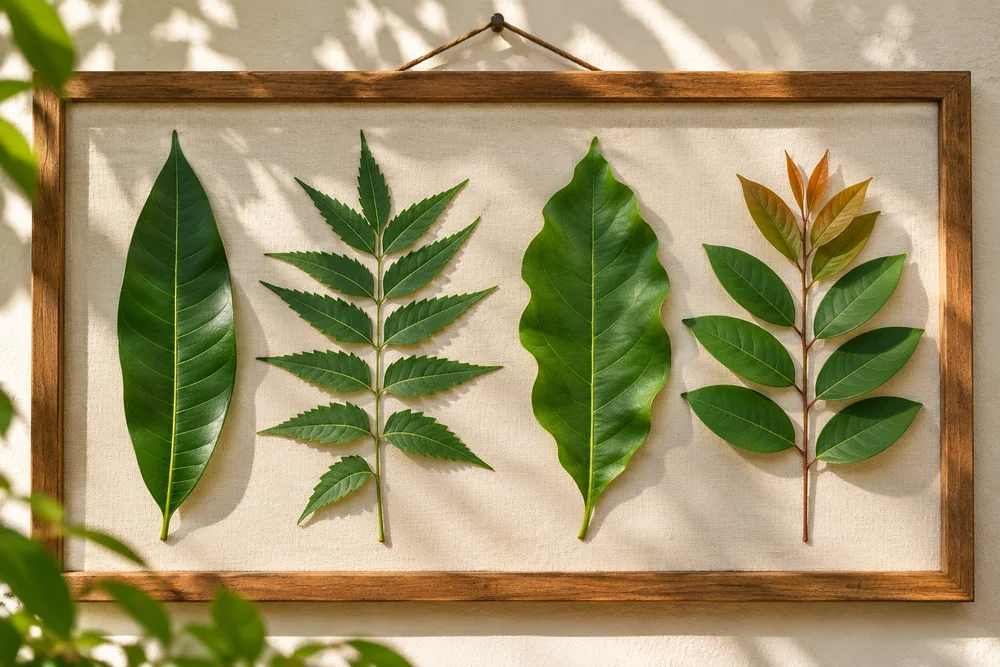
Image note: This is the original educational illustration associated with the article. It does not photograph or certify an individual OmmRudraksha product, and it must not be presented as evidence of a particular supplier's botanical identity.
7. Marigold, jasmine and other floral components
Orange and yellow marigolds are familiar in Indian festive garlands, often combined with mango leaves. One widely cultivated marigold is Tagetes erecta L.; however, “marigold” can describe multiple cultivated species and varieties. The colour or round flower head alone does not verify the botanical species. For a consumer, it is usually most helpful to distinguish fresh flowers from dried flower heads, fabric flowers and coloured synthetic pompoms.
Regional makers may use jasmine, seasonal blossoms, palm parts or other locally available materials. Each option has a different fragrance, degree of shedding and display life. Jasmine is usually delicate and perishable; marigolds may hold their shape longer under some conditions but still deteriorate. Botanical names, local names and ritual suitability should be handled with appropriate specificity rather than assuming all communities exchange flowers freely for every ceremony.
A flower-strewn entrance can be attractive, but fallen petals can become slippery. Provide a clear route through the doorway, clean up debris and never fix dry floral material near lamps, incense, diyas, hot lights or exposed electrical fittings.
8. Fresh, dried, preserved and artificial: four different products
| Material state | What the description should mean | Typical care concern | Questions before ordering |
|---|---|---|---|
| Fresh foliage | Recently harvested real leaves, usually still pliable and moisture-bearing | Wilting, browning, moisture loss, mould and local delivery timing | Plant species, cut/assembly date, delivery area and expected condition |
| Dried botanical | Real harvested leaves or flowers intentionally dried | Fragility, shedding, dust, possible moisture reabsorption and fire sensitivity | Drying process, attachments, permitted indoor use and storage method |
| Preserved or treated botanical | Real plant material processed or coated to change its appearance or handling | Unknown colourants, coating, smell, skin contact and finish degradation | Preservative or dye disclosure and handling instructions |
| Artificial foliage | Fabric, paper, plastic, foam or similar plant-shaped decorative material | Heat, ultraviolet fading, loose wires, dust and material integrity | Actual composition, size, craftsmanship and cleaning instructions |
“Natural-looking” describes appearance, not ingredients. “Handmade” describes a production process, not plant identity. “Herbal” is particularly ambiguous; it must not conceal synthetic leaves or suggest a therapeutic property without relevant evidence. A mixed hanging may contain fresh leaves, a plastic backing, cotton cord, metal bells and glued beads simultaneously. Its listing should disclose the significant materials rather than describing the whole item as pure botanical.
9. Which plant belongs in which ceremony?
There is no responsible one-line substitute for the instructions of a specific household, priest, temple or community. Mango-leaf strings are familiar at weddings, house-entry rites and many festive entrances. Marigolds are common in celebration garlands. Neem has distinct associations in some regional seasonal observances. Particular combinations, leaf counts and preparations may be traditional for one community and unfamiliar to another.
If a ritual specifically requires māvilai or another plant, check with the person conducting it before replacing that material with a silk, paper or plastic version. A reusable artificial toran can remain meaningful as home décor, but the fact that it resembles the original does not prove its ritual interchangeability. Equally, there is no need to describe a modern, well-made floral textile as defective simply because it is not fresh foliage.
For a gift, ask whether the recipient prefers a devotional motif, a festive leaf-and-flower arrangement, a neutral textile hanging or a minimalist entrance. The goal is to honour the intended practice rather than assume that one community's rule binds everyone.
10. Vastu context: welcoming symbolism without guaranteed outcomes
Vastu Shastra considers orientation, access, proportion, movement and the character of a built environment. A welcoming doorway can participate in that broader experience, yet it would be misleading to claim that tying an arbitrary number of leaves automatically fixes unsuitable room geometry, blocked access, poor ventilation or a building-safety problem. Some contemporary advisers associate green leaves with life and renewal; some connect the upper doorframe with auspicious welcome. These are symbolic and customary interpretations, not laboratory measurements of prosperity or health.
When placing a toran, the practical principles are clear: it should not strike people, obstruct sightlines, snag on handles, drag across the door, interfere with locks or restrict an emergency exit. For the traditional dimensions of entrance design, read OmmRudraksha's existing Vastu Shastra overview; for related décor, browse the Vastu collection. Neither page is evidence that a specific item has been ritually energised, laboratory tested or approved for an individual building.
11. How leaf torans are assembled
A basic maker chooses known, healthy material; removes visibly damaged leaves; arranges the leaves in the intended order; and ties the petioles or small grouped stalks to a suitable cord. The suspension must distribute weight without tearing the leaves or cutting the thread. The length and spacing depend on the doorway and local custom. A light temporary string requires little structural force, but even a small hanging should not be attached using a weak adhesive directly above a busy entrance.
- Confirm the required plant and format. Decide whether the family wants mango leaves, another locally recognised material, mixed flowers or a reusable symbolic version.
- Measure the mounting span. Include the actual space between attachment points, not only the width of the door leaf.
- Choose a safe support. Use a clean cord and anchor appropriate to the surface; keep installation reversible when possible.
- Distribute the foliage evenly. Check knots, gaps and the maximum drop of the lowest leaf or flower cluster.
- Test clearances. Open and close the door fully; inspect the latch, closer, handles, overhead lights and any fire escape route.
- Plan removal. A fresh arrangement needs inspection and timely replacement, not indefinite exposure.
For public spaces, apartment common areas, schools, shops or temples, follow the property owner's permissions and relevant fire and accessibility requirements. Decorative descriptions cannot override these obligations.
12. Measuring the door and positioning the hanging
Record three dimensions: fixing width (between mounting points), overall drop (from the top support to the longest component) and clear opening (the space people and door hardware still need). A small photograph may hide long decorative strands, projecting nails or tassels. Ask for the fully assembled measurements of the exact item, not the dimension of an unstrung bundle.
Position leaves above normal head level where possible and away from exposed wiring, heat and rain-driven openings. Check that the toran will not be trapped by a moving door, automatic closer or shutter. If a doorway is unusually narrow or a person has mobility or vision needs, choose a slim, stable design that does not hang into the usable path.
Do not assume a specified compass direction is universally necessary. Family custom may shape placement, but safety, the actual entrance layout and relevant local rules are independent considerations.
13. Freshness, storage and transport
Plant material begins changing after harvest. Heat, travel time, humidity, sunlight, crushing and inadequate airflow influence whether fresh leaves arrive pliable or curled. A fixed display life across all seasons and destinations cannot be assumed without a validated preparation and shipping process. A local same-day or made-to-order service may be practical for fresh botanical arrangements, but that service must be confirmed rather than inferred from a catalogue illustration.
Before dispatch, record the actual cutting and assembly date, the packaging plan and the intended arrival condition. Avoid excessive moisture trapped around tightly packed foliage, which can contribute to deterioration. Do not spray unknown perfumes, pesticide mixtures or preservation chemicals on an item intended for close household contact. If a supplier claims a treated botanical toran is long-lasting, request information about the treatment, staining and contact precautions.
Inspect promptly on arrival. If there is obvious mould, decay, off-odour, pests, leaking dyes or physical damage, do not hang the item inside a living space. Customer service should provide an accurate replacement or resolution process for genuine fulfilment problems.
14. Cleaning, replacement and responsible disposal
Fresh leaves: handle gently and remove when they become unsuitable for display. They are not designed to be scrubbed or washed repeatedly like household textiles. Dried leaves: avoid rough brushing and damp cleaning unless the maker specifically approves it; fragile material can crumble. Artificial foliage: clean according to its fabric, coating, wire and adhesive composition, not according to the botanical name represented by the design.
After a festival or ceremony, use safe access, support the hanging during removal, and seek help for a high or heavy fitting. Clear leaf stems, string and metal pieces from hinges, drains and pedestrian routes. Where local waste arrangements permit, segregate clean plant-only matter from synthetic ribbons, plastic clips, painted foam, wire or glued ornaments. A mixed arrangement should not be placed wholesale into compost merely because some pieces are leaves. Community or household traditions for respectful disposal may also be important and should be followed where safe and lawful.
A beautiful toran does not become disrespectful because it is replaced when spoiled. Good care includes recognising when a fresh decoration has reached the end of its useful display life.
15. Health, fire and household safety: what a plant hanging cannot promise
The historic use of neem in various Indian traditions is distinct from evidence for the performance of a decorative hanging. Hanging a few leaves in an open doorway has not been established as a method to sterilise rooms, prevent infection, purify indoor air to a measurable standard or treat respiratory conditions. Claims that marigolds automatically repel every insect or that any leaf arrangement guarantees mental calm are similarly inappropriate as retail promises.
Natural plant parts can carry dust, pollen, moisture, allergens or pests. People with known sensitivities should avoid direct contact where relevant. Keep loose decorations away from infants and children who may pull down cords or put leaves and small ornaments into their mouths. Pets may chew plants whose suitability has not been checked. Do not mix decorations with edible ingredients or burn them indoors as if they were specially prepared incense.
Dry foliage and synthetic flowers are potential fire loads. Maintain separation from oil lamps, candles, exposed electrical wiring, hot light fittings and cooking flames. An entrance decorated for Diwali or a wedding still needs a clear exit route. The ceremonial significance of the piece does not reduce these risks.
16. Ethical sourcing and truthful botanical labels
Buy from a source that can identify the plant, confirm lawful collection, and distinguish cultivated foliage from wild material. Avoid unnecessary cutting of living branches or gathering from protected areas. Do not advertise an “ancient sacred herb” when the material is a painted polymer or a poorly identified tree branch. Equally, an honest imitation can be a good choice when its purpose is everyday visual decoration rather than a rite specifically requiring fresh leaves.
A useful product listing records the common name, scientific name where verified, plant part, state (fresh, dried, treated or artificial), other components, actual dimensions, installation method, care limits and intended use. A handmade claim requires knowledge of the actual construction. A regional maker or craft claim requires traceable provenance, not simply a pattern that looks familiar.
Never claim a laboratory certificate, farm origin, chemical-free status, pest-free treatment or exact botanical species unless evidence exists for the individual supply lot. An educational photo is not the evidence.
17. How botanical torans compare with reusable fabric designs
| Buying priority | Fresh plant toran | Reusable fabric / artificial toran |
|---|---|---|
| Ritual material | May meet a specified fresh-leaf custom when correct species and preparation are used | A symbolic alternative only where accepted by the relevant household or ceremony |
| Display duration | Perishable; condition depends on harvesting and environment | Often reusable, but life depends on textile, stitching, coating and care |
| Appearance | Natural variation, scent and changing colour | Repeatable colour and pattern, but may fade or accumulate dust |
| Fulfilment | Time-sensitive sourcing and packing; local delivery may be preferable | Generally easier to store and ship, subject to fragile decorations |
| Material disclosure | Plant species, state, cord, harvest date and treatment | Fibre, dyes, wire, adhesive, beads, artificial flowers and support |
| End-of-use | Remove wilted material; separate mixed components | Inspect, clean and store or repair as appropriate |
A household may choose both: fresh leaves for a particular annual observance and a reusable toran for other days. This is a practical choice rather than a ranking of devotion. If the product is a combination of botanical and synthetic material, compare it according to its actual mixed composition.
18. What to ask before ordering online
- Is the offered item made with real leaves, fresh flowers, dried plants or simulated leaves?
- Which species are actually supplied, and who verified the botanical names?
- If the description says “ashoka”, is it Saraca asoca, Monoon longifolium or merely an ashoka-style motif?
- Are the leaves freshly cut, stored, dyed, coated, preserved or treated in another way?
- What are the fully assembled width, longest drop and total weight?
- Does the image show the exact inventory, a representative example or an educational illustration?
- What string, wire, backing, bells, beads, hooks or adhesives are included?
- For fresh items, what are the confirmed dispatch area, preparation date and acceptable arrival condition?
- Can the hanging be safely mounted without restricting the door, light fitting or exit?
- What is the maker's actual care, replacement, returns and disposal guidance?
For a ritual-specific purchase, add one more question: does the family or person conducting the observance accept this exact plant and construction? That avoids treating a generic storefront category as an authority on every regional practice.
19. Frequently asked questions
Is a mango-leaf toran the same as a neem toran?
No. Mango (Mangifera indica) has simple leaves; neem (Azadirachta indica) has compound leaves made up of multiple leaflets. Their cultural associations also depend on different regional practices. Ask the seller to identify the actual plant rather than using the terms interchangeably.
What does māvilai thoranam mean?
In Tamil contexts, māvilai refers to mango leaves and thoranam to a festoon. It commonly describes a mango-leaf decoration above an entrance. The precise number of leaves, mounting and ceremony should follow relevant household custom.
Does every Vastu tradition require neem at the main door?
No universal requirement of that kind can be supported. Regional festivals, family practices and modern Vastu interpretations differ. A doorway should remain structurally safe and functional regardless of the selected decoration.
Is “ashoka leaf” a reliable botanical product name?
Not without clarification. Saraca asoca and Monoon longifolium (formerly often called Polyalthia longifolia) are distinct. Common names such as ashoka and asopalav can be applied ambiguously. Request the scientific identity of the actual foliage.
Can a fabric mango-leaf hanging be called herbal?
No. A cut, stitched or printed fabric leaf is a representation. Describe it as a reusable fabric toran with a mango-leaf motif; list any real plant ingredients separately.
How long will fresh mango leaves stay green?
There is no universal number of days. Freshness depends on when leaves were cut, their condition, weather, humidity, packing and display exposure. Ask for supplier-specific guidance and replace deteriorating material promptly.
Can neem torans purify air or protect a household from illness?
A decorative toran has no demonstrated ability to disinfect indoor air or prevent illness. Neem's other traditional and studied uses should not be converted into medical claims for a doorway hanging.
Can fresh torans be shipped anywhere in India?
Only if a supplier has a confirmed, appropriate fulfilment method for the destination and material. Fresh foliage is time-sensitive. Do not assume long-distance shipment or guaranteed condition solely because a product is pictured online.
May I use artificial leaves for a housewarming?
For general welcome décor, an artificial design may suit the household. If a specific rite requires fresh leaves, confirm with those conducting it before substituting materials. Clearly label the artificial item and its care conditions.
How should I dispose of a finished toran?
Remove it safely, separate plant matter from metal, plastic, wire and textile where practical, and follow household custom and local waste rules. Never leave decaying plant pieces or hooks in a shared entrance.
20. Explore related Vastu and entrance decoration guidance
To compare different home and doorway objects, visit the existing Vastu collection. For architectural context rather than a retail guarantee, explore Vastu Shastra. Select the botanical or botanical-inspired decoration according to the actual plant identity, intended ceremony and safe installation requirements.


