

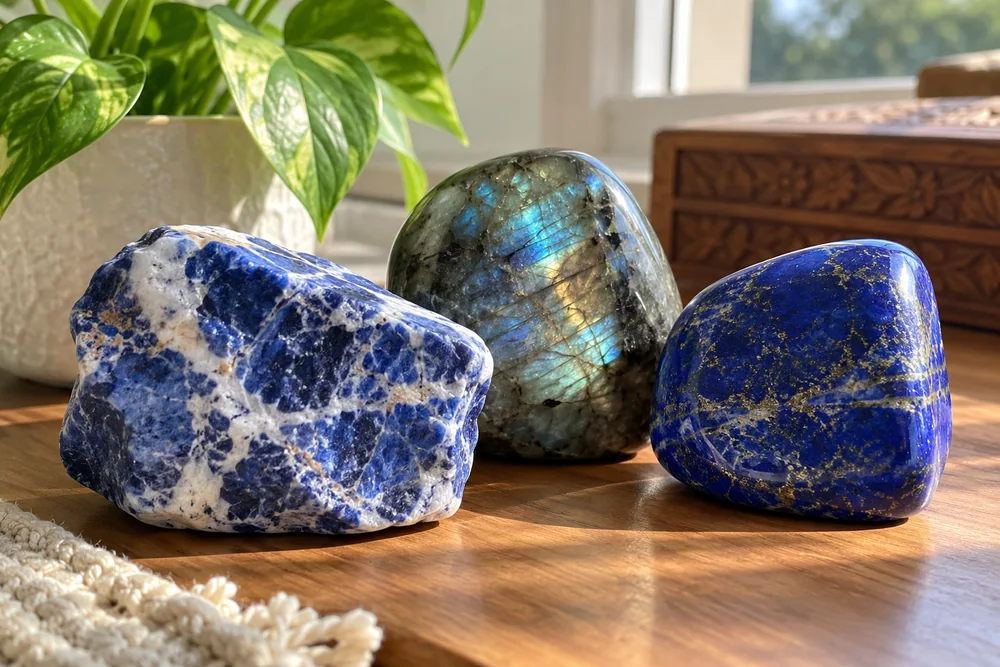
Labradorite, lapis lazuli and sodalite can all create striking blue accents in gemstone hangings, but they are not the same gem material. Labradorite belongs to the feldspar family and can display a shifting flash of reflected colour. Lapis lazuli is a rock composed of several minerals, commonly including blue lazurite, white calcite and brassy pyrite. Sodalite is a separate mineral that often appears blue with pale or white areas. These differences affect appearance, buying claims, handling and care.
A useful buying guide explains what the mineral really is, what is only a visual clue, and how the stone is physically supported. This article compares their mineralogy, optical effects, treatments, bead and pendant forms, secure wire wrapping, cleaning, cultural symbolism and placement in Indian homes. It does not use colour alone as proof of identification or describe a modern decorative hanging as a guaranteed health or planetary remedy.
1. Three blue-looking materials, three different identities
The first distinction is more important than a preferred shade. Labradorite is a mineral in the plagioclase feldspar series. Lapis lazuli is a rock made from a mixture of minerals rather than a single species. Sodalite is a mineral in the sodalite group and is frequently seen as opaque blue material with lighter patterns. A genuine example of each can be beautiful, but substituting one for another without clear labelling is a product-description error.
A photograph can make these materials seem similar. Studio lighting can exaggerate a labradorite flash; a saturated photograph can hide lapis calcite and pyrite; and dyed or coated stone can create a uniform blue that is difficult to identify by sight. Natural appearance varies between specimens, even within one material family.
| Characteristic | Labradorite | Lapis lazuli | Sodalite |
|---|---|---|---|
| Material classification | Plagioclase feldspar mineral | Multi-mineral rock, often lazurite, calcite and pyrite | Distinct mineral of the sodalite group |
| Common body appearance | Grey, dark grey or subdued base; sometimes colourful flash | Rich blue to blue-violet with variable white or gold-coloured constituents | Medium to deep blue, often with pale or white patches |
| Notable visual effect | Angle-dependent labradorescence in suitable specimens | Colour and patterned mineral mixture; gold-like flecks may be pyrite | Blue body colour and pale veining or mottling |
| Common forms in hangings | Polished flat pendants, cabochons, beads, carvings | Rounded beads, polished pendants, carvings and inlay-style pieces | Beads, polished pendants, cabochons and carved ornaments |
| Typical buying concern | Actual flash in different orientations, fractures and surface condition | Dye/wax treatments, correct rock identity, coating and composite material | Confusion with lapis, dyed alternatives and honest mineral identification |
| Physical installation concern | Retaining a smooth stone securely without obscuring the attractive face | Protecting drilled holes and surface finish, checking total weight | Protecting beads, knots, holes and secure wire settings |
These descriptions are educational. They do not validate any particular physical stock item or confirm origin, treatment, weight, exact mineral percentage, price or certificate. Such claims need records for the individual stone or an appropriately documented lot.
2. Labradorite is feldspar—not blue quartz
Labradorite is part of the plagioclase feldspar group, traditionally defined by an intermediate calcium-to-sodium composition in the plagioclase series. It is not a type of quartz or a gemstone species called “blue opal.” In many polished specimens, the stone's ordinary body colour is greyish or dark, while vivid blue, green, gold or other flashes appear as the piece is turned under light.
The colour phenomenon is called labradorescence. Gemological research explains how fine internal layers and structures interact with light to produce the optical effect. It is not simply a blue surface dye, although a seller still needs to authenticate that a specific piece is real labradorite and disclose any applied surface treatments.
Not every piece of labradorite shows a dramatic flash. Some specimens are relatively subdued, have smaller illuminated areas or display their strongest colours only from particular viewing angles. A photo showing nearly the whole stone in electric blue may capture its best orientation rather than its everyday appearance on a wall.
For a hanging, ask to see the actual stone from more than one angle, preferably in diffuse daylight and under a moving light source. A short unedited video can reveal where and when the colour appears. Keep the viewing conditions realistic: a flashing gemstone held in front of a studio light may look different in a shaded entrance.
3. How labradorescence changes placement
A polished labradorite face must be oriented so the intended viewer can see its characteristic reflection. If the stone is mounted edge-on or the suspension lets it turn continuously away from the light, its bright colour may appear intermittently rather than constantly. That is a normal consequence of the phenomenon, not necessarily a defect.
Some pieces are shaped as flat polished ovals or discs to show the flash across a broad area. Others are carved into hearts, pointed shapes or beads. The cutting orientation affects where colour is visible. When buying a particular hanging for a wall or window, compare the stone's face, the top loop's alignment and the angle from which occupants will normally view it.
It is tempting to promise that labradorite will throw bright blue light across a room. That is not how ordinary labradorescence works. The stone exhibits coloured reflections under suitable viewing conditions; it is different from a faceted prism that disperses sunlight into coloured patches. Do not expect it to act as a rainbow projector.
Keep the polished face away from hard collisions, window frames and metal rails. A mechanically secure mounting is more important than allowing uncontrolled swinging to display colour.
4. Lapis lazuli is a rock with a long artistic history
Lapis lazuli is an ornamental rock that has been used in carving, jewellery and pigment-related art for many centuries. The Gemological Institute of America describes it as a mixture of minerals, most characteristically lazurite with variable calcite and pyrite. Its much-valued blue can range in intensity; some examples include prominent white or grey areas, while others show golden-looking metallic flecks.
The brassy points are often pyrite, an iron sulfide, not genuine gold. White regions commonly come from calcite, though individual rocks can contain other minerals as well. A high-quality photograph can show the distribution of these constituents, but their presence or absence is not a foolproof identification test.
Natural lapis lazuli is an attractive choice for polished beads, cabochons and small carved pendants. A piece with minimal white calcite may be preferred by someone seeking a deep uniform blue, while another customer may deliberately appreciate a naturally mottled stone. Visual preference should not be confused with a guarantee of authenticity or a particular geological source.
Some commercial lapis has been dyed to deepen the blue, and wax or other impregnation may be used to improve appearance or finish. GIA and CIBJO gem trade references discuss such treatments. A claim that a specific hanging contains untreated lapis must be supported by appropriate evidence, especially where treatment materially affects pricing.
5. Sodalite: a separate blue mineral, not simply cheaper lapis
Sodalite is a sodium-bearing aluminosilicate mineral in the sodalite group. Mineralogical references describe blue as a familiar colour but also document other colours. Massive decorative sodalite can show white or pale streaks and irregular patterns. Some stones sold under this name may be dyed or mislabelled, so the identification of actual stock remains important.
Because sodalite and lapis can both be blue with white inclusions, they are sometimes confused in retail displays. However, they have different material identities: lapis is a mixture of minerals, while sodalite is a specific mineral. They should not be sold interchangeably, even if a customer happens to prefer the same colour in either one.
Sodalite's typical Mohs hardness is around 5.5–6, as reported in Mineralogical Society of America identification references. That is not a durability rating for the complete hanging, but it signals that some abrasion is possible in contact with harder stones or metal parts. A polished sodalite bead can be scratched or damaged, and drilled edges need attention.
Some sodalite-group materials, notably certain hackmanite, can show distinctive fluorescence or colour-change behaviour, but those special properties should not be promised for every ordinary blue sodalite hanging. The actual material and its observed phenomena must be demonstrated separately.
6. Lapis versus sodalite: what visual clues can—and cannot—tell you
In a photograph, pale white patches may occur in both lapis lazuli and sodalite, and deep blue colour alone identifies neither. Metallic gold-like flecks in an authentic lapis mixture may be pyrite, but a dyed or manufactured imitation can also contain glitter or other reflective particles. Absence of pyrite does not prove a piece is sodalite, because lapis varies naturally.
Check whether the supplier names the material as a rock or a mineral and supplies believable real-stock images. A gemologist may use appropriate observational and laboratory methods when identification matters. Avoid damaging household tests such as scraping, burning, bleach exposure, solvent rubbing or acid drops to authenticate a hanging; those can harm the stone or its finish.
A blue-and-white bead strand could contain several materials. Count each type separately and verify the actual beads instead of labelling all blue pieces “lapis.” The presence of one authentic lapis bead is not proof that the whole hanging uses lapis throughout. This distinction is especially important in mixed beadwork, chakra-themed arrangements and products whose hero image does not show every component.
7. Treatments, dyed stones and misleading trade names
Natural identity, colour enhancement and origin are separate commercial claims. Dyed lapis may be sold as a deeper blue than its natural appearance, while wax, oil or resin can affect surface appearance and cleaning suitability. White sodalite or other stones may also be dyed to mimic an appealing blue. A coated or composite object can look convincing in a photograph.
Marketing terms such as “Afghan blue,” “Canadian lapis,” “blue quartz” or “labradorite crystal” may be used inconsistently in the market. They are not reliable certificates of origin or species. The actual stone identity should be established first; origin should be claimed only with traceable evidence, and any treatment should be disclosed in accordance with applicable trade standards.
Note that lazurite, the major blue constituent in lapis lazuli, belongs to the sodalite mineral group. This mineralogical relationship does not make a chunk of sodalite identical to a lapis lazuli rock. Names based on family resemblance can easily mislead a buyer unless the aggregate and mineral are clearly distinguished.
A price premium for untreated material, exact mine origin or independent laboratory identification should come with appropriate documentation tied to the real item or traceable lot. Generic certificates, stock illustrations and a description copied across several variants are not adequate evidence for an individual high-value stone.
8. Beads, flat faces, slices and wire-wrapped shapes
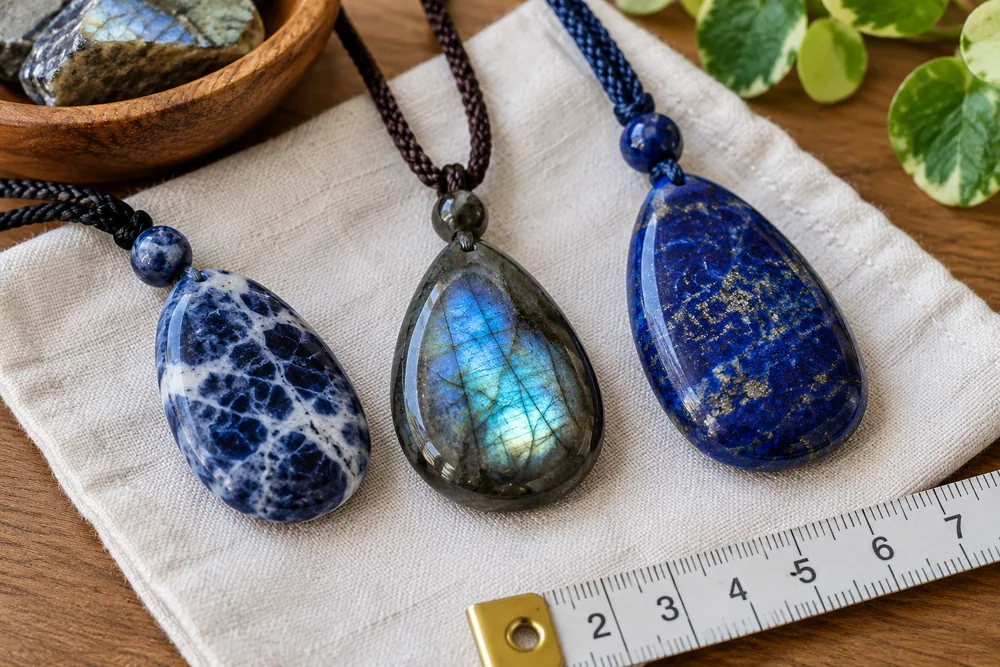
Labradorite is often shown with a broad polished face intended to display labradorescence. Lapis lazuli and sodalite are often made into rounded beads, carved pendants or cabochons, though other forms exist. The actual shape affects display, weight distribution, the strength of the fixing and how much of the stone can be seen.
| Hanging form | Visual benefit | Main construction concern |
|---|---|---|
| Flat labradorite pendant | Can present the colour flash across a broad face | Align front to viewer, check frame or drilled connection and edge protection |
| Lapis polished bead strand | Shows variations of blue with possible white and brassy inclusions | Verify each bead material, drill-hole condition, knots and total weight |
| Sodalite carved ornament | Highlights natural blue-white pattern in a shaped surface | Thin carved parts, drilled holes, impact and scratch protection |
| Wire-wrapped rough stone | Displays a more natural irregular mineral form | Wire cage must truly retain the stone and have no exposed sharp ends |
| Mixed blue-stone hanging | Can combine several colours, textures and shapes | Identify each stone and treatment separately; inspect all load-bearing joins |
| Stone with metal bell or glass prism | Combines gemstone display with separate sound or light feature | Do not attribute metal sound or glass rainbow to the stone; provide collision clearance |
Even if a product is sold as a chime, a stone-only pendant may make no designed musical sound. A working wind chime needs a mechanism that brings one or more sounding elements into contact. Distinguish a quiet mobile, a bell hanging and a tuned musical instrument in the listing.
9. How to inspect the wire cage, suspension and drilled holes
A secure hanging must have a continuous and appropriate load path from the stone to the upper support. On a wire-wrapped stone, the visible spirals should not be confused with retention. An irregular stone or smooth tapered pendant must be enclosed or mechanically supported so it cannot slip through a widening gap. Check the underside and back, not only the front image.
Sharp wire ends should be tucked securely, and a top loop should not be visibly cracked or partly opened. A large polished lapis pendant can be heavy enough to bend thin decorative wire, while small beads can abrade a thread at their drilled holes. In a beaded strand, crimps, end knots, rings and each pierced edge matter.
Ask for a full hanging length, widest span, complete weight, real stone dimensions, number of beads where applicable and details of the supplied hardware. Stone density is only one part of the total load: frame, metal beads and ornaments can also contribute. A static indoor hook rating should not be presumed suitable for a moving outdoor hanging or an overhead location.
A worn cord, loose loop, cracked bead hole or slipping setting is grounds to stop using the ornament. Keep people clear of the fall zone, support the assembly during removal and arrange qualified help for a high or heavy hanging. Do not solve structural failure by adding a random weight, adhesive patch or knot without understanding the material and construction. Where the item is heavy or complex, consult a suitably skilled maker or installer.
10. Light and colour in real rooms
The three materials create different impressions in a home. A labradorite face can change dramatically as the viewer moves. Lapis lazuli can provide a relatively stable blue appearance with natural patterned flecks or patches. Sodalite often shows blue and white veining. These are broad trends, not guarantees for every cut stone or every angle.
Choose the display location based on ordinary illumination and the direction of viewing. A flat labradorite piece might perform visually better on a wall where its face can be oriented toward people than in a rotating hanging that frequently exposes its back. A polished lapis bead strand may be attractive in diffuse light, while a sodalite carving can show contrast against a neutral wall.
A blue stone itself is not automatically a prism. If a product includes a glass drop that throws rainbow patches, identify that optical component separately. Do not promise that lapis or sodalite will create a blue glow, that labradorite will illuminate a whole room or that every dark stone produces a vivid flash in shaded indoor conditions.
Protect polished faces from contact with window panes, railings and other stones. Position heavy pieces away from doors and ceiling fans, and avoid areas where children can pull on long cords or detachable beads.
11. Cleaning without damaging lapis, sodalite or labradorite
The right cleaning method depends on both the stone and its treatment. Lapis may be dyed, waxed or impregnated, which can make solvent, heat or aggressive cleaning inappropriate. Sodalite can have treatments or delicate finishes, and labradorite has its own feldspar properties. An ornamental hanging may also contain metal plating, thread, resin, glue or glass that responds differently to moisture.
Start with a soft clean dry cloth or gentle brush while supporting the pieces on a padded surface. Avoid automatic advice to soak mixed blue-stone hangings in saltwater, acid solutions, vinegar or lemon juice. Calcite in lapis is acid-sensitive, and unknown dyes or coatings can be disturbed by inappropriate chemicals. Avoid steam and ultrasonic cleaning unless an informed professional confirms suitability for the exact material, treatment and construction.
For a known durable and appropriately treated component, a jeweller or maker may recommend a limited damp clean, but the whole assemblage must still be considered. Do not leave water trapped in drilled holes, under wax, around wire joints or in knots. Remove a stone from use when a hairline crack crosses a critical mounting point or when its polish appears to hide an unstable fracture.
Occasional dust and gentle inspection are preferable to repeated polishing of uncertain materials. A blue surface stain or faded coating should prompt a material-identification question rather than immediate use of a metal polish or household dye.
12. Storage, transport and inspection routines
When taking a hanging down, support the main stone or frame before unhooking it. Do not lift a heavy pendant by one decorative bead, a fragile flash face or the lowest tassel. Photograph complex arrangements before disassembly so that the relationship between components is preserved.
Separate hard metal ornaments from polished stones in storage. A labradorite face can be abraded by harder objects, while lapis and sodalite pieces can be chipped or scratched in a tangled strand. Protect thin carving projections and avoid wrapping a wire cage so tightly that it changes shape. Store dry and away from drips, excessive heat and strong direct sun where colours, finishes or thread might be affected.
Check the entire suspension before rehanging: top ring, crimp, knots, wire ends, drilled holes, settings and support hooks. Following monsoon weather or an accidental impact, inspect for loose fittings and surface damage before putting the item back into an overhead position. No amount of mineral authenticity compensates for an unsafe mounting.
13. Choosing among the three for an Indian home
For décor, consider what visual experience the household prefers. Labradorite suits someone seeking shifting reflection and who can orient the polished face toward a useful light source. Lapis lazuli suits someone who appreciates rich blue and the natural mixture of minerals visible in many pieces. Sodalite may appeal where blue-and-white pattern or a quieter visual colour arrangement is desired. There is no universal hierarchy of beauty or suitability.
Ask whether the hanging will be near a bedroom, in an entrance, on a sheltered veranda or beside a window. If it contains bells or other sounding components, ensure the resulting noise is acceptable in shared spaces. A heavy lapis strand or large labradorite slab may be better displayed in a stable interior place than on an exposed balcony with unpredictable gusts.
For the larger family, explore the Crystal & Gemstone Hangings collection and Hangings & Chimes. Check the specifications of individual hangings before choosing.
14. Ratna, Jyotisha, chakra language and Vastu Shastra
India has substantial traditions of ratna (gemstones), gemstone ornaments and astrological associations within particular Jyotisha systems. Lapis and other blue stones may also be appreciated through craft, devotion and historical art. Contemporary retail descriptions sometimes associate blue stones with communication, meditation, intuition or protection. Such symbolic interpretations should be identified according to their source and should not be treated as universal mineralogical properties or verified health outcomes.
Some modern chakra-themed products associate blue with Vishuddha and indigo with Ajna. These associations come from particular modern interpretations and should not be used to claim that natural labradorite, lapis or sodalite automatically activates or cures a chakra. A gemstone hanging is also not the same as a prescribed planetary gemstone worn on the body under a specified Jyotisha method.
Vastu Shastra is concerned with built space, orientation, circulation, entrances, light and the traditional ideas of Vastu Purusha Mandala and Pancha Mahabhuta. No single classical Vastu rule requires a blue-stone hanging in every household. Some contemporary Feng Shui crystal-placement advice belongs to a separate Chinese tradition and should not be described as identical to classical Indian architectural texts.
Readers may value beauty, prayer, symbolism and traditional association without requiring a guaranteed medical, financial or astrological result. For traditional spatial context, see Vastu Shastra or the broader Vastu collection.
15. Buying checklist for labradorite, lapis and sodalite hangings
- Verify material identity: Distinguish plagioclase feldspar labradorite, multi-mineral lapis lazuli and sodalite mineral from substitutes and lookalikes.
- Ask about treatments: Dye, wax, resin, surface coating and composite construction should be declared where relevant.
- Check the actual appearance: Request real neutral-light photos and a useful video of labradorite's changing flash.
- Describe natural patterns accurately: White areas and brassy flecks can be clues, not proof of a mineral's identity or value.
- Confirm the cut or shape: Bead, cabochon, carved object, flat pendant or rough stone have different inspection needs.
- Inspect secure retention: Review wire cage, bail, top ring, crimps, drilled holes, knots, sharp wire ends and stone fractures.
- Measure the full hanging: Total drop, widest span, weight, bead dimensions and genuine component counts rather than only the featured stone size.
- Match the display location: Check light orientation, walls, door swing, balcony exposure, household quiet and impact risks.
- Check care limits: Do not soak treated lapis or mixed-material assemblies without verified instructions.
- Confirm sales facts: Real SKU, images, stock, price, origin documentation, included fittings and individual laboratory claims if advertised.
Frequently asked questions
Is labradorite a variety of blue quartz?
No. Labradorite is a plagioclase feldspar mineral. Its characteristic flash of colour is called labradorescence and depends on internal structures and viewing conditions.
Will every labradorite hanging show a bright blue flash?
No. Colour, intensity and visible area vary among specimens and change with illumination and angle. Ask for real images or video of the actual piece.
Is lapis lazuli one mineral?
No. Lapis lazuli is a rock commonly composed of lazurite, calcite and pyrite, with other constituents possible.
Do gold-coloured flecks in lapis mean the stone contains gold?
No. The familiar brassy flecks are commonly pyrite, an iron sulfide. Gold-coloured particles alone are not an authentication test.
Are lapis lazuli and sodalite interchangeable names?
No. Lapis is a multi-mineral rock, while sodalite is a specific mineral. Both can look blue with pale patches, so accurate identification is essential.
Does every blue-and-white stone without pyrite have to be sodalite?
No. Lapis can have little visible pyrite and other materials can resemble either stone. Visual clues are suggestive, not definitive.
Can lapis lazuli be dyed or waxed?
Yes. Dyeing and surface treatments are documented in gem trade references; any stock-specific untreated claim requires supporting evidence.
Can I clean all blue-stone hangings with saltwater or an ultrasonic cleaner?
No. Stone identity, treatments, adhesives, metal parts and cords may be sensitive. Gentle dry cleaning is a prudent starting point for an unknown assembly.
Does Vastu prescribe one mandatory blue gemstone hanging for every home?
No universal classical rule requires these modern ornamental hangings in all houses. Traditional and contemporary practices differ; material truth and secure mounting remain essential.
Explore related OmmRudraksha gemstone designs
See the Crystal & Gemstone Hangings category and the parent Hangings & Chimes collection. For traditional architectural background read Vastu Shastra. Before buying, confirm the stone identity, treatment, availability and mounting requirements of the individual hanging.


