

A colourful doorway hanging can be described as a toran, bandhanwar, embroidered entrance textile or appliquéd decoration, but these terms do not identify the same craft. Kutch embroidery in Gujarat and Pipili appliqué in Odisha are two especially instructive examples: one creates much of its surface with worked thread, while the other builds motifs from cut and attached cloth. Both traditions have their own makers, regional contexts, evolving forms and documented craft histories. This guide explains their differences, looks at related Indian entrance-decoration practices, and sets out a practical way to assess workmanship, provenance and suitability for a real doorway without assigning an invented history to an object.
1. Start with the object, not the regional label
“Indian door hanging” describes where an object is displayed, not how it was made. A cloth band with stitched mirrors can be an embroidered toran; a bright textile panel with layered shapes may be an appliqué hanging; a string of leaves can be a fresh botanical thoranam. A doorway may also have bells, carved or painted threshold motifs, flower garlands or beadwork. Each category carries different materials, techniques, histories and care needs.
The seller's first duty is therefore a simple one: identify the physical article—its ground fabric, ornament, fastening system, dimensions and production method—before choosing romantic regional language. If an item borrows a motif associated with Odisha but was printed elsewhere, call it “Pipili-inspired print” when supportable, not an authenticated Pipili appliqué work. If it includes mirror-like sequins, do not automatically call it Kutch hand-embroidered shisha work. A careful description can still celebrate its appearance without claiming evidence that does not exist.
2. The role of a toran in an Indian entrance
Toran or torana has a broad history as a doorway or entrance ornament, while bandhanwar is a common name for a decorative door festoon. Indian households may display such decorations at griha pravesha, Diwali, Navaratri, weddings, pujas and family celebrations. The entrance marks arrival and welcome; in many households a newly dressed threshold signifies mangala, an auspicious opening. The precise religious function, materials and arrangement depend on region, community, household and ritual setting.
A historical textile toran is not a universal replacement for sacred living foliage, nor does it have to be one to be meaningful. A family may choose an embroidered band for repeated festive use and fresh leaves for a particular observance. Contemporary Vastu advice may discuss cleanliness, visual order, pleasing colour and care at the entrance, but it should not be mistaken for an ancient instruction prescribing a particular Kutch stitch or Pipili pattern for a compass direction. Separate documented traditions from modern preference.
3. Kutch is a region with multiple embroidery traditions
Kutch (also written Kachchh or Kuchchh) is a district and cultural region in Gujarat, not a single stitch category. Rabari, Ahir, Jat, Mutwa and other communities have distinctive embroidery histories; descriptions vary by locality, maker, time and purpose. The D'Source design-resource documentation of Rabari embroidery at Bhujodi, for example, records a specific community setting and an expressive vocabulary of stitches and mirror arrangements. Its Ahir embroidery material describes another recognisable approach to surface pattern. Neither source supports treating every colourful mirrorworked cloth from India as one and the same “Kutchi” production.
Craft knowledge travels between families and workshops, and contemporary artisans can adapt designs for new markets. This is part of a living craft, not a flaw. Yet a product that merely resembles a motif is not automatically produced in the community most associated with it. A trustworthy listing distinguishes the documented regional tradition, the decorative influence, and the maker or workshop of the individual object being offered.
4. How embroidery differs from appliqué and printing
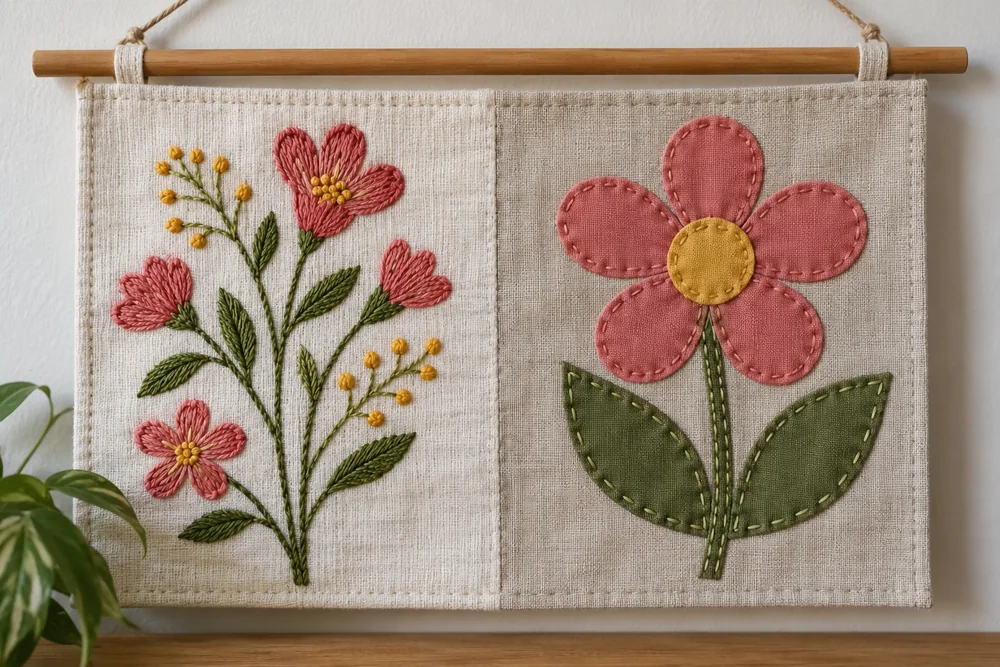
Embroidery works thread onto a ground fabric. Stitches can create outlines, filled areas, texture and borders; reflective elements may be held with stitched frameworks. Appliqué uses pieces of fabric cut into shapes and attached to a base. Printing places colour or an image onto a surface without building the motif from separate fabric layers. Some articles combine all three: a printed ground may carry embroidered accents and appliquéd leaves.
The difference is often visible from the reverse. Embroidery usually leaves thread paths or a backing that covers them. Appliqué may expose stitching around the edges of individual cloth pieces. A flat printed imitation offers neither raised stitched ornament nor layered fabric, though modern printed goods can still make durable and attractive decorations. The accurate label describes process. “Handcrafted” should be reserved for a supported hand-production step; “hand embroidered” means the relevant embroidery itself was worked by hand, not merely that someone packed or finished a machine-produced article.
5. Rabari embroidery: motifs, mirrors and living design
In documented Rabari embroidery traditions, stitches, bold forms, reflective details and motifs drawn from familiar surroundings can carry social and aesthetic meaning. D'Source's Bhujodi material describes mirrors encircled by stitches and motifs that include birds, animals, plants and domestic imagery. The meaning of a motif should be interpreted in its actual context rather than copied into a blanket symbolic claim for every item sold online.
A shopping photograph can reveal thread density, contrast, decorative balance and perhaps the way a mirror is held. It cannot, on its own, demonstrate that a specific community produced the work. Ask for a workshop description, sourcing statement and process images if the seller offers a community-specific label. A mirror may be glass, acrylic or another reflective trim; the design style does not prove which one is fitted. Likewise, slight variations between units may reflect handwork, but variation alone does not prove hand production.
6. Ahir and other Kutch embroidery identities
Ahir embroidery is another distinct tradition documented in Kutch. Its patterns may feature curving outlines, recurring forms, dense stitch-filled areas and carefully organised mirror embellishment. An Ahir work should not be relabelled as Rabari simply because both use colourful thread and reflective pieces. Jat and Mutwa embroidery traditions likewise have their own visual and technical identities, but it is inappropriate to guess a specific community from a generic retail photo.
Correct naming benefits makers and buyers alike. It prevents a retailer from collapsing diverse work into a vague “tribal mirror toran” category and gives customers a reason to ask useful questions. Is the article hand stitched, machine stitched or mixed? What is the ground material? Which design elements are locally sourced? Has the producer verified a geographic or community claim? Where answers are incomplete, broad but factual phrasing is better than a false precision.
7. Gujarat's doorway torans and the Saurashtra distinction
Not every Gujarati toran comes from Kutch. Saurashtra and other parts of Gujarat have traditions of embroidered and beaded doorway ornaments. Cooper Hewitt's Smithsonian Design Museum describes a particular historic Gujarati toran as showing features associated with the Kathipa style; the museum identifies geometric forms, repeated shapes and mirrorwork in that object. It is evidence for a documented textile, not a template that makes every similar new product a verified Kathipa object.
Beaded torans can involve small glass or other beads strung into panels or dangling forms; some historical pieces combine a horizontal lintel band with vertical side elements. These constructions create different maintenance problems from a flat stitched cloth. Bead threads may weaken; seams may pull under weight; a brittle older piece should not be attached by two small weak loops. A regional comparison is most useful when it encourages an accurate inspection of the object in hand.
Traditional textile names deserve careful interpretation when shopping. A Kutch-inspired design is not necessarily documented Rabari embroidery. Similarly, the phrase “Jat embroidery” should not be inferred from an arrangement of dense geometric marks. Distinguish design influence from documented origin; ask for provenance before relying on an origin label. It also helps customers compare a museum-quality collectible, a modern workshop piece and an affordable decorative interpretation without treating all three as the same category.
8. Pipili and the craft of appliqué in Odisha
Pipili (also written Pipli) is a town in Odisha's Puri district associated with colourful fabric appliqué, widely called Chandua in local craft descriptions. Odisha Tourism documents the craft village, and state craft resources describe the use of cut cloth shapes for ornamental canopies, umbrellas and related festive and temple contexts. Appliqué is the defining technique: shapes are laid onto a ground and joined to form a composition, rather than being drawn only by lines of embroidery.
Pipili artisans make more than a single kind of door strip. A tourist may see circular hangings, lampshades, wall panels, umbrella components or banners. Some are adapted for modern residential interiors. An item made in the region may combine hand cutting with machine sewing; the appropriate label should reflect actual practice rather than assume entirely manual sewing. It is also important not to call a screen-printed imitation “traditional Pipili appliqué” merely because the colours resemble it.
9. Chandua: from ceremonial cloth to contemporary decorative design
Regional traditions can carry sacred and ceremonial associations without making every modern derivative a ritual object. Odisha's appliqué has links with festive display and the world of temple textiles, including canopies and umbrellas. A contemporary wall hanging or entrance band can draw on the same craft vocabulary while being intended primarily for domestic decoration. Careful product writing identifies what the actual unit is used for and does not imply that it was used in a temple, offered to a deity or made for a particular festival without supporting evidence.
Buyers can appreciate the visual qualities of Chandua-style forms: high-contrast panels, stylised flowers, birds, circular motifs, layered petals, radiating arrangements and contrasting borders. These examples describe visual language, not a mandatory pattern inventory. The safer choice is to explain the design visible in the product's own photographs and avoid imposing one story on all regions or periods of the craft.
10. Side-by-side comparison: Kutch embroidery and Pipili appliqué
| Question | Kutch embroidery traditions | Pipili appliqué traditions |
|---|---|---|
| Primary decorative process | Thread stitches form outlines, fills and textures on a textile ground | Cut fabric forms are attached to a fabric ground; stitching secures the layers |
| Typical evidence to inspect | Stitches, thread paths, mirror retention, underside finishing | Separate fabric layers, motif edges, attachment stitching, backing |
| Regional context | Multiple communities and embroidery styles across Kutch, Gujarat | Pipili and surrounding Odisha craft practice, including Chandua |
| Objects documented | Garment and household textiles, including decorative pieces and toran forms | Canopies, umbrellas, hangings, festive decorations and contemporary goods |
| What colour or motifs prove | They indicate design choices, not verified maker or exact community | They indicate design choices, not verified workshop or place of manufacture |
| Buying risk | A printed or machine-worked imitation mislabelled as hand embroidery | A flat print or generic layered panel mislabelled as certified Pipili work |
The comparison describes practices, not rules for every object. Some Kutch textile pieces include appliqué; some Pipili items use machine stitches, embroidered accents or other trims. A combined design is possible and should be described as combined rather than forced into one box.
11. Geographical Indications: what a GI name actually establishes
India's Geographical Indications Registry lists Kutch Embroidery and Pipli Applique Work among registered indications. The Registry also maintains an entry for Kutch Embroidery's logo and additional specifically named craft applications. This means the geographical term has a documented registration context; it does not mean that a seller may apply it to any visually similar commodity. Registration of the craft category is different from verification of an individual online listing.
Before claiming that a unit is “GI-certified,” “authentic Kutch,” or “original Pipili,” obtain appropriate evidence from the relevant producer or authorised supply chain and verify the applicable requirements. A generic sticker, a regional word in an advertisement or a photo of a craft village is not enough. Where the item only borrows a look, “Kutch-inspired embroidered motif” or “Pipili-inspired appliqué design” is more defensible if the description does not mislead about place, method or certification.
12. Other regional entrance decorations without false equivalence
Indian doorways feature many materials besides these two textile traditions. Gujarati and Saurashtrian beaded torans may emphasise bead stringing rather than stitch-filled surfaces. South Indian thoranam can refer to leaf festoons, particularly mango-leaf decorations in certain household settings; fresh leaves carry handling and replacement needs unlike cloth. Floral door garlands, sometimes called mala, use flowers or imitations and are not automatically appliqué or embroidery.
Other homes use bells, hanging lamps, auspicious symbols, carved wood, metal elements or doorframe painting. Regional floor-decoration traditions—such as rangoli, kolam or alpana—may be associated with arrival and celebration, but are not textile torans. A useful store guide makes these distinctions so that readers can choose by actual function instead of assuming that all “traditional entrance crafts” are identical products.
13. How to inspect an embroidered toran before buying
Ask for a photograph of the complete front, an unobstructed reverse-side image, close-ups of the border and suspended drops, and a detail showing how reflective pieces are fastened. Check that stitches are secure where decorative segments meet the header. The reverse may be lined; in that case ask whether the stitches are visible in a work-in-progress image or otherwise documented. Neatness is not a demand for machine-perfect regularity: hand stitching often has small variations. The concern is whether the motif and its structural joins are stable.
Next inspect the supporting band. It should carry the weight without excessive sagging. Look for reinforced end loops and a hem that resists fraying. Count mirrors or ornaments only when the actual item and listing agree; a studio photograph of one sample may not describe every handmade unit. Ask whether the item can be gently dusted, whether trims are colourfast, and whether a museum-like older piece needs conservation handling rather than everyday use.
14. How to inspect a Pipili-style appliqué hanging
Look for layers. Is a differently coloured shape actually cut and laid onto the ground, or is it simply printed? Are edges turned under, stitched flat or intentionally left exposed? Is there a backing fabric? Do applique panels sit evenly, or are edges lifting because the thread or adhesive is failing? Check the interface between the decorative fabric and the upper support; wide canopies and circular hangings need different support from a short horizontal door toran.
Ask for a process statement rather than guessing that all seams are hand sewn. Verify the fibre, colourfastness and permitted cleaning method to the extent the maker can provide them. A dense, heavy panel may need several evenly distributed fixing points, whereas a small, light strip may hang from two sound anchors. Some appliqué intended for sheltered interiors should not be exposed to rain, insects or continuous sun, regardless of the festival imagery on it.
For online purchase, request a small set of consistent images rather than ten filtered photographs that hide construction. A full-front photograph establishes the silhouette; a reverse image establishes how the fabric is supported; a ruler or measuring tape gives scale; a macro view reveals actual stitch or applique work; and a photograph of the header and fixing loops helps assess installation. If a seller uses representative images, the page should state whether the delivered unit may vary in colour, motif placement or number of pendants. A variation policy can describe expected handwork without silently substituting a different item or changing the product's claimed origin.
15. Craft claims a responsible seller should document
| Claim on product page | Evidence to request | Safer wording when unverified |
|---|---|---|
| “Hand-embroidered” | Maker/process statement, workmanship images, stitch identification | “Embroidered-look” or “embroidered detailing,” as actually observed |
| “Pipili appliqué” | Producer origin and authentic appliqué construction | “Pipili-inspired appliqué pattern” if that is the factual description |
| “From Kutch” | Supplier and workshop location records | “Kutch-inspired design” without a geographic origin promise |
| “GI registered product” | Applicable GI authorisation and item traceability | Do not use a GI claim until verified |
| “Pure silk / glass mirror / handmade” | Materials disclosure and production records | “Textile with reflective decorative elements” when composition is unknown |
| “Antique or temple used” | Reliable object history and provenance | “Traditional-inspired contemporary decorative piece” |
These questions protect genuine makers from casual imitation claims and help buyers know what they are purchasing. Being honest about mixed hand and machine methods is more respectful than assigning every item an unsupported artisanal history.
16. Measuring a toran for a real doorway
Measure the clear width between the intended fixing points, then check whether the decorative header itself or the adjustable ties contribute to that width. Record the longest hanging drop, not only the header height. On an outward- or inward-swinging door, make sure pendants cannot be trapped in the hinge side, latch or door closer. Check clearance for tall people, moving furniture, children and pets. Decorative elements should not block a peephole, safety signage, lock or exit route.
Use hardware suited to the wall or frame surface and the actual article's weight. Avoid drilling into unknown wiring, glazing or fire-rated door structures. For heavier textile panels, distribute load across additional points; for fragile historic pieces, professional mounting advice is preferable to domestic hooks. A photograph taken from an angle is not an accurate source for dimensions. Ask for verified width, drop, attachment type and mass rather than estimating sizes from an illustration.
17. Colour and motif: respect diversity rather than inventing rules
Vivid reds, yellows, greens, blues and contrasts are common in many decorative textiles, and stylised flowers, birds, animals and geometric forms occur in both historical and contemporary crafts. Their significance differs by object and context. A peacock, elephant, mango leaf or lotus can be auspicious in some uses, but a motif should not be presented as a single universal code across Kutch, Saurashtra and Odisha. Community, maker and household interpretations matter.
Choose a piece that fits the actual entrance and occasion. A richly embellished hanging may suit a festive setting; a small, restrained textile may be easier to maintain in an apartment. Vastu discussions can emphasise a clean and welcoming threshold without promising that an unverified motif, stitch count or colour combination will deliver wealth, health or a specific astrological result. Such promises are not a substitute for provenance, craftsmanship or practical suitability.
Practical selection should also reflect how often the door is used. A busy household entrance with deliveries, bags and school backpacks may need a shorter profile and fewer loose pendants than a ceremonial side entrance. A translucent or lightly coloured textile may look striking against a dark frame but show dust quickly. Dense mirrorwork can sparkle in indirect daylight yet create snag points when the piece moves in a draft. In a humid coastal setting, good airflow and a sheltered position matter more than a general claim of “all-season decor”. These questions belong in the product specification, not in an exaggerated spiritual benefit statement.
18. Cleaning: embroidery and appliqué do not share one universal method
Fabric, dyes, mirror attachments, metal threads, adhesives and backing materials affect cleaning. For a modern article, follow verified maker instructions; first test any proposed method on an inconspicuous area when appropriate. Gentle dry dust removal may be preferable to wet washing when dyes, mirrors or glued parts are uncertain. Never soak a heavy embellished textile or machine-wash it solely because the face fabric appears to be cotton. Metallic-look ribbons, paperboard stiffeners and glass pieces may fail even when the ground cloth tolerates water.
The Canadian Conservation Institute recommends preventive approaches for vulnerable textiles: limit unnecessary handling and light exposure, keep storage areas clean, and provide physical support. These conservation principles are especially important for older, fragile or valuable pieces; home products may have their own supplier-tested care requirements. If the item carries a strong odour, mould or loose fragments, isolate it from clean textiles and seek suitable specialist advice rather than simply spraying perfume or aggressive cleaners over it.
19. Storage, repair and respect for the maker
Before storage, ensure that the hanging is dry and free from loose dust. Protect mirrors or protruding beadwork from pressure; do not stack weight on delicate points. A light, flat modern piece may be laid in a clean, dry box with suitable supporting tissue; larger pieces may be rolled with support if construction permits. Repeated sharp folding can damage embroidery and appliqué edges. For an inherited historic textile, use conservation-grade guidance rather than ordinary seasonal storage assumptions.
A loose thread does not always mean the whole item must be discarded. Photograph damage, check whether the maker offers a repair service, and decide whether the proposed fix matches the construction. Avoid aggressive glue near mirrors, adhesives on dyed fabric or repairs that could damage older work. Where possible, keep records of maker, purchase date, workshop, materials and repairs. Such documentation preserves the story of the piece and helps avoid unsupported origin claims later.
20. A practical buying checklist for regional entrance crafts
First, identify the form: a flat textile band, suspended beadwork, applied fabric panel, garland or another decoration. Second, read the specific production claim: embroidered, appliquéd, printed, hand stitched, machine stitched or mixed. Third, request front and reverse photographs so the main method is visible. Fourth, verify the maker and origin if regional or GI language is used. Fifth, inspect joining points, hems, mirrors, tassels and the upper support. Sixth, confirm measurements, drop length and actual mounting hardware. Seventh, consider pets, wind, rain, sunlight, heat and frequent door movement. Eighth, obtain care instructions that match the materials. Ninth, keep any craft documentation or invoice with the item. Tenth, choose a culturally appropriate design without claiming an unverified ritual result.
For a home entrance that combines tradition and practicality, an honestly labelled contemporary toran is a sound choice when its dimensions and attachments are suitable. For a collector seeking a community-specific Kutch embroidery or authenticated Pipili appliqué object, provenance becomes central and price or appearance alone is not sufficient. These two buying paths need not compete; they simply require different evidence.
Frequently asked questions
1. Is every mirrorworked Indian door hanging from Kutch?
No. Mirrorwork occurs in more than one regional tradition and in contemporary manufactured designs. Kutch origin requires evidence about the actual object, not only the presence of mirrors.
2. What does Pipili appliqué mean?
It refers to a documented Odisha craft associated with Pipili, where cut fabric motifs are attached to a cloth ground. Locally the craft is also described with the term Chandua.
3. Is Pipili appliqué a registered GI?
Yes. India's Geographical Indications Registry includes Pipli Applique Work. That registration is not automatic proof that a particular product or seller is authorised to use the indication.
4. Is Kutch embroidery also covered by a GI registration?
The Indian registry has an entry for Kutch Embroidery. Verify the relevant product and supply-chain evidence before making a GI or authenticated-origin claim for an individual item.
5. Can a textile combine hand embroidery and machine stitching?
Yes. Many contemporary products can contain both. Specify which components are made by each method when that information is supported.
6. Does a printed pattern count as traditional appliqué?
No. A print may imitate the look of appliqué, but it does not use the same cut-and-attached-fabric construction. A print can be sold under an accurate printed-design description.
7. Are Gujarati and Odia torans interchangeable in ritual use?
Not necessarily. They arise from different histories and may serve different decorative or ceremonial purposes. Household custom and the occasion should guide ritual choices.
8. How do I check handmade quality without damaging the piece?
Inspect well-lit close-up photographs of the front and reverse, stitching, edge finish and attachment loops. Do not pull on ornaments or force open a lined panel to test craftsmanship.
9. Can I hang an embroidered or appliquéd toran outdoors?
Only if the actual product is suitable for the exposure. Many textiles, dyes and trims deteriorate under rain and strong sunlight, and a doorway needs safe anchors and clearance.
10. How should I store a festive fabric toran?
Store it clean and fully dry with support for mirrors and delicate extensions, away from strong light, moisture and heavy pressure. Follow the maker's specific instructions where available.
Explore the existing Vastu collection for related home and entrance ideas.
For broader traditional context, read the existing Vastu Shastra overview.


