

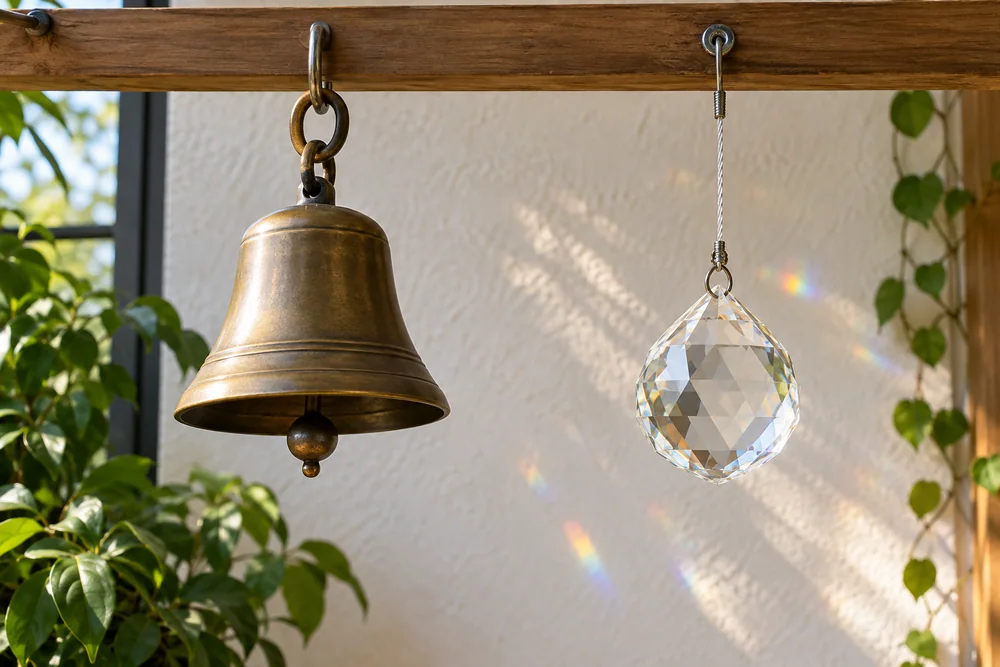
A bell hanging, wind chime and suncatcher can all occupy a small corner, yet they behave differently. Comparing their action makes it easier to choose an object you will enjoy rather than one that surprises you after installation.
Sound-producing choices
A tubular chime commonly uses a moving striker and sail. A bell cluster may depend on its internal clappers or contact between parts. Listen to the actual arrangement if sound matters; a photograph cannot tell you its loudness or how frequently it will ring. A bell toran above a sheltered door may remain mostly still.
Light-catching choices
A faceted glass prism can scatter light when the angle of sunlight is suitable. Natural stone does not automatically have the same optical effect. An opaque stone pendant may be attractive because of its colour, texture or polish, without creating rainbows. Ask whether each clear component is glass, quartz or another material.
Compare positions
Choose a chime where moving parts have free space and the sound is welcome. Choose a suncatcher where it can receive light without striking the window or becoming an obstruction. Keep optical ornaments away from places where concentrated sunlight could fall onto combustible material. A silent stone hanging often suits a protected wall position where its colour remains visible throughout the day.
Compare handling and care
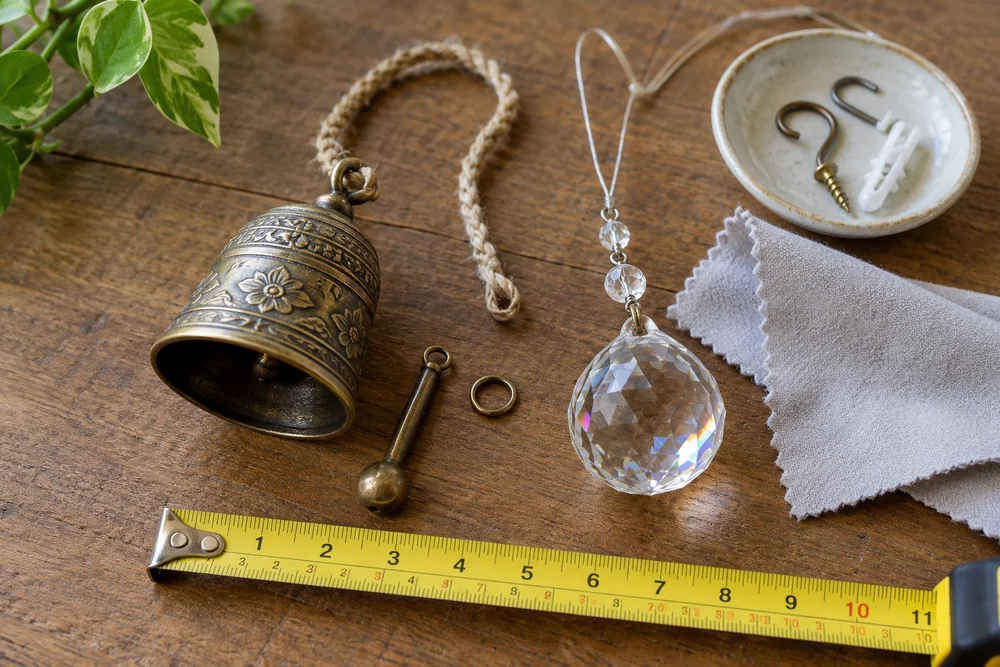
Tube chimes have cords and contact surfaces to inspect. Bell clusters have rings, clappers and potentially sharp edges. Suncatchers have fragile facets, slices or drilled holes. All three need a suitable fixing, but their weak points differ. When cleaning a mixed-material design, follow the most delicate component rather than using a metal cleaner over the entire object.
Choose one clear purpose
If you want a quiet decorative entrance, do not pay for a claimed musical effect you will never use. If you want sound, ask for evidence that the actual assembly sounds in its intended position. Keep small beads, loose prisms and cords away from children and pets, and avoid suspending breakable pieces over a busy passage.
Questions readers ask
Is a “crystal chime” always made from natural quartz?
No. That phrase may refer to glass ornaments attached to a metal chime. Read the component description.
Can one object combine sound and light?
Yes, but the sound-making and optical parts should each be described accurately.
Explore the existing Vastu collection for related home and entrance ideas.
For broader traditional context, read the existing Vastu Shastra overview.
Research references
Woodstock wind chimes; Woodstock product care. Source names are provided as educational attribution.


