

A handmade fabric toran can look like a simple band of colourful cloth hanging across a doorway, yet its details may involve multiple crafts: embroidered stitches, appliquéd fabric shapes, folded gota patti ribbon, secured shisha mirrors, beads, tassels and shaped pendants. These techniques have distinct histories and construction methods. They also affect how an entrance hanging should be examined, mounted, cleaned and stored. This guide explains what those terms actually mean, how to recognise quality workmanship without confusing appearance with provenance, and how to choose a piece that suits a home or celebration. It treats the toran as both a culturally meaningful doorway textile and a physical object that must be represented accurately.
1. What is a fabric toran, and why does it belong above a doorway?
A toran, also spelled torana, is a decorative element associated with a doorway or threshold; bandhanwar is another widely used name in Indian domestic decoration. In Gujarati textile traditions, embroidered doorway torans can form a horizontal frieze with pointed or leaf-shaped drops, sometimes finished with mirrors, flowers, birds or geometric motifs. They may be displayed to communicate welcome and the auspiciousness of a household gathering. The words do not mean that every toran is made by one regional community or has the same ritual role.
The entrance is a meaningful part of griha pravesha, festivals, weddings and other occasions. A toran can participate in this expression of mangala—a favourable or welcoming beginning—alongside cleaning, light, flowers and other household practices. Textile doorway decorations are a distinct living craft: they need not imitate a fresh mango-leaf thoranam to possess cultural value. If a particular observance calls specifically for living leaves, however, a fabric piece should not be sold as an identical ritual substitute without regard to that tradition.
Textile museum and design collections document Gujarati torans constructed with embroidery, glass mirrors and suspended pointed panels. Those examples are useful evidence of material and craft history; they do not establish the maker, place of manufacture or authenticity of a modern retail item merely because it looks similar.
2. Read the vocabulary before judging the photographs
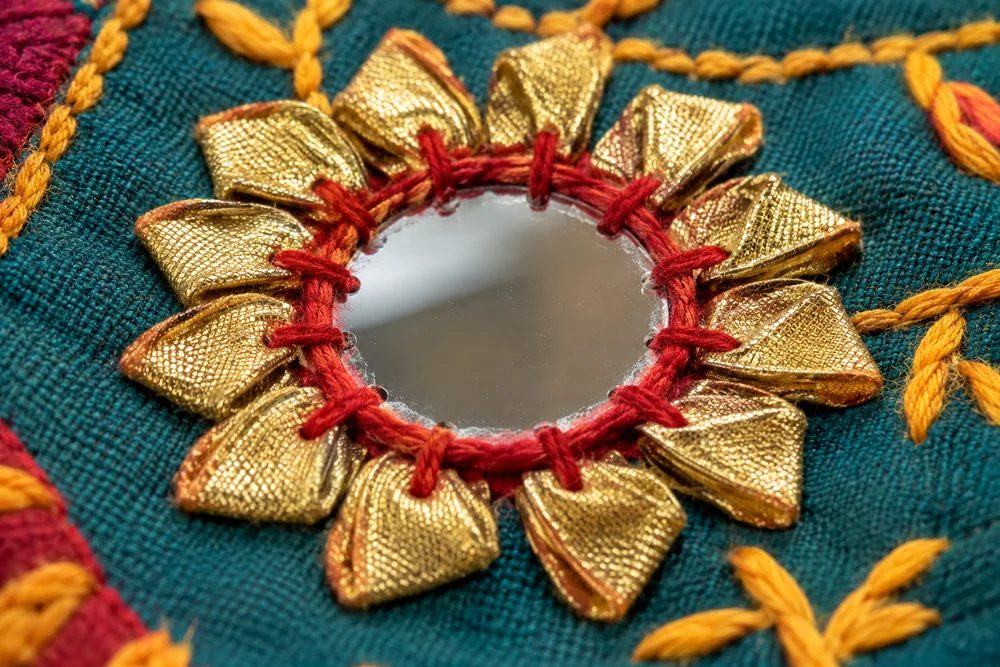
Several labels appear together in catalogues, but they do not describe the same process. Embroidery creates a design through stitches made with thread. Appliqué attaches one fabric shape to another backing. Gota patti uses folded, cut or arranged decorative ribbon, commonly metallic in appearance, secured onto a ground fabric. Shisha or mirrorwork captures reflective pieces on a textile, traditionally often with a framework of stitches. Printed motifs, sequins and glued plastic reflectors may look comparable from a distance while being made differently.
A listing can legitimately combine the methods: an embroidered border may frame appliquéd parrots, gota leaves may surround a glass mirror, and tassels may finish the lower edge. The essential question is not whether the photograph looks festive. It is which details are stitched, printed, woven, glued or otherwise attached, and which materials have actually been verified for the specific item.
3. What museum examples can and cannot tell us
Cooper Hewitt's account of a Gujarati toran discusses the welcoming function of such doorway textiles and the role of domestic embroidery in their making. The Smithsonian National Museum of Asian Art records a Gujarat door hanging with cotton fabric, untwisted silk floss, mirror glass and embroidery, including nine pointed pendants in that particular museum piece. The Museum of International Folk Art documents embroidered, mirrorworked Gujarati torans as well. These are tangible examples of varied craftsmanship rather than a universal prescription for the number of points, mirrors or stitches.
The Victoria and Albert Museum describes shisha mirrorwork in the context of Indian embroidery, notably northwest Indian traditions including Kutch. D'Source's toran-making documentation illustrates how fabric shapes and hanging components can be assembled. Together these sources explain why construction matters and why a seller should not label a printed mass-market imitation as an antique or community-made original.
Distinct craft vocabularies also travel. A contemporary toran may use Rajasthani-inspired gota, Gujarati-style mirrorwork and machine-made trim in one design. That mixture can be attractive and honestly described. It should not automatically be assigned an exclusive origin such as “authentic Kutch” or “handmade in Rajasthan” without maker or supply-chain evidence.
4. Anatomy of a well-planned fabric doorway hanging
Begin with the upper header band, which spans the doorway. This band carries the weight of the piece; its lining, seam allowances and reinforcement are more important structurally than an elaborate surface motif. End loops, ties or hooks are the connection to the doorframe. A design may include triangular or leaf-shaped pendants, a scalloped bottom edge, dangling bells, beads, tassels or small sculpted birds. Each attachment places a different load on its seam or connecting thread.
From the front, the viewer should be able to see a balanced outline and legible ornament. From behind, a careful buyer should expect orderly finishing, supported joins and no exposed snagging ends where hands or the door can catch them. A slightly irregular hand stitch is not automatically a fault, but fraying seam edges, loose mirrors and failing suspension loops are genuine defects.
The right design matches its doorway: a narrow lintel may suit a flatter textile with few drops; a deep decorative entrance can accommodate a larger hanging if clearance, attachment points and the door swing are checked. Decorative width should be measured independently from the length of adjustable ties.
5. The foundation: cotton, silk, synthetic blends and backing fabric
Fabric identity matters because it determines how a piece drapes, wears, fades and responds to cleaning. Cotton is common in domestic and contemporary craft constructions, and museum examples preserve cotton grounds with silk embroidery. Silk, rayon, polyester, velvet-like piles, interfacing, nonwoven backing and mixed fibres may also appear in modern articles. A shiny surface does not, by itself, confirm silk. A label reading “silk-look” or “art silk” should not be interpreted as verified natural silk.
Compare the front and back. The front may be richly embroidered while the backing is a less decorative but structurally important fabric. A well-supported header lies reasonably flat without severe twisting under the weight of the hanging; an under-supported header can sag in the middle and concentrate force at the ends. Very stiff synthetic boards or adhesives may hold a shape initially but can wrinkle or delaminate in heat or damp conditions.
Ask for the disclosed fibre composition only to the level the maker or seller can substantiate. Where mixed materials cannot be individually verified, “mixed textile and decorative trims” is more trustworthy than confidently naming pure cotton, pure silk or precious-metal thread from a picture.
6. Embroidery: how thread makes the motif
Embroidery may outline a motif, fill an area, secure an edge or combine all three functions. Running stitches, chain-like outlines, satin-style filled areas, darning stitches, couching and other regional methods can make distinct surfaces. No single stitch proves a piece came from Kutch, Saurashtra or another locality: the pattern, thread, base cloth, execution, history and maker records must be considered together.
Inspect stitch density at the places that actually carry stress. On a dangling leaf, for example, the stitch holding the leaf to the main band is usually more consequential than dense decorative stitches far from the join. Loose loops can catch rings or door hardware. Uneven stitch spacing may simply reflect hand production, while split seams or unsecured ends are signs of insufficient finishing.
Hand embroidery can be paired with machine stitching. A machine-sewn backing does not make hand embroidery disappear; nor does one hand-attached bead make every feature handcrafted. A precise product description separates the construction stages: “hand-embroidered front with machine-stitched backing”, for example, when that workflow is verified.
7. Appliqué: cut cloth, layered shapes and raised decoration
Appliqué is the attachment of one fabric piece onto another to create a shape or pattern. In a toran it may form stylised mango leaves, lotus petals, elephants, birds, blossoms or repeated geometric drops. The shapes may be stitched flat, padded for volume or joined into three-dimensional hanging elements. D'Source's toran-making description shows cutting and folding fabric to construct decorative forms; it does not mean all similar market products follow the same process.
Turn an item over where possible to inspect how appliqué edges are handled. Folded or securely enclosed edges help reduce fraying. Open cut edges may be intentionally raw in some designs, but loose fibres should not compromise the joins. If stiff filling is present, assess whether it is evenly enclosed, not escaping from seams and not adding unsafe weight at the lower edge.
Printed appliqué motifs and appliquéd fabric shapes are different things. A photograph of a printed elephant on plain cotton cannot properly be described as an appliqué elephant merely because the visual shape matches. The listing should state how the material is actually constructed.
8. Gota patti: ribbon, folding, stitching and metallic appearance
Gota refers to decorative ribbon or braid; patti suggests a small strip or leaf-like component. In gota work, pieces of ribbon may be cut, folded and stitched to form petals, leaves, borders and geometric arrangements. Rajasthan's craft documentation describes the process of transferring patterns and stitching ribbon shapes; the V&A also notes the difference between traditional real-metal ribbons and modern plastic-based alternatives. Gota is therefore best identified by its construction rather than by sparkle alone.
Historic gota could include metallic elements such as silver or gold ribbon constructions; contemporary gota frequently uses synthetic or metallised materials. A bright golden ribbon is not proof of gold. Silver-coloured foil is not proof of silver. Exact metal content, dye, fibre and wash instructions require supplier evidence. A seller can accurately say “gold-tone gota ribbon” when the colour is known but the material is not.
Examine whether the ribbon is folded cleanly, whether points or edges lift and whether the stitching anchors small leaf shapes without distorting the backing. Check around high-contact sections where the hanging may brush against doors or hands. Some commercially made trims are stitched on; others are glued. Both methods must be identified honestly, since adhesives can age differently from sewn connections.
9. Shisha and mirrorwork: reflective material held by textile
Shisha describes small mirrors incorporated into embroidery; in western Indian contexts the term abhla or abhla bharat may also be encountered. In stitched mirrorwork, threads can form a surrounding network that retains the reflective piece. Modern designs may instead use plastic mirrors, reflective films or glued discs. Some are intentionally non-glass for reduced breakage risk. Do not assume that “mirrorwork” always means either real glass or hand-sewn retention.
Look at the edges: are the mirrors properly seated and surrounded by intact thread? Does the backing flex without the piece shifting? Are there cracked, chipped or sharp fragments? A loose glass disc can become a cut hazard, particularly in a doorway used by children or in a product with dangling pieces at hand height. Decorative brilliance does not outweigh mechanical security.
A photograph can verify the appearance of a reflective element but not its exact composition or attachment. If a product claims “hand-stitched glass shisha”, the item or supplier documentation should support both the glass identity and the method. If not, use the narrower description “mirror-look embellishment” until verified.
10. Mirrorwork, gota, embroidery and appliqué compared
| Technique or appearance | How the decoration is made | What to inspect | Avoid claiming without evidence |
|---|---|---|---|
| Thread embroidery | Thread stitches outline, fill or build motifs on a base | Thread security, backing, loose ends, joins | Every stitch is hand-worked or from a specific region |
| Fabric appliqué | Cut shapes attached to a larger fabric ground | Edges, seam strength, padding, fraying | Printed shapes are sewn-on fabric pieces |
| Gota patti | Decorative ribbon shaped and secured to fabric | Ribbon edges, folded points, stitching or adhesive | Golden colour proves precious-metal content |
| Shisha mirrorwork | Reflectors secured by stitches or another disclosed method | Reflector retention, chips, backing, exposed edges | Every shiny disc is glass or hand-stitched |
| Printed, sequinned or glued imitation | Design reproduced by pigment, sequins or adhesives | Print wear, peeling, adhesion, sharp parts | Printed texture is physical hand embroidery |
These techniques can coexist. Their differences are not a hierarchy in which any handmade item is automatically durable or any machine-assisted item is automatically poor. Buy for the intended use and evaluate the construction actually offered.
11. Design motifs: welcome, celebration and regional expression
Floral chains, stylised leaves, lotus forms, parrots, peacocks, bells, elephants, lamps and abstract geometry appear across Indian decorative textiles. Some motifs may express welcome, growth, beauty, devotion or celebration within particular traditions. Yet their meaning is not fixed across every community, nor does including a lotus automatically turn a retail hanging into an item consecrated for ritual use.
In a household observing Diwali or a wedding ritual, a toran can mark a prepared and festive entrance. In other settings the same piece may simply be appreciated as an expression of textile skill. Consider whether the colour and motif are appropriate to the family or occasion instead of declaring one direction, number of mirrors or palette universally compulsory under Vastu Shastra.
Contemporary Vastu advice often treats an uncluttered, clean and welcoming doorway as desirable. That can inform placement, but a metal-looking ribbon or specific mirror count should not be sold as a guaranteed remedy for financial, health or planetary problems. Respect the tradition while keeping promises proportionate to what the object can substantiate.
12. What “handmade”, “hand-embroidered” and “hand-finished” really communicate
The word handmade can describe several labour arrangements: wholly hand-sewn construction, hand embroidery applied to pre-cut fabric, machine-made backing with hand-tied tassels, or purchased decorative components assembled by hand. Each is different. If a product listing uses the term, it should tell customers which meaningful stages are done manually and which materials are purchased ready-made.
Claims such as “artisan-made”, “village-made”, “women's cooperative”, “Kutch traditional”, “Pipili appliqué”, “GI authentic” or “heritage craft” require evidence from the maker or accountable supply chain. Visual resemblance to a museum object is not provenance. A fabric that shows irregular stitch length is not proof of a specific community. Nor is a perfectly regular appearance conclusive evidence that no human work was involved.
For quality control, the best evidence includes close photographs of the front, reverse, edges, mirror retention and suspension points, along with honest material labels and source documentation. Buyer confidence should rest on traceable facts rather than broad sentimental phrases.
13. Hand embroidery versus machine embroidery: practical differences
Hand embroidery offers scope for individual variation in stitch shape, thread tension and motif placement. Skilled artisans can execute remarkably regular work; unevenness is not an authenticity test. Machine embroidery can be consistent and repeatable, with its own aesthetic and production advantages. A mixed-method toran may use machine-embroidered bands alongside hand-appliquéd shapes and hand-sewn finishing.
When shopping, look for how the edge behaves. Is the motif lifting from its backing? Are dense stitched areas puckering the cloth? Are thread tails secured? Does the hanging drape without folding sharply where the weight changes? Those questions matter more than assuming that one technique is always superior.
A responsible product page can use terms such as “machine-embroidered”, “hand-appliquéd”, “hand-finished”, “printed with embroidery-effect motifs”, or “mixed stitching” only to the extent verified. A generic stock photograph cannot establish the labour method of the particular SKU.
14. Examine the reverse, not just the showpiece front
The rear of an embellished hanging reveals much of its structure. Look for reinforced end loops, securely turned edges, intact lining, backing seams, thread ends and how pendant tabs attach to the main band. A backing that is lumpy around one heavy ornament may suggest an imbalance; frayed ties may not safely carry the load. Check whether the reverse has exposed hot-melt glue, sharp wires or scratchy plastic supports that could mark a polished doorframe.
If the seller cannot provide a reverse photograph, request one before relying on descriptions such as “premium artisan finish” or “reinforced”. Magnified photographs should not be used to imply an item is jewellery-grade or laboratory-certified. The realistic goal is to verify craftsmanship and suitability for a household decorative object.
An illustration can demonstrate a plausible stitch path without being an actual product inspection. The original article illustration below is preserved as an example of construction and must not be interpreted as proof that every listed item uses those stitches or components.
15. Choosing the right size and suspension
Measure the actual horizontal fixing span, not only the approximate door width. Account for hinges, door closers, wall fixtures, nameplates and head clearance. A toran may have a 90 cm decorated header with longer ties; confusing these measurements can leave the piece overly stretched or too low. The product listing should state what is measured, including the total drop from the top of the mounting loop to the lowest tassel where available.
Choose fittings suited to the doorframe and the toran's real weight. Lightweight textile loops may be appropriate for secure fixed hooks, but adhesive hooks have manufacturer-specific load, surface and temperature limits. Do not rely on decorative stitches alone to suspend a heavy line of bells. Use load-bearing fittings suited to the full assembly and seek competent assistance for high or heavy installations. Avoid installation that obstructs a fire exit, a latch, security equipment or an automatic door mechanism.
In an apartment corridor, check shared-space regulations and whether the hanging can sway into a neighbour's path. If the entrance experiences strong wind, a heavily fringed or mirrored item may snag and deteriorate faster. “Indoor decorative use” is a safer default than “weatherproof” when materials and testing are unknown.
16. Care instructions should follow the weakest component
A textile toran can combine cotton, metallic-looking ribbon, dyes, glass or plastic reflectors, adhesives, woolly tassels and thin stitching. These materials respond differently to water, sunlight and abrasion. Washing advice must therefore follow the most vulnerable part—not just the base fabric. The Canadian Conservation Institute's textile-care guidance emphasises handling, support and the risks associated with fragile or embellished textiles.
For routine domestic care, first inspect for loose pieces. Light dust removal may be appropriate with a very soft brush or carefully controlled, non-contact methods recommended by the maker. Do not scrub mirror surrounds or yank tassels. Do not soak, machine wash, steam clean, bleach, iron directly over gota or mirrorwork, or use a hot hair dryer unless the verified item-specific instructions permit it.
If cleaning is needed after a festival, record the condition and contact the maker for a method suitable for all components. Dyes may bleed, stiff backing may deform, adhesives may soften and some metallic trims may tarnish or delaminate. Museum-level conservation advice is a useful cautionary model, not a guarantee that a home textile can be cleaned with museum procedures without assessment.
17. Storing a toran between festivals
Store the piece clean and fully dry. The preferred method depends on size and embellishment. A flat, supported position protects many textiles from folds, but a large decorative toran may need a generously padded roll or carefully supported layout. Avoid tight knots in tassels and sharp creases through glass mirrors, folded gota ribbon and stiff appliqué pieces. Place clean interleaving material between vulnerable surfaces rather than allowing protruding ornaments to rub against one another.
Choose a stable, dry, clean storage area away from direct sunlight, leaks, insects, high heat and prolonged compression. Unverified plastic bags may trap moisture; strong mothballs or fragrance can leave residues and are not a substitute for inspection. Do not place heavy objects on a packed hanging.
On taking it out again, check the header seam, both end loops, each suspended panel and any reflective discs. If a glass piece is broken, or a heavy ornament is barely attached, set the article aside for competent repair before hanging it over a busy entrance.
18. Buying quality: faults, tolerances and seller evidence
| Observation | Possibly acceptable variation | Reason to question or reject | Useful evidence |
|---|---|---|---|
| Stitch spacing | Small deliberate hand-work differences | Open seam, unanchored embroidery, loose loops | Close front and reverse photographs |
| Gota ribbon | Subtle differences in fold placement | Sharp projecting foil, widespread peeling or detachment | Trim material and attachment method |
| Reflective pieces | Minor decorative alignment differences | Cracked glass, loose or exposed sharp edges | Close photo and confirmed reflector material |
| Fabric body | Natural texture or small colour variation | Severe bleed, mould, tearing, unsupported load | Fibre disclosure, clean-back photograph |
| Pendants and loops | Small handmade length differences | Unsafe suspension or drop blocking access | Overall dimensions, total drop and weight |
| Origin and craftsmanship | Contemporary interpretation of regional style | Unverifiable “GI”, “village-made” or antique claims | Maker and supplier traceability |
“Handmade variation” should describe harmless differences rather than excuse safety defects, material substitution or a product that differs materially from the advertised sample. A buyer can appreciate individual work while insisting on strong joins, honest labelling and responsible fulfillment.
19. Choose by occasion, household and practical setting
For Diwali or a housewarming: look for colours and motifs that suit the household's customs; a reusable embroidered toran can help mark a welcoming entrance when fixed securely. Do not assume textile decoration replaces fresh plant material specified by an officiant or family custom.
For a wedding or festive event: a broader band with gota, mirrorwork and multiple pendants may appear celebratory. Confirm the real drop and safe installation, especially where guests, children and luggage move past the doorway. Fragile glass reflectors may be less suitable in low, high-contact positions.
For an apartment: a flatter, quieter piece that does not swing or strike the door may be more useful than a long bell-hung design. Keep the peephole, lock, door closer and common corridor clear. Select a textile whose cleaning and storage are realistic for the available space.
For a gift: neutral or meaningful motifs, clear dimensions, material disclosure and simple mounting instructions are often more useful than unsourced promises of “Vastu correction”. When gifting a regionally styled piece, describe it as inspired by the tradition unless its actual origin is established.
20. A practical 12-point buying and listing checklist
- Confirm the actual format: horizontal lintel band, shaped drops, tassels, bells and overall silhouette.
- Measure the decorated width and total drop: specify if ties are included or excluded.
- Identify the base and backing: describe fibre composition only where supported.
- Separate techniques: thread embroidery, fabric appliqué, gota patti, shisha, printing, sequins and glue are not synonyms.
- Confirm manual stages: distinguish hand embroidery from machine stitching and hand assembly.
- Inspect the reverse: check finishing, loops, knots, lining and attachment seams.
- Check reflective pieces: glass versus acrylic or film, and retention or damage.
- Clarify ribbon composition: golden appearance alone does not establish metal content.
- Verify craft and origin claims: request maker or supplier evidence instead of guessing from style.
- Review mounting safety: actual weight, anchor suitability, clearance and shared-space rules.
- Read care and storage instructions: avoid unverified washability or outdoor-suitability claims.
- Compare photographs with the item supplied: real inventory images should be distinguished from illustrations and representative samples.
For a seller preparing a product page, it is better to flag dimensions, origin or exact trims as unverified than to fill missing details with assumptions. The relevant item should not carry an unrelated gemstone or Rudraksha laboratory certificate simply because other OmmRudraksha product families use one. A toran's value can rest in its design and craft without such claims.
Frequently asked questions
1. Is every embroidered toran completely handmade?
No. Some use machine embroidery, machine-stitched backing, hand-applied ornaments or a mixture of processes. The term “hand-embroidered” should refer to actual hand stitching where verified.
2. Is gota patti made of real gold or silver?
Not necessarily. Historic gota may contain precious-metal elements, while many modern ribbons use synthetic or metallised material. Gold colour does not prove gold content.
3. Does mirrorwork always contain real glass?
No. Some contemporary decorations use acrylic, reflective film or other materials. Confirm the reflector composition for the particular product if it matters to safety or purchase.
4. What is the difference between appliqué and embroidery?
Appliqué attaches pieces of fabric onto a base; embroidery makes patterns through stitches. A toran can include both at once.
5. How can I tell whether a fabric toran is from Kutch?
Visual style alone is insufficient. Request maker identity, sourcing history or reliable provenance documentation before accepting a precise regional-origin claim.
6. Can a gota and mirrorwork toran be washed?
Only if the actual maker has approved a method for all materials. Water, agitation and heat may damage metallic-looking trims, dyes, mirror attachment, adhesives or backing.
7. Do handmade irregularities mean the item is defective?
Small harmless differences can be part of hand production. Loose suspension stitches, broken mirrors, tears or inaccurately described materials are not acceptable merely because a piece is handmade.
8. Is a textile toran suitable for an outdoor entrance?
Do not assume so. Sun, rain and wind can damage dyes, fibre, glue, glass retention and trims. Choose outdoor use only when the exact article has suitable verified materials and instructions.
9. Is there a fixed number of points or mirrors required by Vastu?
No single number applies to every textile tradition or household. Museum examples show different constructions. Follow a specific family or ritual practice where relevant rather than a universal sales claim.
10. What should I check before hanging a heavily embellished toran?
Inspect weight, loops, stitching, reflectors, anchor suitability and clearance. Do not hang a damaged piece where people may brush against it or where it interferes with doors or exits.
Explore the existing Vastu collection for related decorative categories and the Vastu Shastra overview for traditional context. Compare actual materials, workmanship and safe fitting requirements before selecting a fabric toran.


