

A handmade or herbal toran can do more than decorate a doorway: it can welcome visitors, mark a shared celebration and give visible expression to a family's customs. For Diwali, griha pravesha (housewarming), weddings and festivals, the right choice may be a fresh mango-leaf thoranam, a fragrant flower garland, a stitched bandhanwar, or a reusable arrangement made by skilled artisans. The decision should begin with the occasion and the household's practice, then consider material identity, reliable sourcing, fit, care and safety. This guide explains the meanings and practical differences without claiming that one material, leaf count or direction is mandatory for every community.
1. What is a toran, bandhanwar or thoranam?
The term torana can refer to a ceremonial gateway or decorative threshold element; in domestic use, toran and bandhanwar commonly describe a horizontal decoration across the upper entrance. Thoranam or toranam is widely understood in several South Indian contexts, including fresh-leaf festoons. Usage overlaps, but regional names do not imply that every design, material or ritual function is identical. The long textile band found in many Gujarati homes is structurally different from a quickly assembled string of fresh mango leaves.
Across communities, the doorway is a meaningful transition between public and household space. A visible toran may indicate hospitality, a festive mood, devotion or a wish for mangala—auspiciousness. In Vastu language the entrance is important to the experience and orderly use of the home. These are traditional and cultural interpretations, not measurable guarantees of wealth, protection or health. A household's own observance deserves more weight than a seller's claim of a single universal prescription.
For a new purchase, first distinguish fresh botanical, dried botanical, handmade textile and mixed-media torans. Those categories determine how the decoration is ordered, handled and maintained as much as they determine its appearance.
2. Why the occasion changes the right choice
A Diwali gathering might need a bright, welcoming entrance that remains attractive through visits over several evenings. A griha pravesha may include a particular puja sequence, a chosen muhurat, rangoli and a ceremonial doorway arrangement. Wedding entrances can accommodate more elaborate floral installations, but their scale, venue rules and crowd movement create additional responsibilities. A smaller home puja may suit one carefully assembled strand. School, office or community celebrations require attention to shared exits, maintenance and fire-safety policies.
Begin by asking the host or family priest whether fresh leaves, flowers, a specific symbol or a particular arrangement is expected. Some families use mango leaves and marigolds; others have regional conventions or prefer a cherished reusable bandhanwar. Local custom and seasonal access should guide these decisions. An item sold as “festival toran” is not automatically suitable for every ceremony, nor does an illustrative photograph confirm the components supplied.
The best arrangement supports the event without creating avoidable difficulty. Consider who will install it, when materials will arrive, whether it will be outdoors or near a kitchen or diya, and who will remove or store it after the occasion.
3. Diwali: light, welcome and an uncluttered entrance
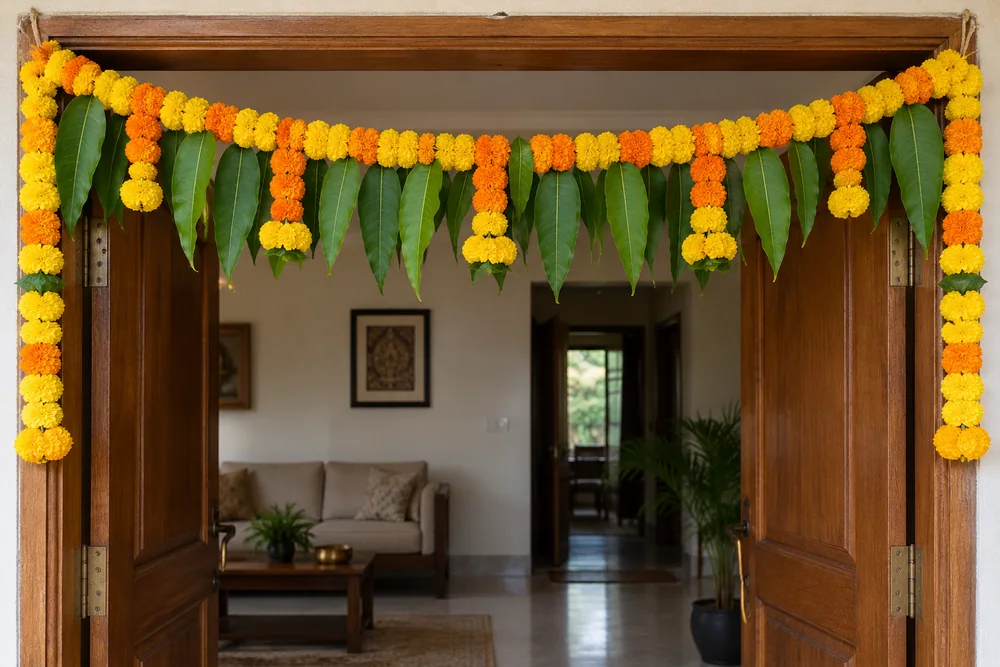
Diwali decorations commonly bring together lamps, rangoli, flowers, colourful textiles and welcoming signs. Torans may carry leaf shapes, lotus motifs, bells, beads or a Shubh–Labh inscription in homes where these are meaningful. A fresh marigold-and-mango-leaf arrangement can suit a short gathering when it can be prepared close to the occasion. A reusable cotton or embroidered toran may be easier where the home is decorated for several days and the family wants a familiar design for subsequent years.
Do not treat the presence of a flame as a decorative detail. Dry leaves, synthetic tassels, fabric, thread, paper, plastic backing and even fresh plant strands must be kept clear of burning diyas, candles, incense, open electrical fittings and hot lamps. A torch or battery-operated light does not remove the need to inspect the electrical cable and mounting. National and state fire authorities stress keeping combustible materials away from ignition sources during festivals.
For doorways with a rangoli below, keep the hanging high enough that people carrying trays, gifts or bags can walk through comfortably. Avoid dangling loops that could snag a visitor. Choose a material whose appearance and maintenance match the number of days it will actually be displayed.
4. Griha pravesha: welcoming a household's new beginning
Griha pravesha is a house-entry observance, often accompanied by puja, family gathering and preparation of a clean, welcoming threshold. Depending on the household's tradition, a fresh-leaf festoon, marigold flowers or a decorative bandhanwar may be placed over the entrance. Some families coordinate the installation with a selected muhurat, kalasha or related ritual actions; others use a simple welcome arrangement. These practices vary and should not be collapsed into a fixed commercial checklist.
If fresh foliage is requested, plan procurement for the actual ceremony, not several days early without appropriate handling. Inspect leaves for freshness and damage, and allow enough time to string them without rushing. If a permanent house-warming keepsake is desired, consider a reusable handmade textile separately from the perishable ceremonial strand. The reusable piece may be installed after the fresh material is removed, rather than inaccurately presenting artificial leaves as fresh offerings.
Check that the attachment will not damage a newly painted doorframe or interfere with locks, sensors and closers. For a rental or newly finished home, obtain permission before drilling. Place any decorative item so it does not obstruct mobility access or the movement of furniture during the house-entry celebrations.
5. Weddings: festive scale, local practice and venue coordination
Weddings may use torans at the home entrance, wedding venue, mandap approach or a ceremonial threshold, but the word covers many local arrangements. In some traditions the groom's arrival and entrance decoration have particular significance; elsewhere the doorway is primarily a welcoming floral display. A handmade embroidered toran may become a lasting household memento, while fresh leaves and flowers are usually event-specific.
Ask the wedding planner or venue what may be attached to beams, doorframes, temporary structures and heritage surfaces. Heavy beadwork, hanging bells or dense flowers add weight and should never be tied to electrical conduits, sprinkler pipes, signs or fixtures not intended as supports. In a busy entryway, installation height and lateral clearance matter more than a photograph-perfect low drop.
For a mixed ceremonial and reception venue, separate fragile ritual pieces from decorative display pieces. If fresh material is required by a particular family practice, arrange a reliable local supplier and an arrival-condition check; avoid promising a nationwide courier delivery that has not been tested with this type of perishable product. Name the craft, material and origin of a reusable wedding toran only when the seller has evidence.
6. Other occasions: seasonal and regional variations
Doorway decorations also accompany puja, Navratri gatherings, Ganesh festivities, harvest celebrations and regional New Year observances in some households. Materials and names differ by language, climate and available plants. In parts of South India, mango-leaf thoranam is a familiar ceremonial form; in western India, embroidered or beaded bandhanwar designs have distinctive domestic craft traditions. Flowers may be used with leaves or as standalone garlands, depending on local custom.
These examples are not a declaration that a given festival universally requires a particular plant or ornament. For a temple or community venue, check the customs and practical guidance of its organisers. At home, a family's inherited pattern can be more appropriate than an online rule about exactly how many leaves must hang or which compass direction guarantees success.
A small reusable toran with a personal story can make sense across multiple celebrations. If a household switches between fresh and fabric decorations, keep separate supplies and care notes. A natural leaf strand is not permanently reusable; a cloth one does not become “herbal” merely because its printed motif resembles leaves.
7. Fresh mango leaves: symbolism, identity and condition
Leaves of the mango tree (Mangifera indica) are widely associated with ceremonial adornment in several Indian traditions, including doorway festoons. The mango leaf's appearance is distinctive: an elongated blade with a central midrib and tapering tip, usually green in fresh ceremonial use. A real leaf is a living plant part that begins to lose freshness after harvest. Its condition depends on timing, handling, heat, sunlight and airflow; no universal shelf life follows from the name “mango toran.”
Where a household prefers mango leaves, ask whether the supplier provides actual mango leaves, how recently they were collected, how they are transported and how the finished strand will be assembled. Check for insects, damaged leaf surfaces, decay and unsightly staining. If leaves become brittle or discoloured, replace them. Never promise that they will remain fresh for a specified number of days unless the particular delivery process and environment have been tested.
Fresh leaves are valued for their ceremonial associations and visual character, not because a garland has been proven to disinfect a home, prevent illness or guarantee a spiritual outcome. A household may dispose of used foliage through an appropriate local organic-waste arrangement after its observance; disposal customs vary by community.
8. Marigolds and other fresh flowers
Yellow and orange marigolds are familiar in festive Indian garlands because they create dense colour, can be strung into repeated shapes and are used in many local celebrations. When choosing flowers for a toran, decide whether they should be loosely tied, clustered into short drops, or combined with a leaf base. Ask for the type of flowers, colour range and approximate arrangement, recognising that real flowers show natural variations rather than identical machine-cut forms.
Fresh flowers bruise, wilt and may stain surfaces. Examine the strength of the thread, the moisture condition, and the space beneath the festoon. A heavily watered or damp arrangement should not touch delicate paint, wood finishes, treasured textiles or electrical fittings. Scent can be pleasant but can also bother individuals in confined spaces; favour an airy placement and avoid treating fragrance as a medicinal intervention.
For a multi-day event, decide who will inspect the flowers and whether a replacement is necessary. A photo of a newly assembled floral toran is not evidence of its condition after delivery. For delivery of perishable foliage, ask about packing, delivery limits and refund terms rather than relying on an attractive illustration.
9. Neem and other botanical materials: avoid assumptions
Neem (Azadirachta indica) appears in some regional decorative or ceremonial practices, but it is not interchangeable with mango leaves in every family tradition. “Herbal toran” is an imprecise retail label: it might describe actual plant leaves, dried aromatic material, botanical motifs stitched into cloth or a mixed assembly. Read a product's component list before relying on the label.
Actual neem leaves may be used where a specific household or local observance calls for them. Their appearance and condition should be described as botanical material, not as a proven air purifier, disease-prevention device or guaranteed insect barrier. Similarly, claimed “ashoka” leaves require care because the name is commonly used for more than one ornamental tree. A supplier should identify the plant when botanical identity is a selling point rather than quietly relying on a familiar common name.
Dried leaves and stems can become brittle and shed. If a toran contains real seeds, pods, citrus slices, herbs or spice bundles, consider their weight, moisture response, fragrance, allergen implications and access by children or pets. Do not assume that a dried arrangement can be rehydrated or washed safely. Verify regional legality and responsible sourcing if an unusual natural component is offered.
10. Handmade textiles: bandhanwar as a lasting craft object
A reusable textile toran may be made from cotton, silk, felt, brocade, crochet, patchwork, repurposed fabric, woven cord or several of these together. Traditional Gujarati torans include rich embroidery and sometimes small mirrors; museum collections document how such doorway textiles express welcome and regional design practices. Design institutions also document artisans stitching borders and vertical hanging elements to a backing band. This craft history should be presented respectfully, not used to invent the origin of a particular SKU.
Look for secure stitching, reinforced end loops, well-attached pendants and neatly finished backing. A handmade piece can legitimately show minor variation between units; these differences are not permission to omit material details or actual measurements. Specify whether a product is genuinely hand-stitched, machine-embroidered, assembled from purchased components or a combination. If a listing claims Kutch, Rabari, Ahir, Pipili or another named origin, verify provenance from the maker or supply chain.
Textile torans suit households that want a reusable object or gift. They still require care. Sunlight, moisture, dust, handling and pests may fade or weaken fibres; mirrors and beads may be vulnerable to impact. A reusable decoration is not maintenance-free or necessarily suitable for a fully exposed exterior entrance.
11. Mixed-media and symbolic hangings
Handmade torans may combine embroidered leaves, mirrors, ghungroo-style bells, metal charms, glass or acrylic beads, wooden shapes, ceramic accents or Rudraksha beads. Om, lotus, kalasha and Shubh–Labh motifs may communicate devotion, hospitality or a festive wish in particular contexts. These symbols have different histories and meanings; they should not be flattened into interchangeable “energy” accessories.
When a toran includes Rudraksha, identify whether the components are actual Elaeocarpus ganitrus endocarps, decorative imitations or another kind of seed. Never assign a Mukhi type, country of origin or laboratory authentication to an unverified ornament. Gemstone beads need accurate mineral identification; dyed glass or resin should not be called precious stone. Bells should be described by observed construction and finish without claiming a particular metal alloy, pitch or sacred frequency unless checked.
Consider practical sound: a hanging bell may ring when the door moves or in a draught. Near an apartment neighbour, sleeping room or study, a quiet textile alternative could be better. Where religious motifs are used, keep them clear of mud, repeated door impact and locations the household finds disrespectful.
12. Side-by-side comparison: choose material before colour
A useful shopping decision begins with the properties of the actual material, then the occasion. The table below is a planning guide rather than a claim that every item of a material behaves identically.
| Construction | Typical purpose | Care and lifespan reality | Buying question |
|---|---|---|---|
| Fresh mango-leaf strand | Short ceremonial use where household tradition calls for fresh foliage | Perishable; inspect and replace as condition changes | Are these real leaves, and when will they be prepared? |
| Fresh flowers or leaf-flower blend | Diwali, entry ceremony or wedding colour and fragrance | Can bruise, wilt and stain; careful delivery and removal needed | Is the arrangement assembled locally, with an arrival-condition plan? |
| Dried botanical toran | Natural texture in a sheltered decorative setting | May shed or become brittle; keep dry and away from flames | Which species and treatments are present? |
| Hand-stitched or embroidered textile | Reusable festival decoration or keepsake | Protect fibres, mirrors and colours; store clean and dry | Is it handmade, and what are the fabric, width and drops? |
| Bead, bell or mixed-media toran | Symbolic doorway accent or decorative sound | Weight, collision, corrosion and detachable components matter | Are materials, total weight and attachment points verified? |
| Artificial leaf or flower toran | Reusable appearance when freshness is not part of the rite | Usually cleanable only as its materials permit; can fade or melt | Is it clearly described as artificial, and what is it made from? |
If a ceremony specifically requires real leaves, an artificial design does not automatically substitute for them. Where the purpose is general festive decoration, a verified reusable piece may offer easier planning and less perishable waste. Ask the family or officiant rather than allowing the product label to decide the ritual.
13. Craftsmanship and authenticity checklist for sellers and buyers
Good product information should make the choice easier, not rely on unspecified “premium” or “handmade” claims. Record the measured end-to-end width, approximate total drop, actual materials, colour/finish, hanging arrangement, total weight where relevant, whether the illustration is representative, and any special care. A handmade unit may vary within a disclosed tolerance, but its functional dimensions must still be useful to the customer.
Ask whether the toran is stitched, crocheted, strung or glued; what bears its weight; how bells or mirrors are secured; whether dye may transfer to paint; and whether its hooks are included. For botanical pieces, document the plant identity and freshness arrangements. For regional crafts, source the maker, region and technique. “Inspired by Gujarati embroidery” is not equivalent to “made by an artisan in Kutch.” A generic image of an ornate door hanging cannot prove GI status, handmade provenance or laboratory certification.
Before ordering, confirm availability, specifications, price, packaging, provenance claims and photographs of the actual item.
14. Choosing by occasion: a practical preparation matrix
| Occasion | Questions for the host | Reasonable preparation | After-event plan |
|---|---|---|---|
| Diwali at home | Fresh or reusable? How many days of guests? Any diya nearby? | Place away from flames; test clearance and lighting | Inspect daily; dry and pack reusable parts |
| Griha pravesha | Any specified leaf, flower, timing or priestly guidance? | Arrange fresh supply near ceremony; protect new finish | Remove deteriorating foliage respectfully |
| Wedding/home welcome | Venue rules? Crowd flow? Ritual versus decorative entrance? | Coordinate secure supports and local delivery | Return hired structures; conserve keepsake textiles |
| Navratri, puja or community festival | Local custom? Shared entrance and fire rules? | Use clearly labelled materials and maintain open exits | Assign a person to remove, sort and store materials |
| Year-round everyday decor | Weather exposure? Dust? Accessibility? Desired sound? | Choose a tested reusable material and secure fitting | Schedule inspection and gentle cleaning |
The matrix is deliberately flexible. It identifies decisions, not a mandatory ritual sequence or a prediction of auspicious results. For puja-specific instructions, defer to the household's chosen lineage or officiant.
15. Measure, mount and protect the working doorway
Before choosing a toran by its product name, measure the intended span between attachment points and the clear width of the doorway. Then measure its maximum downward projection from the fixing line, including tassels, flower drops, bells and end ornaments. Check the door's full opening arc, security hardware, door closer, transom, curtain rail and any nearby electrical fitting. A toran that fits a lintel on paper can still obstruct a person or snag when the door swings.
Choose hardware rated for the actual weight, surface and environment. Adhesive hooks have specific preparation, curing and load instructions; their ratings do not apply indiscriminately to textured plaster, dusty stone or damp paint. Drill-mounted fixings need the correct anchor for the substrate and permission where necessary. For heavier ceremonial installations at venues, use competent installers rather than string or tape alone.
Test stability without pulling on delicate mirrors, leaves or hand-stitched drops. Arrange loops so that the suspension carries the load instead of a fragile embroidered section. Never cover exit signage, ventilation, alarms or a necessary access route. These instructions support safe display; they are not an engineering certification for any particular product.
16. Fresh-material procurement and delivery timing
For a fresh toran, the logistics are part of the product. Confirm the preparation date, expected transit duration, local temperature conditions, handling and the point at which responsibility passes to the customer. Ask whether the arrangement can be assembled after arrival, whether replacement foliage is available and what constitutes acceptable condition. A short-distance local florist or traditional garland maker may be better suited to a ceremony than a long-distance parcel service, but their performance must also be verified.
Avoid compressing flowers or placing damp leaves directly against inks, unprotected metal ornaments or absorbent cloth. Packing materials should permit the product to arrive without crushing or excessive condensation, according to tested practice. Exact shipping methods must be based on trials for the species and route, not invented shelf-life numbers. If the retailer has no validated perishable fulfilment process, keep the article educational until the seller approves actual inventory and logistics.
For events on a strict muhurat, consider a simple fallback: a confirmed local supply, a spare length of suitable thread, and a plan for replacing damaged leaves. A reusable toran can provide additional decoration, but should not be advertised as a ceremonial substitute where a household specifically requires a fresh material.
17. Vastu, auspicious symbolism and responsible language
In Vastu-oriented discussions the main entrance may be treated as an important place of arrival, welcome and movement. Torans are often associated with shubha or favourable beginnings in lived practice. A leaf or floral arrangement can express festive attention to that threshold, while a carefully chosen textile may bring inherited imagery into a modern home. These traditions matter culturally and spiritually, even though their interpretation varies.
It would be misleading to say that every ancient Vastu text specifically prescribed a modern polyester toran, a fixed number of metallic bells, or a universal northwest-facing door arrangement. Nor is it accurate to promise that a decorative strand creates wealth, removes disease, eliminates negative forces or guarantees a successful marriage. Describe such interpretations as beliefs or customary symbolism, and describe physical materials and dimensions as verifiable facts.
If the family follows a particular puja, the occasion's instructions may be more specific than this guide. Respect those decisions without making them compulsory for readers from other regions. The decoration's positive role can also be practical: a cared-for, unobstructed entrance that welcomes relatives and guests.
18. Safe festival installation: flame, weather and visitors
Festivals frequently combine lamps, candles, incense, temporary wiring, high footfall and small children. Keep fabric, flowers, dried leaves and artificial foliage away from all open flames and heat sources. Do not hang decorative strings across a path where visitors must duck. Avoid unsecured small beads or bells within reach of toddlers or pets; detached components may become choking hazards. Keep heavy ornaments high and adequately supported.
Outdoor use introduces wind, rain and humidity. “Natural” does not mean weatherproof: leaves may decay, thread can weaken and metal fasteners can corrode. Conversely, an artificial leaf toran is not necessarily certified for outdoor weather or fire exposure. Confirm the finish, textile suitability and mounting conditions before using a decoration outdoors.
At a communal venue, coordinate with the organiser and applicable local fire-safety requirements. Do not tie decorations to emergency hardware, sprinkler heads, cable trays or smoke detectors. A decorative threshold should never impair evacuation. If there are exposed electrical connections, damaged wires or hot lighting nearby, resolve those hazards before installing the toran.
19. After the celebration: clean, separate and store
Remove fresh leaves and flowers when they wilt, shed or develop mould. Follow the household's disposal custom and local waste arrangements, keeping noncompostable clips, plastic threads and metal fittings separate where practical. The correct handling of used ceremonial materials depends on community tradition and local facilities; no single disposal rule is suitable everywhere.
For reusable fabrics, inspect the back and suspension points before storing. Remove dry dust gently with suitable soft tools where safe; do not soak embroidery simply because the base cloth is cotton. Mirrors, metal bells, dyed tassels, natural seeds and adhesives may react differently to water and cleaners. If the material or colourfastness is unknown, avoid immersion and obtain specialist advice for valuable handmade textiles. Canadian Conservation Institute guidance favours careful handling, protection from light and dust, and supportive storage for fragile textiles.
Store fully dry pieces in a clean, protected place without crushing raised embroidery or glass. Use soft interleaving for delicate parts and avoid tight folds that permanently stress an old textile. Label seasonal pieces so family members know what they contain, how they attach and what repairs are due. Before the next festival, inspect hooks, thread and all small components rather than assuming last year's installation is safe.
20. An honest buying checklist for OmmRudraksha customers
Before purchasing, decide the role of the toran: fresh ritual foliage, a decorative garland, an artisan-made keepsake or a permanent everyday accent. Then verify: (1) exact material and botanical species where relevant; (2) whether the piece is fresh, dried, textile or artificial; (3) real length, fixing span and full drop; (4) included hooks or thread; (5) weight and small detachable components; (6) documented craft origin if claimed; (7) indoor/outdoor suitability; (8) expected care and storage method; (9) accurate representation of images and variants; and (10) delivery readiness for the event date.
A meaningful toran does not need an unsupported laboratory certificate, an exaggerated therapeutic claim or a made-up artisanal backstory. A genuine handmade item can be described through technique and workmanship; a fresh botanical offering should have a realistic arrival-condition plan; and a simple reusable piece can still carry powerful household significance. Ask for clarification when the listing does not make these distinctions.
The final choice can be modest: a carefully chosen mango-leaf festoon for a puja, marigolds for a welcoming celebration, or an embroidered toran kept for years. What matters is that the description is accurate, the custom is respected and the entrance remains welcoming and safe.
Questions readers ask
Is a mango-leaf toran required for every griha pravesha?
No universal requirement applies to every community. Mango leaves are customary in many households, but confirm the material, timing and form with the family or officiant guiding the observance.
Should a Diwali toran be fresh or handmade?
Either can be appropriate depending on household preference and purpose. Fresh materials suit a short botanical arrangement; a verified handmade textile can be reused when the ceremony does not require fresh leaves.
Can an artificial leaf toran be called an herbal toran?
Not without clear qualification. A polyester or plastic leaf motif is an artificial decoration, not fresh botanical material. A mixed design should identify which parts contain actual plant matter.
Are neem leaves and mango leaves interchangeable in a ceremony?
Not automatically. Regional practices differ. Use the species requested by the household and ask the seller to identify what is supplied.
Does a fresh toran purify air or prevent illness?
No such result should be claimed from a decorative festoon. Botanical materials may have cultural meaning, but a hung garland is not a validated medical or indoor-air treatment.
Can a reusable embroidered toran hang outdoors?
Only if the actual material, backing, decorations and manufacturer guidance support that exposure. Fine embroidery, mirrors and dyes often need shelter from prolonged rain and direct sun.
What should I measure before ordering?
Measure the attachment span, total drop including pendants, clear passage and door swing. Check weight and attachment method; the advertised width alone may not predict the installed fit.
What precautions matter most around Diwali diyas?
Keep combustible toran materials well away from flame, incense, hot lights and loose wiring. Maintain an unobstructed doorway and follow local fire guidance.
How do I store a toran after a wedding or festival?
Remove or separate perishable materials; inspect reusable parts; clean gently according to the most delicate component; allow them to dry fully and store supported in a clean, protected place.
Can I claim an ornate toran is authentic Kutch or Pipili craft?
Only with substantiated origin and process information. Similar colours or embroidery motifs are not proof of the item's place of manufacture, artisan lineage or GI status.
Further reading and verified category context
Explore the existing Vastu collection for related traditional home and entrance ideas. For broader concepts in Indian spatial traditions, read OmmRudraksha's Vastu Shastra overview. Dedicated product, category and related article links should be added only after their exact canonical Smartstore URLs and scheduled publication status have been verified.
Research context: Cooper Hewitt Smithsonian Design Museum's documented Gujarati toran; D'source / NID toran-making resources; the Canadian Conservation Institute's textile-care guidance; and state fire-service advice on combustible Diwali decoration. These are educational source acknowledgements, not claims that a pictured retail item has documented provenance, specific dimensions or a certification.


