

Green jade and green aventurine can look similar in a small online photograph, but they are different gemstone materials. Jade is a traditional name applied principally to jadeite or nephrite; some modern gemological descriptions also consider particular green omphacite under specified conditions. Green aventurine, by contrast, is a quartz-rich material whose colour and subtle sparkle frequently come from chromium-bearing mica inclusions. Both can be attractive in a bead strand, carved pendant or wire-wrapped hanging. Neither should be sold under the other's name merely because it looks green.
This article explains the main mineral differences, the sparkling appearance called aventurescence, jade treatment terminology, green-stone imitations, structural mounting, care and traditional symbolism. Use it to assess material, certification and origin claims for the individual hanging before purchase.
1. Start with the material, not the shade of green
Colour is useful for interior decoration but insufficient for gem identification. Two stones can share a pale leafy green or a deeper forest green while differing in mineral composition, internal texture, density, durability and treatment history. Photographic lighting, colour correction and a seller's use of “jade green” as a purely descriptive colour can add to the confusion.
In gemology, jadeite is a sodium aluminium pyroxene mineral, while nephrite is a tough, interlocking fibrous aggregate of amphibole minerals of the tremolite–actinolite series. These are the principal traditional gem materials called jade. GIA's current overview also discusses green omphacite under certain gemological criteria. The specific identification of a stocked piece should therefore be based on appropriate testing rather than an oversimplified colour-based rule.
Green aventurine is often described as aventurine quartz or quartzite, a quartz-rich material containing tiny plate-like inclusions, frequently green chromium-bearing mica known as fuchsite. It is not jadeite or nephrite. Green material sold as “Indian jade,” “aventurine jade” or “jade-colour quartz” requires particularly clear disclosure, because these phrases may mix an appearance, a trade name and a mineral identity.
| Feature | Jadeite jade | Nephrite jade | Green aventurine |
|---|---|---|---|
| Material | Pyroxene mineral jadeite or jadeite-rich material | Fibrous amphibole aggregate | Quartz-rich stone, often with fuchsite mica inclusions |
| Typical green appearance | From pale to vivid green; variable translucency and texture | Often softer or deeper greens, with a fibrous texture | Green, sometimes with fine sparkly specks or a granular look |
| Distinctive structure | Interlocking mineral grains | Interwoven fibres contributing to notable toughness | Quartz-rich aggregate with reflective mica platelets in some pieces |
| Approximate Mohs hardness | 6.5–7 | 6–6.5 | Quartz-rich material near 7; inclusions may differ |
| Common treatment question | Waxing, acid-bleaching, polymer impregnation, dyeing | Colour treatment, impregnation or coating as applicable | Dyeing, coating, polymer impregnation and whether it is real aventurine |
| Hanging construction concern | Carved edges, drilled holes, heavy beads and secure support | Bead and carving attachments, knots and total load | Drilled quartz beads, chips, polished point retention and cord abrasion |
These are useful broad comparisons, not authentication criteria for a particular bead. More than one green imitation can fit the visual description of each material; individual certificates and source records must apply to the actual product if claimed.
2. Jadeite: a mineral with many appearances
Jadeite is known for a variety of colours, including green, lavender, white and other shades. The highest-valued green jadeite in certain markets may have a very specific combination of vivid colour, fine texture and translucency, but those value factors do not turn every green bead into valuable jadeite. Retail phrases such as “imperial,” “A-grade” and “Burmese” should not be attached to an ordinary hanging without a defensible gemological and provenance basis.
Jadeite can be polished into beads, cabochons, rings, carved pendants and small ornaments. A smooth green bead may look uniform, but that visual quality is not sufficient to establish whether it is natural, dyed, polymer-treated or a non-jade imitation. GIA and SSEF document the need for appropriate identification and treatment analysis when such distinctions affect a sale.
For hanging decoration, a genuine jadeite piece may have substantial weight relative to the delicacy of its visible cord or wire support. A carved pendant may include thin decorative projections, while a polished bead may have a drilled hole vulnerable to edge damage. Even if the stone itself is tough enough for jewellery use, the whole suspended assembly must be inspected.
Commercial claims of a specific mine, country of origin, translucent grade or laboratory certificate require records associated with the exact stone or a traceable, properly tested lot. Neither a green body colour nor a generic educational image provides that evidence.
3. Nephrite: why toughness is different from scratch hardness
Nephrite has an interwoven fibrous structure that gives it notable toughness—resistance to fracture and impact—relative to many other ornamental stones. This property is distinct from its Mohs scratch hardness. A stone can be relatively resistant to breakage yet still acquire scratches or be damaged at a delicate carved tip or drilled hole.
Nephrite may be green, cream, whitish or other colours. Some material has a slightly waxy visual character, while other stones can be polished to a fine sheen. Such qualities do not provide a foolproof method of identification without gemological evaluation.
When a product is called “green jade,” the seller should specify jadeite or nephrite where established rather than assuming all green jade is jadeite. The material may be genuinely nephrite even though a catalogue photograph resembles an advertised jadeite ornament. Genuine does not necessarily mean untreated; treatment disclosure is a separate question.
The craft history of nephrite carving is extensive, especially in East and Central Asian traditions. Historical value can be discussed, but the cultural importance of jade does not prove that a modern retail hanging was hand-carved in a particular region or used in a particular ritual.
4. Green aventurine: quartz with fuchsite inclusions
Green aventurine is a quartz-rich material often containing green, chromium-bearing mica platelets called fuchsite. Mindat and gemological literature describe this combination and its appearance in polished ornamental material. Some pieces have a fine granular green tone; others show small glittering particles when the stone moves under light.
The sparkle is known as aventurescence. It comes from the interaction of light with reflective inclusions, not from embedded gold or a guaranteed magical property. The effect may be pronounced in one bead, subtle in another or nearly absent in ordinary room light. A seller should not promise a strong glitter effect without showing the real item.
GIA has published cases of aventurine quartz mistaken for jadeite, including a polymer-impregnated aventurine bangle initially believed to be “ice jade.” This is particularly relevant to OmmRudraksha product editing: an attractive green translucent ornament must not be labelled jade solely because it resembles jadeite.
Aventurine is used for beads, pendants, carvings and decorative strands. Its quartz-rich body has useful polish and scratch resistance, but its appearance, inclusions, coatings and structural fittings still vary. It should be called green aventurine when that identity has been verified, without implying that every example is untreated or of one fixed mineral percentage.
5. Aventurine quartz is not aventurine glass or goldstone
The word aventurine can create a second source of confusion. Natural aventurine quartz is a quartz-rich gemstone material; aventurine glass is manufactured glass containing particles that create a glittering effect. It is frequently known as goldstone in decorative commerce. A green or copper-coloured manufactured glass object may sparkle strongly but is not natural aventurine quartz.
Mindat specifically warns against confusing aventurine quartz with manufactured aventurine glass. A glossy green bead with regular glittering flecks can be attractive in its own right, but it should be sold as the correct glass product if that is what it is. The same principle applies to resin, dyed quartzite, serpentine or another jade simulant.
Do not use the presence or absence of sparkle as an infallible home test: natural aventurescence can be subtle and manufactured imitations can be designed to resemble it. For higher-value material or a claim of exact mineral species, obtain suitable gemological evidence rather than carrying out damaging scratch, flame, solvent or acid experiments.
6. A, B and C jade: treatment terminology belongs to jadeite
In the familiar jadeite trade classification, Type A refers to jadeite that is untreated or has undergone only traditional surface waxing. Type B commonly refers to acid bleaching followed by polymer impregnation. Type C refers to dyed jadeite, and B+C may describe both polymer treatment and dye. GIA and the current CIBJO jade guidance describe these terms and their treatment implications.
The A/B/C terminology should not be transferred casually to green aventurine, other green stones or every form of nephrite. Nor does an A-type jadeite description by itself specify the finest colour, best workmanship or a particular country of origin. The proper scope of a gem report and the exact test results matter.
Some treatments can affect long-term appearance and cleaning requirements. Bleached and impregnated jadeite may respond differently to heat or chemicals than an untreated specimen; dyed pieces can require additional caution. A commercial statement such as “natural A jade” needs supporting documentation tied to that material, not an arbitrary label added to every green item.
For low-cost decorative products, a clear honest declaration that the exact treatment is unknown can be more responsible than a dramatic but unverified promise. If a supplier cannot establish whether its material is jadeite, nephrite or aventurine, the listing should be held for identification or described without an unsupported mineral name.
7. Why green colour alone is not enough
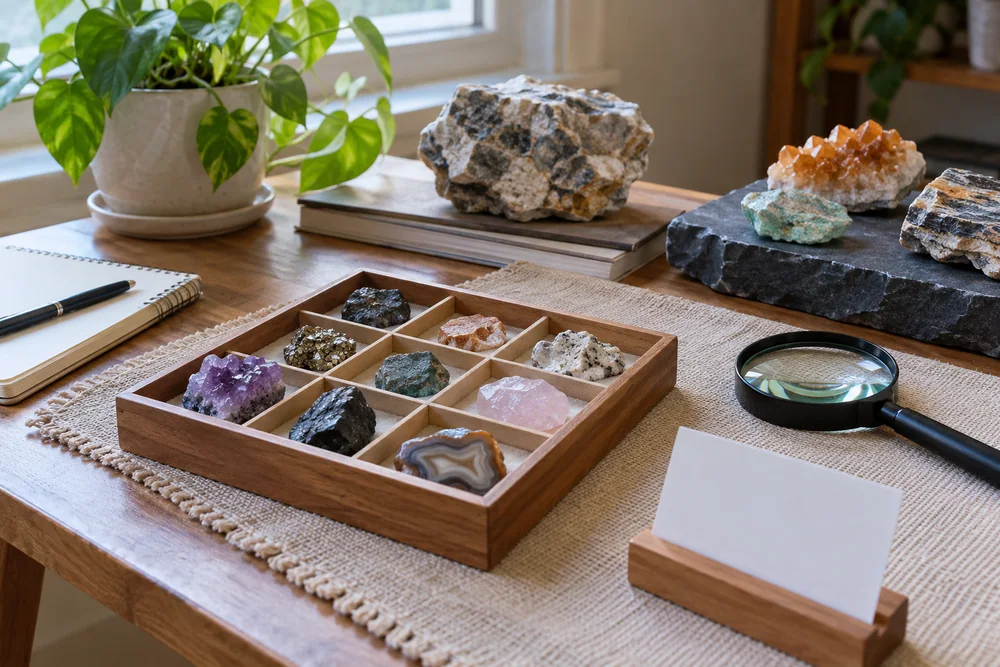
Green stones vary enormously. Serpentine, prehnite, chrysoprase, dyed quartzite, aventurine, nephrite, jadeite and green glass can overlap in appearance. Terms such as “new jade,” “green jade,” “Indian jade” or “lucky jade” may be used commercially for materials other than the principal jade gems. Buyers should ask what a trade name means in mineralogical terms.
GIA's research on green jade simulants contrasts their physical and optical properties, including the way mica inclusions can produce aventurescence in aventurine. Its documented misidentification cases show that visual appearance alone can mislead even experienced market participants. Colour, translucency and weight can be helpful observations but are insufficient as sole identification criteria.
A genuine material may still be dyed. A translucent light green aventurine could have been impregnated, or a green jadeite piece may have received dye or polymer treatment. These cases should not be conflated with outright substitution: natural mineral identity, colour treatment, assembly method and provenance are independent things to verify.
Ask for real-stock photographs against a neutral background, several viewing angles and a material description. A report from a competent gem-testing facility can establish the claims it actually covers, but do not treat a generic certificate image as proof of the material in another hanging.
8. Light effects: polish, translucence and sparkle
Some jadeite and nephrite pieces show attractive translucence or a glow when viewed near a suitable light source. Their appearance can range from subdued to vivid depending on the stone's internal structure, thickness, texture and lighting. Green aventurine often shows a more granular or gently sparkling appearance, particularly where reflective inclusions are visible.
In a hanging, the position of the stone and direction of illumination matter. A polished flat pendant may display more of its surface than a small round bead. Thick green stones can appear darker when backlit, and a strand of different bead sizes may show more variation than a single carved piece. Show customers a realistic representation of the item in ordinary interior light, not only an intense studio image.
Neither jade nor aventurine automatically projects rainbow patches like a properly designed optical prism. If a product combines green beads and a glass suncatcher, identify which component is producing the colourful light effects. The stone's symbolism and its observable physical behaviour should not be merged into a claim of special energy output.
9. Hanging construction: beads, wire wraps and carved pendants
The physical construction deserves attention because green jade and green aventurine are often displayed as compact polished beads, larger carved motifs or single pendants. A strand of heavy rounded beads may put load on one narrow upper cord. A carved pendant can contain delicate edges or a shallow drill hole. A wire-wrapped rough stone may have an ornamental spiral that does not actually retain the stone if the loop is pulled.
| Construction | Visual purpose | Safety and identification check |
|---|---|---|
| Drilled green bead strand | Repeated shape, colour and possible gradual tonal variation | Identify each stone, examine holes, strand terminations and combined weight |
| Single polished pendant | One larger jade or aventurine focal piece | Check carved attachment, bail, loop, cracks and real dimensions |
| Wire-wrapped stone | Shows natural or polished material within a decorative frame | Ensure the cage actually retains the piece and wire ends are secure |
| Carved green leaf or motif | Decorative symbolism and craftsmanship | Protect thin projections; confirm it is a carving, not a natural crystal form |
| Mixed jade-and-aventurine strand | Combines green shades and textures | List accurate counts and species separately; do not label every bead jade |
| Stone with bells or glass pieces | Adds sound or light to a mineral ornament | Identify which component rings or refracts; check collisions and load |
A gemstone-only hanging is primarily visual unless it contains an actual chime or bell mechanism. The number of beads should not be used to claim a musical scale or to infer a traditional prescription that is not substantiated. Ask for supporting information when a hanging is described as handmade.
10. Inspect loops, wire ends and drilled holes
Follow the load path from the top hook through the loop, cord, wire, crimps and any drilled stones. A polished heavy jade carving may be secure in a properly fitted setting but unsafe in a loose decorative cage. A strand of aventurine beads may look strong while one frayed line is near failure at a sharp bore.
Inspect the hidden back of a wire-wrapped pendant, not only its attractive front. Look for open rings, sharp cut wire, cracked bead holes, partly slipped knots and a bottom opening wide enough for a smooth stone to escape. A stone with a damaged drill hole should not continue hanging above people simply because its polished surface is still attractive.
For a doorway, measure full drop and check the door's complete swing. For a balcony, consider wind-driven movement and whether the selected hook or anchor is suitable for the actual structural surface. An adhesive hook rated for a small stationary object is not automatically approved for heavy or freely moving gemstones outdoors.
Protect children from loose beads and long cords, and avoid heavy or fragile hangings above cots, occupied seating and busy passageways. Stop using damaged connections rather than relying on untested glue or a decorative knot to carry the original load.
11. Choosing where the green stone will be seen
Both materials can work as quiet entrance or window accents if properly supported. A green jade ornament may suit a restrained interior scheme where polished texture and translucence matter. Green aventurine may suit someone who enjoys subtle mica sparkle and an earthy green tone. Neither is inherently superior for every house; actual appearance, craftsmanship, weight and household preference are stronger selection criteria.
Light affects the result. A uniformly deep green pendant may appear almost black against a dark background, while pale jade or aventurine beads can look more luminous near indirect daylight. In a naturally lit room, observe the chosen hanging at several times of day rather than assuming one studio image predicts the result.
Keep the piece clear of windows, metal railings and other gemstones so it cannot strike them during a gust. In an apartment, a silent stone hanging may be preferable to one fitted with a metal bell where neighbours require quiet. For further designs, explore the Crystal & Gemstone Hangings collection.
12. Cleaning jade, aventurine and the completed hanging
GIA advises gentle care for jadeite and nephrite and points out that treatment history matters. Warm soapy water can be appropriate for many jade gems, but a completed hanging may include soft cord, unknown dyes, metal coatings, glue, wood and other stones. Do not automatically immerse the entire object merely because one part is durable jade.
For a hanging of uncertain identity or treatment, start with a soft dry cloth or gentle brush while supporting the ornament on a padded surface. If the manufacturer confirms material and finish, use its specific approved cleaning method. Avoid aggressive acids, bleach, abrasive pastes, steam or ultrasonic methods without professional assessment. Polymer-treated or dyed jadeite may have care limitations that differ from untreated material.
Green aventurine is quartz-rich, but mica inclusions, colour treatment, surface coating and drilled connections can alter care needs. A matte finish or small glittering inclusions do not justify scrubbing with a metal brush. If a product contains “aventurine glass,” follow glass-appropriate care rather than pretending the material is natural stone.
Dry any permitted damp-cleaned piece thoroughly, particularly around drilled holes, hidden knots and rings. A natural material name is not evidence that the full hanging can withstand monsoon rain, prolonged direct sun, coastal salt or harsh cleaning chemicals.
13. Storage, transport and repair
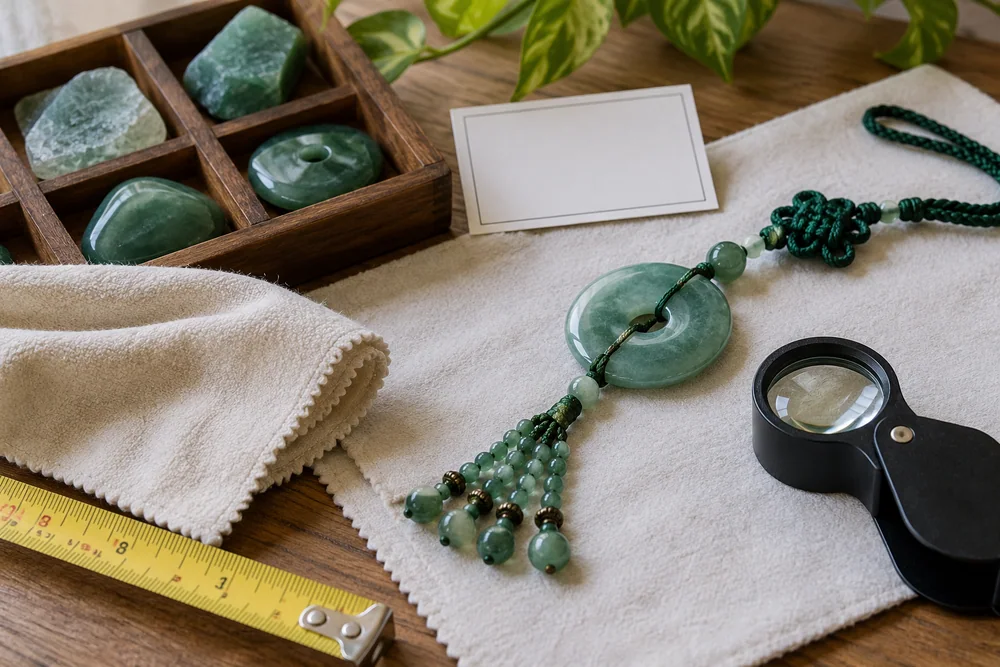
Before packing, check for loosened stones, cracked or strained connections, surface damage, dulling coatings, failed crimps and frayed cord. Keep people clear of the fall zone, use stable access and support the main hanging during removal; seek qualified help for high or heavy installations. Do not pull a large carved jade pendant by a small attached bead. Keep hard metal components from rubbing the polished face, and prevent a heavy stone from resting on more delicate ornaments.
Wrap individual pieces with soft clean separators. Avoid tightly knotting a beaded strand, twisting a wire cage or compressing a carved leaf tip. Store in a dry place away from leaking walls, sudden temperature changes and unwanted pressure. If the assembly has been damp-cleaned, ensure the permitted parts are fully dry before enclosing them.
Before reinstalling, inspect the wall or ceiling support as well as the hanging. If the upper loop is bending, a drilled hole is fractured or a wire cage is slipping, have it repaired by a suitable craftsperson or replace the damaged assembly. Do not treat polish, wax or a decorative adhesive as structural repair.
14. Jade heritage, Indian ratna and Vastu associations
Jade has a particularly rich history in East Asian and other cultural traditions, including carving, personal adornment and artistic objects. Indian jewellery and ornamental traditions also embrace diverse ratna materials, but a modern hanging labelled green jade is not automatically part of the classical navaratna sequence or a prescribed planetary gemstone.
Contemporary crystal literature commonly associates green aventurine with themes of opportunity, harmony or prosperity and jade with protection or wellbeing. Those interpretations may be meaningful to individual households, but they are not proof of physical effects or a uniform prescription across Vedic astrology, Hindu Tantra and Chinese Feng Shui. The provenance of the interpretation should be named when appropriate.
Traditional Vastu Shastra addresses orientation, entrances, spatial proportions, circulation, light and wider ideas such as the Vastu Purusha Mandala and Pancha Mahabhuta. Modern crystal-placement suggestions are not equivalent to a universal classical Vastu command to hang jade or aventurine in a specified direction. The green associations of contemporary chakra systems or the wood phase of Chinese Feng Shui should be distinguished from classical Sanskrit sources.
A family may choose a quiet green hanging for aesthetics, personal symbolism or devotional ambience while still checking genuine materials, secure installation and household comfort. For wider background read Vastu Shastra and the Vastu collection.
15. Buying checklist for jade and aventurine hangings
- Verify the material: Jadeite, nephrite, appropriately identified other jade material, aventurine quartz, glass or a different green imitation?
- Ask about treatments: Dye, polymer impregnation, bleaching, waxing, resin, coatings or other enhancement should be disclosed where relevant.
- Understand jade A/B/C terms: Apply them in their documented jadeite treatment context, not to natural green aventurine.
- Check natural sparkle: Real aventurine may have fuchsite inclusions, but appearance alone is not a certificate.
- Request actual photographs: Show ordinary light, different angles, bead sizes and the back of the setting.
- Identify the form: Confirm polished beads, carved pendant, wired stone, mixed strand or another design, with true component counts.
- Inspect the entire load path: Ring, bail, cage, drilling, crimp, knots, cord, frame and top support.
- Measure the complete piece: Total drop, width and combined weight—not only the largest bead.
- Confirm care and exposure: Indoor or sheltered outdoor use, treatment-sensitive cleaning and safe removal before severe weather.
- Verify commercial claims: Laboratory report, mine or country origin, handmade source, price, stock and inclusion of mounting hardware.
Frequently asked questions
Is green aventurine a type of jade?
No. Green aventurine is a quartz-rich material, often with fuchsite mica inclusions. It differs from jadeite and nephrite, the two principal traditional jade materials.
Are jadeite and nephrite the same mineral?
No. Jadeite belongs to the pyroxene group, while nephrite is a fibrous amphibole aggregate. Both have a long history under the name jade.
Can a green stone be identified as jade from one photograph?
No. Aventurine, serpentine, dyed quartzite, glass and several other materials can resemble jade. Suitable identification evidence is needed where the exact species matters.
What gives some green aventurine its subtle sparkle?
Reflective inclusions, commonly green fuchsite mica, can produce the appearance called aventurescence. The effect varies from one specimen to another.
Does an A-grade jade label guarantee top quality?
No. In the relevant jadeite treatment classification, Type A primarily concerns treatment status, not a universal grade of the finest colour, origin or carving.
Can green aventurine be mistaken for jadeite?
Yes. GIA has documented cases of aventurine quartz mistaken for jadeite, including material treated with polymer impregnation.
Is all aventurine sold in craft shops natural stone?
No. Manufactured aventurine glass or goldstone can be marketed with a similar name. Ask whether the piece is quartz-rich stone or glass.
Can every jade or aventurine hanging be soaked in saltwater?
No. Stone treatments, coatings, metal parts, cords, adhesives and other components may be affected. Use verified care guidance for the whole assembly.
Does Vastu require every home to hang green jade or aventurine in the east?
No universal classical prescription requires these modern decorative stones in that direction. Specific modern spiritual or Feng Shui recommendations should be identified by their tradition.
Explore related OmmRudraksha gemstone hangings
Explore the Crystal & Gemstone Hangings category and parent Hangings & Chimes for different stone, bead and suspended forms. For traditional Indian home-planning context see Vastu Shastra. Confirm the actual stone identity, treatment status, price and availability before ordering.


