

A doorway toran may be made of living foliage that was cut this morning, dried leaves prepared weeks earlier, or a reusable arrangement of cloth, beads and imitation flowers. From a small product photograph these can look almost identical. In daily use, however, they behave differently: one wilts, one may shed brittle fragments, and another can fade or lose its stitching. This guide compares fresh, dried and artificial door torans through the questions that matter most—traditional purpose, accurately identified materials, safe hanging, reasonable care, storage, shipping and honest product descriptions—so that an auspicious welcome remains practical as well as beautiful.
1. What does “fresh”, “dried” or “artificial” actually describe?
The first distinction is the physical state and composition of the decoration. A fresh toran contains recently harvested plant matter, such as leaves or flowers, that still carries moisture. A dried botanical toran uses real plant matter after drying, whether naturally or through a disclosed preservation process. An artificial or reusable toran reproduces botanical forms using fabric, paper, polymer, metal, beads or other non-living materials. Some products blend several types: a cotton-backed hanging may include dried seed pods, artificial foliage and metal bells. In that case a single label cannot describe every component.
Terms such as “natural-looking”, “premium”, “heritage”, “everlasting” and “handmade” describe appearance or a sales proposition rather than proving composition. “Artificial silk” is not natural silk. A flower made from coloured foam is not a dried flower. “Dried neem” should identify actual neem leaves if that is what the seller promises; an illustration or a fragrance added to cloth does not establish plant identity. For OmmRudraksha, the most useful product description states plainly what the customer receives.
The familiar words toran, bandhanwar and thoranam refer to overlapping doorway-decoration traditions across India. A toran can be textile, beaded or botanical. These words do not, by themselves, specify whether an item is perishable, suitable for a ritual or safe outdoors.
2. The traditional meaning of a decorated threshold
At entrances used for weddings, festivals, griha pravesha and household puja, a hanging may express mangala—an auspicious welcome—and offer a visible sign that a home is prepared for visitors or a ceremony. A fresh mavilai thoranam (mango-leaf hanging) belongs to particular regional practices, while embroidered or beaded torans have their own living textile traditions. Museum collections document elaborate Gujarati doorway textiles as objects of welcome; they are not merely substitutes for fresh foliage.
Whether a fabric representation can replace specified fresh leaves in a particular rite depends on the instructions of that household, community or officiant. There is no useful universal rule that all festivals require fresh material, that every entrance must have a specific number of leaves, or that one decorative product can repair an architectural defect. In contemporary Vastu discussions, a cared-for threshold may be interpreted through cleanliness, movement, light, welcome and the broader setting of the home. These symbolic interpretations should not be sold as guaranteed financial, medical or planetary outcomes.
The practical decision is therefore twofold: what does this occasion require? and which material can the household realistically receive, display and maintain? Neither question can be answered by colour alone.
3. Comparison table: choose by material and use
| Question | Fresh leaf or flower toran | Dried botanical toran | Artificial or reusable toran |
|---|---|---|---|
| What is supplied? | Recently cut real foliage or flowers | Real plant parts after removal of moisture; possibly treated | Fabric, paper, polymer, metal or mixed decorative components |
| Best suited to | Time-specific ceremonial use when a fresh supply is confirmed | Dry indoor display when the exact material and handling are verified | Repeated celebrations and general décor when storage and cleaning are manageable |
| Typical change | Wilting, browning, scent change, shedding | Brittleness, breakage, dust, fading or moisture damage | Fading, dust, creasing, loose embellishments or corrosion |
| Shipping question | Harvest/assembly timing, transit temperature and arrival condition | Crush protection, moisture barriers and verified packing method | Crease, abrasion and breakage protection appropriate to each component |
| Storage approach | Follow the actual supplier's short-term instructions; use promptly | Completely dry, supported and protected from damp and insects | Clean and dry, then gently fold or support the particular construction |
| What not to assume | Guaranteed freshness for a fixed number of days | Indefinite durability or mould immunity | Weatherproof, washable, natural or fire-resistant |
These are decision categories, not warranties. A well-made fabric hanging can be fragile if it has mirrorwork or tiny ornaments; a dried leaf arrangement can be robust only if its specific material and packing are known. Read the actual listing and confirm the use case before assigning a “best” category.
4. Fresh torans: the appeal and the time constraint
Fresh mango leaves, seasonal foliage or flower strings bring living colour, texture and often a distinct smell to a ceremonial entrance. Their appeal is inseparable from their perishability. After cutting, plant tissue continues to lose moisture and can curl, droop, darken or shed. The rate varies with plant species, maturity, handling, temperature, air movement and delivery conditions. There is no defensible universal promise that every fresh leaf toran will remain green for a specified number of days.
For a fresh purchase, ask the maker when leaves are harvested, whether the toran is assembled shortly before dispatch, the delivery radius, the expected arrival condition and how it is packaged. Confirm whether a recipient can receive it immediately. An ordinary parcel network for dry decorative goods is not automatically appropriate for tender foliage in hot or humid conditions. A shop that has not established a fresh-item supply and fulfillment process should not present a research concept as ready for national delivery.
Before installation, keep fresh material away from direct heat and crushing, and follow the seller's plant-specific handling advice. A shallow, supported arrangement may be preferable to compressing tender foliage. Avoid sealing damp plants in a warm, airtight bag where condensation can accelerate deterioration. Some cut flowers benefit from stem hydration and cool handling, but a tied, leaf-only doorway string may not be designed to stand in water. Do not improvise chemical treatments or spray water across dyes, electrical lights and glued ornaments.
5. Freshness is not the same as ritual suitability
If an observance specifically calls for mango leaves or another named plant, the correct botanical material and the household's method matter more than a marketing photograph. The choice of leaves and their number may differ by community. A fresh arrangement made from the wrong plant does not become a traditional mango-leaf thoranam merely because it is green. Conversely, a textile toran can still be appropriate for ordinary decoration even if fresh material is reserved for a particular ritual.
Ask the person guiding the ceremony whether freshness, species, size, method of tying or timing are essential. When substituting for convenience, say clearly that a replacement is artificial or decorative. Never attribute “ritually energized”, “blessed”, “temple-made” or similar provenance to an item without a reliable, item-specific record.
6. Dried botanical torans: real plants, different strengths and weaknesses
A dried toran is assembled from genuine botanical matter whose moisture has been reduced. It may feature grasses, preserved foliage, flowers, seed pods or other plant parts. Drying can retain some shape and colour, but often changes texture and flexibility. Thin leaves may crack around holes; brittle flower heads may shed; stalks can break at tie points. A dried product therefore needs an identified material and an assembly design that supports its weakest parts.
Horticultural extension guidance describes methods such as air drying and the use of desiccants for suitable flowers. No single technique works equally well for every leaf or blossom. Proper ventilation during air drying helps reduce mould risk, while flower type and preparation affect the result. Some preserved products use dyes, glycerin or other treatment; they should be described as treated or preserved rather than presented as untreated dried foliage.
Drying does not make plant material immune to humidity, insects, dust or sunlight. Storage in damp conditions can lead to deterioration, while repeated bending can damage fragile material. Never promise “permanent botanical”, “lifetime fresh” or “pest-proof” without a credible, limited specification. The safe approach is to inspect condition on receipt and before each display.
7. Dried is not automatically easier to ship
Moisture removal makes some products less perishable than fresh leaves, but increases the importance of crush protection. Delicate seed heads and thin leaves may require rigid outer packing, internal supports and separation from hard bells or beads. A flat mailer that works for cloth may destroy a brittle design. The seller should assess actual damage in trial shipments, not infer reliability from the word “dry”.
Before approving a dried botanical SKU, document its plant identity, preparation method, colour or chemical treatment, allergy or handling considerations where applicable, fragility, dimensions, mounting strength, packaging and tested shipping radius. Until such facts exist, the product remains a candidate concept rather than a sale-ready item. A verified wood, fibre or textile hanging is an alternative only when its own materials and construction have likewise been checked.
8. Artificial torans: reusable does not mean indestructible
Artificial torans range from stitched cotton and felt leaves to crocheted flowers, printed ribbons, paper shapes, metalwork, glass beads and polymer foliage. Their design can closely evoke a fresh toran without containing living leaves. That is perfectly acceptable when described truthfully. A buyer looking for a reusable doorway decoration may value colour consistency and repeated installation more than botanical authenticity.
Every material still has limitations. Cotton and silk fabrics can fade, bleed colour or collect dust; embroidery and mirrorwork can catch on rough surfaces; paper may curl in humidity; some polymers become brittle or discoloured in sunlight; metal bells may tarnish or corrode depending on their actual alloy and finish; glued stones may detach. “Handcrafted” should refer to actual production steps, not the use of a traditional motif. A synthetic satin should not be called pure silk, and a base-metal ornament should not be described as copper or brass without confirmation.
A modern reusable toran can celebrate regional visual traditions—mango-leaf silhouettes, lotus forms, beadwork or shubha-labha motifs—without falsely claiming antique origin, ritual provenance or a specific artisan community. Treat the materials as decorative objects with their own care requirements.
9. Textile versus plastic versus paper versus mixed construction
| Reusable construction | Common advantages | What to inspect | Care limitations |
|---|---|---|---|
| Stitched cotton, felt or textile applique | Soft, flexible, often easy to pack | Fibre claim, stitching, dye transfer, loops, fringe and lining | Do not assume machine-washable; protect from moisture and strong sunlight |
| Embroidery, mirrorwork and beadwork | Detailed craft appearance and visual texture | Backing, thread strength, mirror edges, bead security and workmanship | Snagging and breakage; do not immerse without a specific safe-care method |
| Polymer or foam foliage | Repeatable shapes and colour, lightweight options | Actual polymer, wire cores, odour, attachment and heat sensitivity | May fade or deform; not automatically recyclable or weatherproof |
| Paper or card shapes | Lightweight and often inexpensive | Coating, adhesives, thickness and hanging strength | Water damage, tearing and ignition risk around lamps |
| Mixed cloth, bells, wood or metal | Multiple textures and possible sound | Every substantial component, total load and separate fixing points | Care must follow the most delicate component; keep cords and bells secure |
Do not claim every “eco-friendly” or “biodegradable” item will safely decompose. A composite of natural cotton, synthetic thread, plastic sequins and hot-melt adhesive may be difficult to separate. Environmental descriptions should identify actual components and any documented recycling or composting route rather than relying on a green colour or a leaf motif.
10. Where will the toran hang?
A sheltered indoor doorway is different from a sunlit balcony, a kitchen entrance or an exterior gate exposed to monsoon rain. Fresh foliage may deteriorate quickly in a hot, exposed location. Dried leaves may be weakened by repeated wetting. Textile dyes and synthetic surfaces may fade under prolonged ultraviolet exposure. Metal elements can corrode where moisture and salt-laden air are present. A product should only be described as outdoor-suitable if its actual construction and finish support that claim.
Measure the lintel width, the available fixing points and the free height below them. Include the depth of hanging tassels, not only the width of the top band. Check that the toran does not swing into a person's face, catch in the door closer, snag on a handle or interfere with locks, signage and any accessible route. If the entrance is a shared or fire-rated door, follow applicable building rules rather than treating decoration as permission to alter hardware.
For an entrance used constantly by children, pets or older visitors, shorter, lighter and more firmly secured designs may be preferable. Loose small ornaments and long cords deserve particular attention. An attractive entrance should remain safely passable.
11. Installation: securing the decoration without damaging the doorway
The mounting method must be appropriate for the load and substrate. A light temporary leaf string can sometimes be tied to a suitable existing hook; a heavier beaded textile needs dependable attachment points. An adhesive strip may fail on dusty plaster, rough stone, damp tile or high heat even when it holds on a clean test surface. Avoid drilling into an unknown electrical route, protected building fabric, rated door assembly or concealed service. Do not attach any hanging to a sprinkler head, smoke detector, emergency sign or exposed wiring.
- Measure the usable span and decide whether the hanging should sit above or within the opening.
- Check the total weight, loop strength and the construction of both ends.
- Select fixing hardware compatible with the doorframe or wall, including its finish and any building restrictions.
- Mount level and test gently without pulling on delicate leaves or ornamental threads.
- Open and close the door fully; check the swing path, access to locks and head clearance.
- Inspect once more after wind, rain, cleaning or a crowded celebration.
Never suspend a toran near a burning diya, incense flame, candle, heater or hot lamp. Fresh and dried plant matter, fabric, paper and many polymers can burn or deteriorate from heat. Fire-safety bodies recommend keeping decorations away from ignition sources. This is especially important during festivals, when an entrance may contain lamps and garlands together.
12. The original visual comparison
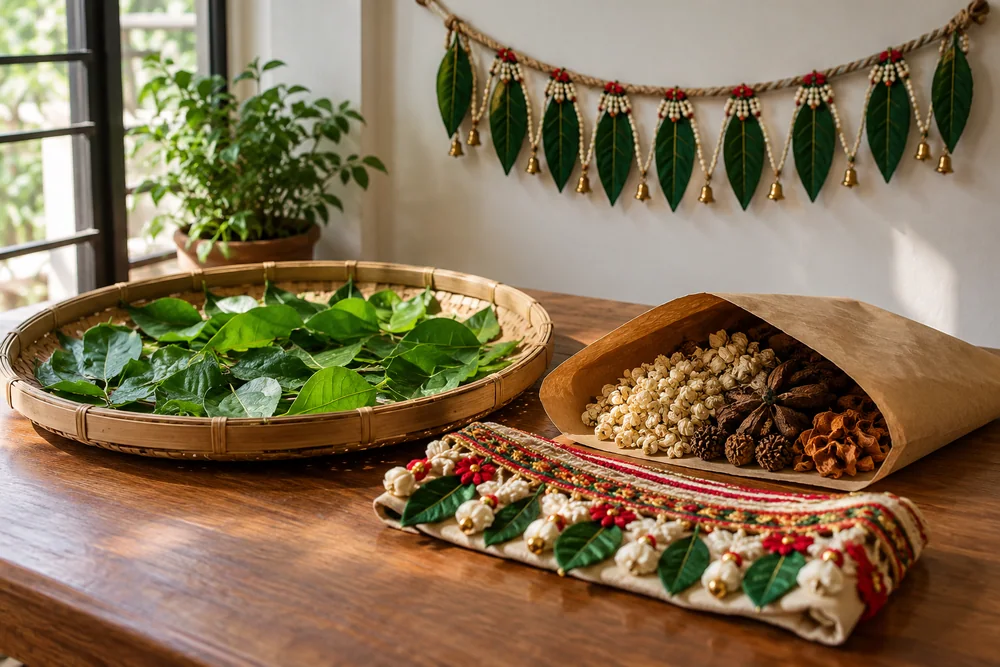
The illustration below contrasts suggested handling for a fresh arrangement, a supported dry specimen and a folded textile example. It is an educational drawing of representative construction, not a photograph of actual inventory, and does not prove the size, components or packaging supplied with any particular SKU.
13. Receiving and inspecting a toran
Take a quick condition check before cutting away supports or discarding the packaging. For fresh foliage, inspect colour, visible wilting, unpleasant odour, damage and excessive trapped moisture. Mild variations in leaf shape are natural, but wet decay, conspicuous fungal growth or a broken suspension need attention. Compare the delivery with the seller's specific arrival promise rather than assuming that every leaf must look identical.
For dried botanicals, look for broken stems, crushed petals, excessive loose fragments, damp patches, unusual odour and signs of insect activity. For artificial pieces, check stitching, glue lines, sharp edges, detached beads, bent wires, colour transfer and hanging loops. Photograph a significant defect before making adjustments. A torn loop or loose heavy bell can make an otherwise attractive item unsuitable to hang over a busy entrance.
Do not use an item that shows mould or unstable construction. Avoid using household disinfectant, fragrance spray, pesticide, oil or a moisture-based cleaner simply to make an uncertain material look fresh. Where an item is sold with a care card, the card should identify the actual material and the permitted cleaning method.
14. Cleaning and refreshing a fresh display
Fresh torans are usually intended for an occasion rather than indefinite storage. Keep the display area clean and check it periodically as the material ages. Remove detached leaves and dropped flower petals before they create a slipping hazard. If the arrangement has become badly wilted, discoloured, slimy or mouldy, arrange safe removal and replacement rather than masking the problem with perfume or water. Support the full hanging and use safe access.
Some plant types respond differently to cool holding or water, so the correct handling depends on a verified supplier instruction. A fresh leaf hanging may not be able to take up water in the way a cut flower in a vase does. Do not publish a universal instruction to soak, refrigerate, freeze or coat every traditional leaf toran. For a scheduled ceremony, arrange procurement so the material is available close to the time of use and have a sensible backup plan.
15. Caring for dried botanicals
Prevent rough handling first. Support the whole arrangement when moving it; lift it by its designed hanger rather than a fragile flower head. Keep it away from moisture, prolonged strong light and direct air jets. Dust gently only if the material is stable enough; aggressive brushing or shaking can accelerate shedding. Dried botanical objects can also be attractive to insects, so inspect before bringing a long-stored piece back into a clean home.
Storage begins only once the material is fully dry. Use a clean, supportive container that prevents crushing. Depending on the construction, a rigid box with appropriate cushioning may be better than a tight bag. In a humid climate, sealing incompletely dried leaves may trap moisture; a moisture-control packet cannot rescue an already mouldy arrangement. Museum preservation advice for dried natural specimens emphasizes fragile handling, moisture management, monitoring and protection from pests and light.
If you observe new mould, widespread infestation or structural collapse, retire the decoration rather than continuing to expose it indoors. Never heat a decorated toran in a kitchen oven or microwave in an attempt to rescue it; coatings, wiring and adhesives may be present even when the visible surface is botanical.
16. Cleaning and storing reusable cloth, beads and imitation leaves
For a fabric hanging, begin with the maker's care instructions. Some sturdy textiles may tolerate careful cleaning, but mirrors, glued stones, dense embroidery, metallic threads and uncertain dyes can make immersion unsafe. If no washing instructions are verified, prefer a gentle surface dusting on a supported piece, and test any proposed cleaner on an inconspicuous area. Do not machine-wash merely because the backing feels like cotton.
Keep a textile thoroughly dry before packing. Fold along natural seams or support larger decorative sections so beadwork is not crushed. Flat storage may suit many cloth torans; an awkward fold through a metal motif may cause permanent damage. Place an interleaf between delicate or abrasive surfaces if needed, and protect the package from dust and sunlight. Canadian conservation guidance notes that light, humidity, handling and storage conditions affect fabric durability and colour.
For imitation leaves, inspect any wire stems and polymer joints before reuse; gentle wiping may be appropriate for some plastics, but strong solvents can attack coatings. For metal bells or chains, use care compatible with the known alloy and finish. Do not treat a mixed-material toran with one universal chemical or “waterproof” method. The most delicate component determines the safest overall care.
17. Packaging and delivery: what customers should be told
Product pages should separate preparation, shipping and arrival expectations. For fresh torans, specify a supported delivery region and order cut-off only after the seller has actually tested the process. Note how the toran will be held, packed and inspected, and define what delivery condition is considered acceptable. A special occasion may make a delayed fresh package unusable; broad, unverified promises are especially harmful here.
For dried pieces, photographs should show the construction and identify fragile sections. Pack to avoid crushing, abrasion and moisture exposure, with a support appropriate to the design. For reusable pieces, include information on folding, creases, colour transfer, and any separate detachable ornaments. If packaging includes wire or sharp pins, the receiving instructions should explain how to remove them safely.
A product image cannot establish an item's exact width, weight, constituent fibres, origin, artisan, outdoor resistance or dispatch readiness. Those are inventory facts to be checked against a real SKU. The article itself is general buying guidance, not a representation that OmmRudraksha currently stocks or nationally ships fresh or dried botanical torans.
18. How to choose for a wedding, house entry or repeat festival
For a ceremony requiring specific leaves: confirm the household tradition first, then choose a verified fresh supplier who can meet the event window. If the plant species or freshness is a ritual condition, do not assume cloth or dried foliage is a substitute. Keep the installation simple and allow for timely removal.
For a welcoming décor piece at a new home: a well-made textile or beadwork toran may offer repeated use while retaining its own cultural and artisanal identity. Select a size that fits the doorway and a motif suited to the household rather than claiming a universal directional correction.
For an apartment entrance: consider low weight, quiet construction, secure mounting and shared-space rules. Avoid deep tassels that block the frame or hit passers-by. If the location is sunny or occasionally wet, choose a construction with verified suitability; do not assume any artificial item is outdoor-rated.
For a return gift: reusable pieces may be easier to present and store than fresh leaves, but the recipients' cultural practices and preferences matter. A small handmade hanging is not automatically a one-size-fits-all ritual item.
19. A 12-point buying and inspection checklist
- Name the format: fresh, dried, preserved, artificial or a disclosed combination.
- Identify plant materials: ask for botanical names when specific leaves are claimed.
- Identify non-botanical materials: fabric fibre, plastic, paper, backing, bells and adhesives where material to the sale.
- Confirm ritual requirements: especially when an actual ceremony calls for fresh foliage.
- Measure the doorway: width, depth, clearance and fixing points.
- Review actual photographs: distinguish styled illustrations from real SKU evidence.
- Check assembly: loops, thread, joins, heavy ornaments, small parts and sharp edges.
- Ask about arrival condition: especially for perishables or brittle botanicals.
- Confirm delivery boundaries: area, timing and packaging based on a tested process.
- Read care instructions: avoid unverified washing, spraying, soaking or preservation advice.
- Check the installation location: keep clear of exit paths, doors, flames and heat.
- Plan removal and storage: fresh replacement, dry-specimen support or reusable textile packing.
A product that cannot answer several of these questions may need additional research before purchase. A trustworthy seller can mark uncertain specifications as unverified rather than presenting a generic description as a completed product inspection.
20. Waste, reuse and responsible material language
Fresh plant matter may be appropriate for local plant-waste disposal where not contaminated, subject to municipal rules. A mixed garland with wires, foam, thread or decorative films should be separated where practical. Dried natural elements do not automatically qualify for every composting system; coatings, dyes and adhesives may change disposal requirements. A decorative plastic leaf is not biodegradable simply because it resembles a mango leaf.
Reusable designs can reduce repeat replacement for some households, provided the item is durable, kept in use and stored rather than discarded after one season. That is a practical comparison, not proof of a lower environmental footprint in every case. Manufacturing, materials, transport, cleaning and lifespan all influence impact. A good product page states which components are repairable, detachable or reusable instead of claiming “zero waste” without evidence.
Frequently asked questions
1. Is a fresh mango-leaf toran always required for Griha Pravesha?
No universal rule applies across all households. Mango leaves are important in several regional practices, but the specific ceremony and the person conducting it determine the relevant materials. Confirm before ordering or substituting.
2. Can dried torans be used for more than one festival?
Sometimes, if the actual botanical material, construction, humidity control and storage are suitable. Drying does not guarantee that leaves will survive repeated handling or an extended storage period.
3. Does “artificial silk toran” mean natural silk?
No. “Artificial silk” usually describes a look or a manufactured fibre, not verified natural silk. Ask for an accurate fibre composition rather than relying on the word silk alone.
4. Can I wash a reusable cloth toran in a washing machine?
Only when the maker has verified that the exact construction is machine-washable. Mixed beads, mirrors, metallic threads, glues and dyed fabrics may be damaged by immersion or agitation.
5. Are dried leaves completely mould-proof?
No. Inadequate drying, humidity or damp storage can still cause mould. Remove and retire affected items rather than masking the problem with fragrance.
6. Can a toran hang on a door with a diya or incense nearby?
Maintain substantial separation from flames and other heat sources. Do not position combustible leaves, cloth, paper or polymers where a flame, hot lamp or ember can reach them; never obstruct a fire exit.
7. Are plastic torans suitable for outdoor monsoon use?
Not automatically. Check material, colourfastness, suspension strength, adhesive, metal fittings and real weather exposure testing. Decorative indoor products should not be sold as outdoor-rated without evidence.
8. Which type is easiest to send as a gift?
A carefully packed reusable textile or lightweight artificial design may be practical, but fragile mirrorwork, glass and metal still need protection. Fresh and dried botanical shipping require different controls.
9. Is a dried or artificial toran a guaranteed Vastu remedy?
No material format guarantees a change in fortune or corrects structural problems. Doorway décor may express a household's traditional aesthetic and auspicious welcome. Evaluate its placement, safety and ritual context separately.
10. How do I store a toran until next year?
Fresh foliage is generally not a long-term reusable item. Support completely dry botanicals against crushing, damp and insects. Clean and fully dry reusable textiles before storing them flat or gently supported, as the construction allows.
Related OmmRudraksha reading
Explore the existing Vastu collection for decorative and traditional products, or consult the Vastu Shastra overview for wider principles of home planning and symbolism. Choose the material according to your ceremony, expected display duration, actual construction and care requirements.


