

A doorway hanging should welcome people without making the doorway harder to use. Indian households express that welcome through fresh mango leaves, marigold garlands, embroidered torans, beaded bandhanwars, bells, sacred motifs and contemporary mixed-material designs. These choices have cultural meanings and regional histories, but they also have physical dimensions, suspension points and maintenance needs.
For an OmmRudraksha entrance, the best choice respects the family's observances while preserving the full door swing, usable passage, safe head clearance and an unobstructed escape route. This guide explores living doorway traditions, compares permanent and seasonal designs, explains secure installation in Indian homes and apartments, and identifies the specific risks of long cords, fragile beads, fire, weather and heavy ornaments. It separates symbolic interpretations from measurable product and building-safety facts.
1. What is a doorway hanging?
A doorway hanging is a decoration displayed at, above or beside an entrance. It can be a horizontal garland spanning the top of the opening; a narrow pendant near the frame; a string of metal bells; a textile valance with embroidered flaps; or an arrangement of flowers, leaves, beads, shells or gemstones. The shared location does not mean all such objects have the same construction or cultural use.
Some hangings are temporary and made for an occasion. Others are permanent textile or metal work intended to remain indoors for months or years. A real-leaf toran changes as the leaves dry, whereas an embroidered one needs attention to stitching, tassels and dust. A suspended stone or brass bell may last much longer as a material but place a substantially larger load on its top connection.
A doorway ornament can be beautiful even when it produces no sound. A bell-shaped charm without a functioning clapper is silent décor; a wind chime needs the mechanism and airflow to sound. A hanging that is meant for a wall should not be assumed safe to attach to a freely moving door.
2. Toran, bandhanwar and thoranam: names and contexts
The term toran is widely used for the decorative festoon across a doorway, while bandhanwar is another familiar regional or commercial term. South Indian traditions also use spellings such as thoranam or toranam for leaf and other garlands displayed at entrances. Local language, household custom, plant material and the occasion can shape the actual form.
The Smithsonian's Cooper Hewitt design museum describes the toran as a doorway frieze linked to the wider architectural idea of a gateway. It records its use among Gujarati communities as a sign of welcoming, with elaborate embroidery, mirrors and pendant forms. D'source design education describes Indian decorative torans made from leaves, marigolds, fabrics and stitched motifs for festivals, ceremonies and weddings.
The existence of multiple terms should not be flattened into a claim that every Indian community uses an identical seven-leaf pattern, one compulsory length or the same religious prescription. A family's preferred style is worth asking about—particularly when buying a gift for a wedding, housewarming or festival.
A product listing can name the form in simple language—embroidered Gujarati toran, mango-leaf thoranam, beaded bandhanwar or metal bell doorway hanging—and then describe the actual material and dimensions.
3. Mango leaves and marigolds in seasonal entrance decoration
Fresh mango leaves and marigold flowers are familiar materials in many Indian doorway customs, particularly around auspicious household occasions. Leaves may be tied across a thread or arranged in a repeated pattern, and flowers can be interspersed for their bright colour and festive appearance. The exact use varies by region, religious practice and season.
Fresh natural material brings living texture and fragrance to a doorway, but it is perishable. Leaves wilt and may turn brittle; flowers can shed petals, dry out or develop mould when kept damp and tightly packed. Their continued display should depend on their condition and the observance, not on a claim that old foliage remains fresh or hygienically beneficial indefinitely.
Use sound, appropriately sourced plant material and replace damaged pieces promptly. Avoid stringing or handling botanical material near electric wiring, candle flames or exposed heating elements. If someone in the household has an allergy or sensitivity to particular flowers or pollen, select a different decoration instead of insisting every entrance must use the same plant.
Traditional symbolism of welcome, auspiciousness and hospitality can be described respectfully. It should not be converted into a guarantee that a leaf garland sterilises a doorway, eliminates insects or provides a measurable medical effect.
4. Gujarati textile torans: embroidery, mirrors and regional craft
In Gujarat, especially Kutch and Saurashtra, textile torans represent a substantial decorative craft tradition. They can use embroidered cotton or other cloth, geometric patterns, stitched pennants, mirrors, coloured thread and beadwork. The Cooper Hewitt Smithsonian museum describes a historic toran with a cotton foundation, silk embroidery, mirrorwork and stylised mango-leaf pennants; the object illustrates how a doorway decoration can also be a record of family and community craft.
National and international museum collections likewise preserve torans from Gujarat. The Smithsonian National Museum of Asian Art has catalogued a Gujarat door hanging, and the Nelson-Atkins Museum of Art describes a beaded toran designed to frame the top of a doorway as a welcome. Such evidence supports calling textile torans an established cultural object rather than merely a modern marketing label.
Different embroidered styles should not be attributed to one community indiscriminately. Material, pattern, provenance and period may vary across artisans and regions, and an individual piece should be given a specific village, community or maker attribution only when supporting evidence exists. A machine-made decorative imitation may still be attractive, but it should not automatically be sold as a hand-embroidered Kutch antique.
For a purchaser, verify stitching quality, any exposed mirror edges, firmly attached beads, loops and tassels. The same craft detail that creates a beautiful surface may be fragile when repeatedly brushed by a tall visitor or struck by an opening door.
5. Contemporary options: beads, bells, Rudraksha and motifs
Reusable doorway hangings now include combinations of traditional and newer materials. Fabric may carry small metal bells, artificial leaves or wooden forms. A bead strand might include glass, shell, gemstones or Rudraksha. Some designs use Om, kalasha, lotus, elephant or other sacred and auspicious symbols. The meaning of such motifs can depend on the household's tradition and the maker's intention.
Rudraksha is the hard organic endocarp of an Elaeocarpus fruit, not a mineral gemstone. A higher-Mukhi or named Rudraksha claim requires appropriate evidence for the actual bead. Quartz, dyed agate, glass or resin spacers should be named separately and not collectively called “certified natural sacred stones.”
Metal bells can be brass, bronze, coated iron, plated steel or another material. Sound depends on a real bell and clapper mechanism. A copper-coloured finish does not establish a solid copper body, and a group of bells does not automatically produce a verified musical scale or an uninterrupted chime.
These combinations offer many visual choices, but each added heavy or brittle component raises the importance of accurate mass, secure retention and enough clearance from people, doors and windows.
6. Compare the main doorway hanging families
| Design | Typical material | Primary appeal | Important upkeep or safety issue |
|---|---|---|---|
| Fresh leaf toran | Mango leaves or other culturally appropriate foliage on thread | Traditional seasonal welcome | Wilting, leaf shedding, moisture and secure replacement |
| Fresh flower garland | Marigolds or other flowers, natural fibre | Festive colour and temporary ceremonial decoration | Petal fall, plant deterioration and keeping away from flames |
| Embroidered textile toran | Cloth, thread, sewn pennants, sometimes mirrors | Regional craft, durable decorative pattern | Stitch and loop condition, dust, sharp mirror edges |
| Beaded bandhanwar | Glass, wood, stones, shells or plastic beads | Repeating colour and shape | Small detachable parts, knots and dangling cords |
| Rudraksha hanging | Botanical fruit stones, cord and optional symbols | Devotional significance and natural texture | Authenticity, drilling, knots, damp and item-specific care |
| Metal bell hanging | Brass, bronze, coated iron or other metal body | Visible bell form and possible sound | Complete load, clapper, corrosion and noise |
| Glass or gemstone mobile | Faceted glass, agate, quartz or mixed elements | Light, colour and changing reflections | Heavy or sharp parts, impact with doors or windows |
No row automatically qualifies for outdoor use or a particular religious ceremony. Product durability, provenance, ornament size and fire suitability must be checked for the real stock. The category should distinguish decorative design from material identity and the actual intended installation.
7. The cultural idea of a welcome at the threshold
An Indian entrance can mark a meaningful transition between public and private space. Families may combine a toran with a clean doorway, rangoli, lamps, seasonal leaves, ceremonial symbols or other observances. The decoration can express hospitality, celebration or reverence without requiring that every visitor follow the same custom.
The term torana also appears in broader architectural settings and historical religious gateways. A domestic thread garland at a door should not be treated as identical in scale or ritual status to a monumental gateway, though the vocabulary reflects a shared interest in marked entrances. Cooper Hewitt's museum interpretation makes this connection while describing actual fabric examples.
For contemporary use, a toran may be displayed for Diwali, a marriage ceremony, griha pravesha, regional festivals or ordinary home decoration. Ask whether the intended purpose is daily, occasional or part of a specific family practice. An embroidered toran kept year-round can be culturally appropriate, while a fresh plant garland may be replaced after a festival.
Do not prescribe an exact material count or plant species as universally mandatory across Hindu, Jain, Buddhist or other households. A respectful description explains the tradition that is actually relevant to a particular design.
8. Vastu Shastra and doorway positioning
Vastu Shastra concerns the arrangement of built space—its orientation, circulation, entrances, proportion and related Indian architectural principles. Some modern interpretations recommend specific colours, motifs or materials at the entrance. These recommendations vary and should be attributed accurately to the relevant school or practitioner, rather than declared compulsory across every classical treatise.
A toran can be chosen to express welcome and auspiciousness, but its physical positioning should not make a building less usable. A beautiful hanging that blocks a door closer, catches on a handle or obscures a safety sign is not a good installation simply because it has a sacred motif.
Distinguish a doorway toran from an architectural torana, and distinguish Indian Vastu from Chinese Feng Shui crystal or wind-chime sector practices. Modern homes may draw inspiration from several sources, but combining their language without attribution creates a false impression of one ancient universal instruction.
Within OmmRudraksha, a particular traditional or individual recommendation may be explained separately from a product's measured dimensions and installation requirements. No hanging is a guaranteed correction for an unsafe, poorly ventilated or structurally deficient entrance.
9. Position above, beside or on the moving door?
A horizontal textile toran is commonly fixed near the upper doorway or lintel. A single vertical strand may sit beside the opening. Another product might be designed to hang on the moving door itself. These positions are not interchangeable: the moving door generates different snag, impact and hardware risks from a stable frame or adjacent wall.
Above the doorway works best when the toran and its low points remain clear of the usable opening. A decoration extending beneath the lintel must be assessed against head clearance and the full path of people entering or leaving. Do not invent a universal “safe drop” in centimetres without knowing the doorway, occupants, local requirements and actual product.
Beside the doorway may suit a narrow bead strand or bell, provided it cannot swing into the latch, a wall corner or people moving through the entrance. Keep it clear of electrical switches, intercoms and controls, and consider how wind from an open door might move it unexpectedly.
On a moving door requires special care. Adhesive pads or loops must suit the door material, and the attachment cannot interfere with hinges, handles, locks, closers, panic hardware, seals or emergency operation. Do not drill into or modify a rated fire door or apartment common-area door without building-authorised and code-compliant guidance.
10. Measure the full door swing, not just the closed frame
Before purchase, measure the width of the intended mounting area and the full length of the proposed hanging, including loops, ties, tassels, beads, bells and any suspended symbol. A photo often shows the decoration at rest with the door shut; in practice, the door may open inward or outward and sweep through the hanging's location.
Open and close the door through its entire permitted motion while checking upper corners, frame, hinge side, handle, latch, closer arm, peephole, doorbell and any security grille. A strand that clears the centre of the frame when the door is shut may still catch on a handle or outer gate as the door opens.
Allow for movement from air, people passing and occasional contact when bags or furniture are carried through. A heavy bell can travel beyond its resting position during a strong gust. The chosen hanging should not reduce the effective passage width, force people to duck unnecessarily, or become a hidden obstacle during evacuation.
If the intended location cannot offer sufficient clearance, choose a shallower textile design or move the ornament to an adjacent stable wall. It is better to change the decoration than to compromise the entrance.
11. Exit routes and emergency access must remain clear
Doorway styling has a clear safety limit: never obstruct or conceal a required exit or the path through it. The Government of Goa Directorate of Fire and Emergency Services emphasises keeping common corridors and staircases free of obstacles. International fire-safety guidance likewise requires unobstructed exit routes and forbids decorations that obscure an exit door's visibility.
For apartment buildings, do not place decorative hanging clusters in common stairwells, rated fire-door openings, refuge routes or locations that interfere with exit signs, smoke detectors, sprinklers, door-closing mechanisms or emergency hardware. Where the door is regulated by building or fire rules, building management and applicable authorities should determine what, if any, decoration is permitted.
These are general safety principles rather than a declaration that a particular overseas fire code applies directly to all Indian private homes. Relevant local building regulations can vary. The practical standard remains: everyone must be able to see and use the escape route freely, including during crowding, smoke or an emergency.
A festival or housewarming is not an exception to basic door access. Decor should not narrow an exit, prevent a door from latching or interfere with an authorised fire door's self-closing operation. Avoid modifying fire-rated components to attach a toran.
12. Match hooks and ties to the actual material and load
A light textile garland and a string of heavy bells need different support. For a soft cloth toran, inspect the stitched end loops, attachment points and fabric condition. For bead and metal hangings, follow the whole load path: frame, hook, ring, cord, crimp, knots, drilled holes and the lowest ornament. A secure wall plug cannot compensate for a weak sewn loop or open jump ring.
The correct fixing depends on whether the substrate is wood, brick, plaster, concrete, a metal frame or another building material. A self-adhesive hook may suit a specific lightweight stationary ornament only if the manufacturer approves that use and surface. Do not assume it can safely carry a swinging stone or a metal bell subjected to repeated impacts and wind.
For rented apartments, avoid damaging a door seal, security system or required escape hardware. Ask an installer or building authority where necessary; do not drill a reinforced or fire-rated door solely to mount a seasonal textile. Check the complete assembly's weight, not just the decorative band along its upper edge.
Inspect the work before use and periodically thereafter. Repeated opening, vibration and wind can loosen a tie even when it initially held firmly. If frayed stitching, a cracked ring, spreading metal connector or damaged anchor threatens the load path, keep people clear and arrange safe removal while supporting the full weight. Seek competent help for high or heavy installations; do not rehang until repaired.
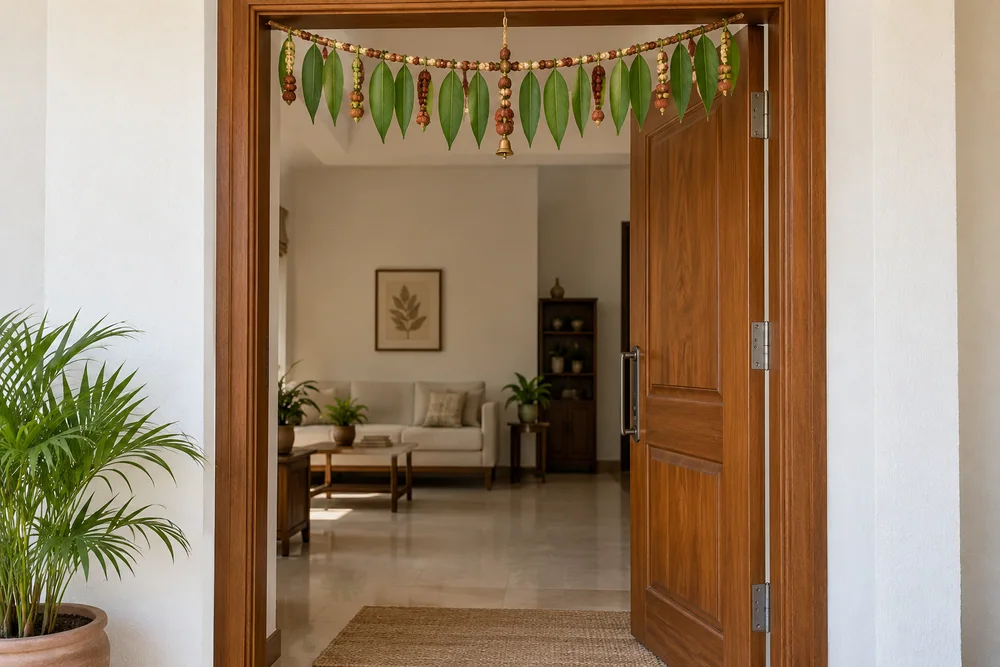
13. A practical doorway safety matrix
| Location or condition | Possible problem | Safer response |
|---|---|---|
| Main apartment entrance | Interference with grille, latch, closer or escape route | Choose a shallow decoration on a permitted stable frame or adjacent wall and test full operation |
| Wide living-room doorway | Low textile pennants or long bead strings brushing visitors | Check clear headroom and walking width; shorten or reposition if necessary |
| Bedroom door | Hanging cords and small beads accessible to children | Keep out of reach; avoid loops, long dangling strands and loose small parts |
| Puja room entrance | Nearby diya, incense, hot lamp or cloth touching flame | Maintain safe separation and do not use fire-sensitive decorations close to flames |
| Exposed balcony or outer gate | Wind, rain, rust, flying parts and falling-object risk | Use only documented suitable products and mount where permitted and safe; prefer protected interior placement |
| Common staircase or fire exit | Exit obstruction, fire-door damage or sign concealment | Keep clear; follow building fire-safety requirements and obtain authorisation before any attachment |
| Seasonal fresh-leaf toran | Wilted material, falling leaves, moisture or mould | Inspect and replace promptly; collect fallen plant matter and maintain a clear threshold |
This table is not a substitute for a licensed installer, fire officer or building-specific assessment. It is a reminder that the same decorative item can be suitable in a sheltered interior place and unsafe at an exposed exit, active door hinge or heavily trafficked entrance.
14. Protect children, pets and visitors
Long hanging cords and small detachable components deserve particular attention. The U.S. Consumer Product Safety Commission warns about dangerous cords in window-covering products; the broader lesson for decorative objects is to avoid creating accessible loops or dangling strands that a child can wrap or pull. The Royal Children's Hospital similarly advises keeping hanging mobiles and long strings beyond young children's reach.
Small bells, beads, glass pieces and tassel ornaments may detach after knots fail or a child pulls the decoration. Such parts can present choking, cuts or other hazards, particularly to younger children. Do not describe an adult home-decoration item as a toy or something designed for children to handle unless its construction and applicable requirements support that use.
Pets may chew plant materials, cords or ornaments. Avoid assuming that a specific leaf, flower, dye, glue or polish is harmless for all animals. Keep an unfamiliar decoration out of reach, especially when it contains small bells, thread or glass. Ask a veterinarian about a particular ingestion or exposure concern.
At busy entrances, consider tall visitors, people using mobility aids and anyone carrying luggage, prams or large packages. If they must bend or push the hanging aside, choose a different placement.
15. Bells and sound: welcome without disturbance
A metal-bell toran may make a soft sound when the door moves or wind passes, but the sound depends on bell body, clapper and suspension. A tiny bell-shaped charm may have no clapper; a decorative strand without a striker may remain silent. A collection of bells should not be advertised as a set of specific musical notes unless the actual item is tested for that purpose.
For a bedroom entrance or apartment corridor, a quiet textile or bead hanging may be more suitable than a freely moving metal cluster. Neighbours and residents may hear repeated ringing during gusty weather, even if the owner originally selected the ornament for its appearance rather than sound.
Keep metal clappers from repeatedly striking fragile glass, shell or gemstone parts. If a bell hits the door frame each time the door opens, adjust the position instead of accepting ongoing scratches, loose connectors or annoying noise as normal behaviour.
Traditional Indian worship uses bells in certain practices, but a decorative doorway bell does not automatically become a prescribed ritual ghaṇṭā. Distinguish the family's spiritual preference from the product's actual acoustic function.
16. Mirrors, glass, stones and fragile edges
Many historic Gujarati textile torans use mirrorwork or beadwork. Contemporary designs may add mirrored discs, faceted glass, semi-precious stones or coloured mineral slices. These elements can sparkle at an entrance but require different attention from fabric-only ornaments, particularly around edges and attachments.
Inspect stitched mirrors for loose threads and any exposed sharp edges. Avoid hanging glass or stone drops where a door can strike them. A thin agate slice can crack near a drilled hole, a quartz point can chip and a faceted glass element can cut a cord if the bail is damaged. Do not assume that a product's beautiful front view guarantees a secure rear attachment.
A product described as crystal may contain natural quartz, glass or another material. Identify it honestly, including dyed, coated or manufactured components. Some curved glass objects can concentrate direct sunlight; do not place them where focused bright patches could fall on combustible curtains, paper or furnishings.
Use a padded surface when removing or cleaning fragile ornaments. If a mirror tile or mineral piece breaks, take the hanging down and repair it properly rather than leaving loose fragments above a walkway.
17. Fresh leaves versus reusable hangings: care and replacement
A fresh toran needs condition checks because its materials change quickly. Remove dried petals and brittle leaves before they fall across the threshold, collect loose string and avoid leaving deteriorating plant matter against a wet wall or door frame. Replace as appropriate for the season, observance and condition; do not declare an arbitrary universal replacement time for all climates and plant types.
Reusable textile torans need different care. Start by inspecting cloth, embroidery, mirror attachments, tassels and colourfastness before cleaning. A gentle dry brush may be sufficient for dust. Dyed or embroidered fabric should not automatically be soaked, bleached or machine washed if the maker has not approved it, especially when mirrors, beadwork, metallic thread or adhesives are present.
Metal bells can form patina or corrosion depending on alloy and coating. Avoid harsh polishing across mixed cloth, organic beads and metal. Rudraksha, glass, shells and mineral accents have their own care requirements; the most sensitive part may determine the cleaning method for the whole assembly.
During storage, fold fabric carefully without crushing attached mirrors or beads. Dry natural materials appropriately, and never put a damp garland or textile into a closed container with metal attachments and expect it to remain undamaged.
18. Monsoon, wind and exposed entrances
In Indian cities, monsoon showers, humid air and strong winds can reach even partly covered entrances. Fabric can remain damp, natural plant materials may deteriorate, metal finishes can corrode and cords can fray under repeated movement. A product pictured on an outdoor gate is not automatically certified for year-round exposure.
Outdoor or balcony use is especially demanding for metal bell clusters and heavier gemstone hangings. Wind can swing the assembly into glass or door hardware, while a loosened connector can drop metal pieces from height. High-rise homes should not suspend heavy ornaments on the outside of balcony railings or in any position where they may fall onto people below.
Choose an interior or well-protected location unless the actual manufacturer documents environmental suitability for the entire assembly. Move vulnerable decorations before severe weather and check condition afterwards. Do not reach from a dangerous balcony, climb onto a railing or try to retrieve a hanging during a storm.
Seasonal care should reflect real exposure. A sheltered interior textile toran and an exterior iron-bell string will not have the same maintenance needs, and neither should receive a blanket promise of permanent colour or corrosion resistance without evidence.
19. Festival installation and after-event removal
For Diwali, weddings, housewarmings or other family observances, plan the entrance before guests arrive. Test the door through its full arc, confirm there is sufficient passage for visitors and check decorations from multiple viewing angles. Keep lights, diya flames, electrical cords and temporary displays away from easily ignited cloth, dried leaves and flowers.
Temporary decor should still be securely fixed. If several garlands overlap, the combined weight and added movement may exceed the capacity of a hook chosen for one lightweight item. Do not attach a heavy bell or wet flower arrangement to delicate door hardware, a fire-door closer or an untested adhesive strip.
Once the event ends, remove perishable materials promptly and inspect any reusable frame before storage. Clean fallen petals and loose ties from the threshold so people do not slip or trip. Check that festival decorations have not damaged a door seal, lock, doorbell, sensor or nearby wall finish.
Meaningful ceremonial decoration and safety can be maintained together. Leaving a route clear is not a rejection of tradition; it ensures that the household and its guests can use the entrance throughout the occasion.
20. Craft provenance and honest product descriptions
A good doorway-hanging listing explains the type, material, actual dimensions, complete weight, number and length of pennants, bead count, mounting style, intended location, maker information when verified, and any limitations. If it is hand embroidered, identify the actual craftsmanship where records permit; if it is machine stitched, say so. A textile imported from another region should not automatically be represented as a Kutch-made heritage object.
Museum examples show the variety and quality of real historical torans, but they do not prove the origin of any contemporary merchandise. A decorative article can be inspired by Gujarati embroidery without being handmade by an identified local artisan. Similarly, an artificial mango-leaf garland should be labelled as such rather than presented as freshly sourced plant material.
If beads are marketed as genuine Rudraksha or gemstones, verify their real material and any high-Mukhi or untreated claims. A brass-coloured bell may be plated steel or coated iron; no alloy, artisan origin, tuned note or certification should be inferred from colour alone.
For OmmRudraksha, real-stock photographs, clear mounting views and honest supplier information are crucial. The original illustration in this article remains educational; it cannot authenticate the specific item a customer will receive.
21. A ten-point doorway-hanging buying and installation checklist
- Choose the use: daily welcome, seasonal festival, puja-room entrance, quiet decorative display or a bell that genuinely rings.
- Name the form: toran, bandhanwar, fresh garland, textile valance, bead strand, Rudraksha ornament or bell hanging.
- Verify the materials: fresh or artificial leaves, cloth and thread, genuine beads, bell alloy and any treated or manufactured components.
- Measure the complete article: top width, full drop including tassels, weight and potential movement or swing span.
- Test the doorway: full inward/outward swing, head clearance, handle, latch, hinge, closer, peephole, security grille and pass-through width.
- Protect escape routes: keep exit doors, signs, stairways, alarms, sprinklers and common-area fire doors unobstructed and unmodified.
- Assess fixing strength: inspect loops, stitching, knots, rings, hooks, substrate and any approved adhesion system for the complete load.
- Protect children and pets: keep cords, small beads, detachable bells, sharp glass and unfamiliar plant materials out of reach.
- Plan for fire and weather: separate from diya and incense flames, direct heat, moisture and strong outdoor winds.
- Check real sale information: actual photos, stock, origin claims, finish, care, included hardware, price and the current public product URL.
Frequently asked questions
Is toran the same as bandhanwar?
They are related terms commonly used for festive doorway decorations, though regional language and specific design traditions vary. A product should still identify its actual fabric, foliage or other components.
Must a doorway toran be made of fresh mango leaves?
No. Fresh leaf arrangements are well-known traditional options, but textile, embroidered, beaded, flower and other designs also belong to established or contemporary doorway decoration practices.
What makes Gujarati embroidered torans distinctive?
Many examples use colourful textile panels, geometric embroidery, mirrors, beadwork and leaf-shaped pendants. Specific styles and craft origins vary and should not be assigned to every contemporary product without evidence.
Can a toran hang low across the entrance if it is only for a festival?
It must still leave the doorway safely usable. Check actual headroom, door swing, visitor movement and escape access; ceremonial use is not an exemption from physical safety.
May I attach a heavy bell hanging to a fire exit or common stairwell door?
Do not do so without the relevant building and fire-safety authorisation. Required exit routes, signage, closures and fire-rated components must remain fully effective and unobstructed.
Are long beaded doorway hangings safe around young children?
Long accessible cords and detachable small beads can present entanglement and choking hazards. Select a position and design that keep them beyond children's reach and check connections frequently.
Does every metal bell doorway hanging work as a wind chime?
No. A bell needs an appropriate clapper or striker and sufficient movement. A silent ornament or hand-moved bell should not be advertised as continuously wind-activated.
How should I care for a fresh marigold or leaf hanging?
Inspect it regularly for wilted, mouldy or shedding material and replace it as appropriate. Keep it away from flames and moisture-sensitive electrical devices, and remove fallen leaves or petals from the threshold.
Does Vastu prescribe one mandatory toran and direction for every Indian house?
No single universal classical rule applies to every household and building. Families and practitioners may follow specific traditions, but the entrance should remain practical, safe and usable.
Explore related OmmRudraksha doorway decorations
Explore the Hangings & Chimes collection for silent and sounding options, read the existing Vastu Shastra overview, or browse the broader Vastu collection. Choose the actual item only after confirming its dimensions, materials and safe fitting requirements.


