

Choosing quiet wind chimes for apartments starts with a question that product photographs cannot answer: how often will the hanging ring, and who will hear it? A pleasant sequence of notes on a calm afternoon can become intrusive near bedrooms, study desks or neighbouring balconies when strong evening winds make the chime sound repeatedly. An apartment-friendly choice considers not only the beauty of the hanging but also the movement of air, the actual sound, how easily it can be silenced and the rules of the building.
There is no single metal, tube count or product size that guarantees a quiet chime. The sounding pieces, striker, suspension, wind sail, location and listening environment all matter. This guide explains the difference between soft tone and infrequent sound, how to assess models realistically, what adjustments are safe, where to hang a chime and when a silent decoration is the better option.
1. What does “quiet wind chime” actually mean?
A quiet chime could mean low sound level when struck, infrequent ringing in ordinary wind, a shorter sound decay after each impact, or simply a tone someone finds gentle rather than sharp. These are different properties. An isolated deep tone may seem soothing, yet a long-sustaining chime might be noticeable from another room. A short metallic click may be physically brief but unusually conspicuous when repeated near a sleeping neighbour.
Terms such as “soft,” “gentle,” “meditative,” “relaxing” and “musical” are subjective retail descriptions unless a maker also provides a defined measurement or a faithful demonstration of the exact model. A declared note or musical scale is not a decibel rating. Rather than trusting one adjective, ask about the chime's construction, sound recording, movement in modest breezes and any manufacturer-supported control.
| What you want | What to assess | Common misunderstanding |
|---|---|---|
| Less sound when struck | Actual loudness, striker, tube design and authentic model recording | Lower pitch is not automatically lower volume |
| Less frequent ringing | Wind-sail activity, sheltered position and airflow | A “soft” tone can still sound constantly |
| Shorter-lasting notes | How long each actual sounding part continues vibrating | Small size alone does not prove short sustain |
| Control over silent hours | Maker-approved mute, removable sail or safe indoor storage | Improvised knots and added weights are not always safe |
| No sound at all | Stationary fabric toran, secured bead hanging or non-sounding décor | Decorative colour or symbolic meaning does not require audible ringing |
2. Why apartment balconies behave differently from gardens
Air currents around tall buildings, walls and corners can be unpredictable. A balcony that feels sheltered at midday may catch stronger or swirling winds at night or during seasonal weather changes. A partially enclosed sit-out can channel air through a small opening; a hanging beside a sliding door may be triggered whenever the door opens. The same model can remain almost silent in one position and ring frequently a short distance away.
Sound also travels differently in compact residential environments. Concrete surfaces, window recesses and narrow courtyards can reflect it, while open surroundings may disperse it. An owner may hear a pleasant soft sound near the chime, but another occupant may hear a repetitive tap or sharp ring reflected into a bedroom. For this reason the decision should be based on the proposed location and daily use, not just the product's recording in a shop.
Check the location across ordinary weather changes and from the adjacent rooms, including evening and early morning conditions. A shared hallway, stairwell, common terrace or a position that crosses into a neighbour's space may create extra practical or building-management issues.
3. Which sounding materials are quieter?
There is no universal answer from material alone. Aluminium tubes, brass tubes, copper designs, stainless steel, bamboo pieces, shells and small bells differ in their physical behaviour, but geometry, suspension, striker and construction strongly affect the finished sound. A long aluminium tube can produce a relatively low note; a small metal bell can make a sharp, noticeable ring; bamboo can give a more percussive sound, but individual models vary.
Marketing descriptions sometimes call bamboo wind chimes “mellow” and metal wind chimes “resonant.” Such comparisons may be helpful starting points, not reliable guarantees of a particular sound level. A short bamboo strike next to a busy neighbour's window may still be unwelcome, and a carefully designed metal model placed in sheltered air may ring only occasionally.
The practical approach is to listen to the actual model and consider how it responds to gentle versus stronger airflow. When comparing metal designs, examine the Metal Wind Chimes category and different tubular formats such as the Aluminium Tube Wind Chime. Confirm the actual materials, sound and availability of the specific model before choosing.
4. Tube count, musical tuning and volume: three separate questions
Five, six or seven sounding rods do not by themselves determine quietness. A chime with fewer tubes may have a sharp striker and large wind sail, while another with more tubes may use a gentler mechanism. A decorative seven-colour bead arrangement does not make the sound suitable for a small balcony or prove the seven musical notes of a particular tradition.
Tuning means the sounding elements are designed or adjusted to produce specified pitches or a particular scale. Some manufacturers document the notes or key of tuned models. Tuning can make musical relationships more pleasing to a listener, but it does not establish a fixed sound level, prevent frequent ringing or cause the wind to play a predetermined melody. A pentatonic label requires an actual pitch collection, not merely five tubes.
When reading a listing, separate three requests: “What does this model sound like?”, “Which notes or scale are documented?”, and “How often does it ring in typical breezes?” A trustworthy demonstration or supplier specification should help answer those independently.
5. Striker design, suspension and sound duration
Many conventional wind chimes contain tubes arranged around a central striker, connected to a lower wind catcher or sail. The striker touches the tubes when wind moves the central suspension. Its size, hardness, weight, position and contact speed can change the attack and the mix of vibrations heard. A softer or suitably engineered striker may sound less sharp in some designs, but an arbitrary softer substitute is not guaranteed to work correctly.
The suspension matters too. Freely vibrating tubes may ring for a longer period when supported in an appropriate position. Moving suspension holes, shortening the tubes or restringing a maker-tuned chime differently can change sustain and sound, as well as mechanical safety. It is better to choose a model with the sound you want than to buy an unsuitable model and try to redesign its acoustic parts later.
For shared residential space, check that the striker does not scrape, jam or repeatedly knock one tube against a wall or railing. A rattling loose connector can be more intrusive than the notes of the actual chime. Repair broken components with suitable parts instead of wrapping sound-producing pieces in improvised materials that could damage them or cause a fall.
6. The wind sail: a useful factor in how often a chime rings
The wind sail is commonly the lower suspended piece that catches moving air. In many tubular chimes it helps the central striker move. Its size, weight and position affect activity. Wind River, a specialist wind-chime manufacturer, explains that choosing a smaller wind sail can reduce how much certain models play. That is an example of a manufacturer-supported design adjustment, not an instruction to resize the sail of every hanging.
Some manufacturers also make windcatchers or striker assemblies that can be removed or repositioned according to their own instructions. If a product specifically supports an adjustable or removable part, keep the original components and instructions so the hanging can be restored safely. Do not assume that every lower pendant is a wind sail, that every sail can be detached, or that an added weight is an appropriate silencing device.
A quick practical test is to observe the chime in gentle airflow. If the sail moves constantly and the striker reaches the tubes almost continuously, the model or position may be too active for the intended apartment. The first change should often be a more sheltered location rather than a modification of the designed parts.
7. How to quiet or temporarily silence a chime safely
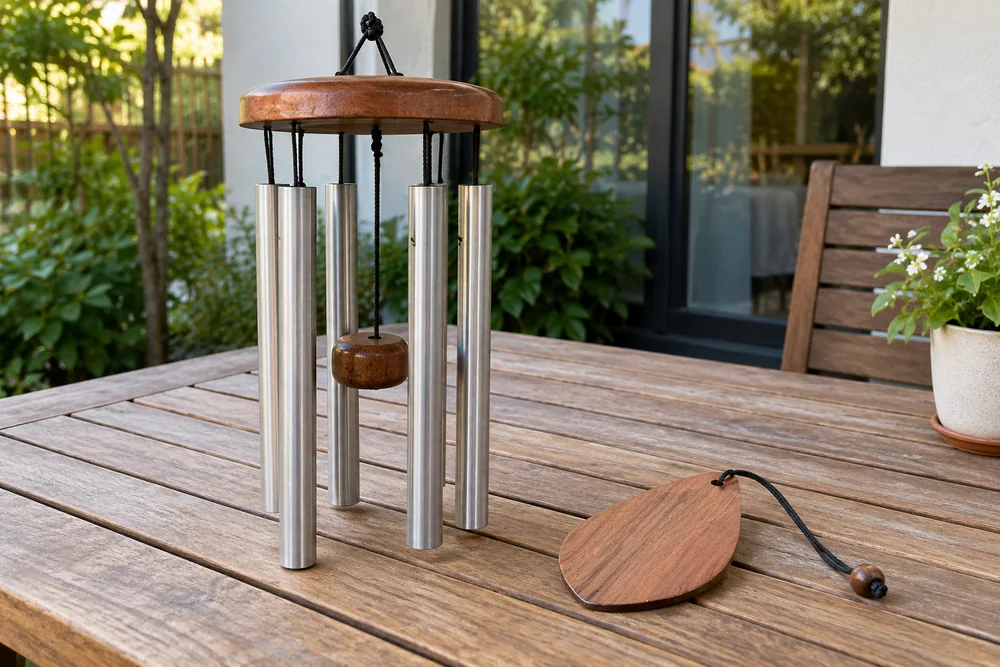
The best approach is simple and reversible. A chime can be moved to a calmer location, brought indoors during windy or quiet hours, or adjusted using an explicit manufacturer-supported mute or removable-sail feature. Any chosen method must preserve load-bearing support and keep small removed pieces stored safely away from children and pets.
- Choose a sheltered position. Move it away from the outermost balcony edge, without putting it in the path of doors, windows or people.
- Check for unintended contact. If tubes strike a wall or railing, correct clearance before attempting to damp the notes themselves.
- Use documented controls. Follow the model maker's mute, windcatcher removal or sail-sizing instructions only where those controls genuinely exist.
- Bring it inside when silence is needed. A stable, reachable hanging point makes seasonal removal easier; do not lean over a rail or climb unstable furniture.
- Replace the decoration if necessary. If even occasional ringing is unwelcome, a secure silent hanging may better meet the household's needs.
Do not recommend tying tubes into a tight bundle, placing stones on the sail, attaching arbitrary counterweights or cutting suspension cords as universal solutions. Such changes can overload a hook, fray lines, damage surfaces or create a falling hazard. Even a supposedly temporary fix deserves a check of the real manufacturer's construction.
8. Placement options for small flats and balconies
Covered side of the balcony
A sheltered side may receive less direct wind than an exposed outer corner. However, side walls can reflect sound and allow a moving chime to collide with the structure. Observe its movement throughout the day, not just in one calm moment, and leave adequate swing clearance around the widest part.
Inside the home near an occasional open window
Indoors, the hanging may remain largely decorative and ring only when the window is open. That can be suitable for someone who values the appearance more than constant sound. Use fixings appropriate to the supporting surface, complete hanging weight and loads from movement; seek qualified advice if unsure. Avoid ceiling fans and check that opening windows and curtains cannot snag the cords.
Entrance without a shared-corridor obstruction
On a private entrance, a small hanging may fit if there is sufficient headroom and it stays outside the door's full swing. Avoid placing moving metal in a common passage, at the top of stairs or where visitors can brush against it. An entrance adjoining a neighbour's door may be better suited to a stationary toran.
Puja, reading and meditation areas
An occasional tone may appeal to some households; others prefer silence for mantra japa, prayer, study or rest. A decorative wind chime is not the same as the deliberately rung ritual ghanta. Keep wind-driven pieces away from diyas, incense, sacred images, loose fabric and delicate furnishings.
9. A buying comparison for apartment-friendly décor
| Option | Likely experience | What to check |
|---|---|---|
| Compact tubular metal chime | Occasional metallic ringing under suitable airflow; may be sharp or sustained | Exact model sound, striker, wind sail, mounting and quiet-hours plan |
| Bamboo or wooden-sounding chime | Distinct percussive sound; not guaranteed quieter than metal | Actual sounding material, sustain, weather suitability and cord wear |
| Small decorative bell | Bell sound when moved or intentionally rung | Whether wind can trigger it, clapper construction and neighbour comfort |
| Stationary gemstone or bead hanging | Mostly visual decoration if fixed against wind-driven collision | Material identity, mounting, small parts and impact clearance |
| Fabric toran or bandhanwar | Traditional entrance decoration without designed musical ringing | Dimensions, door swing, fabric care, cleaning and secure attachment |
| Glass suncatcher or prism | Light and possible colour reflections rather than intentional chime sound | Glass identity, sun angle, safe suspension, glare and breakage risk |
For a quiet entrance, consider the broader Hangings & Chimes collection instead of assuming every decorative object needs a moving musical part. Ensure that a “silent” hanging is securely arranged so its beads or bells do not accidentally strike a hard surface during ordinary wind or door movement.
10. Neighbours, sleep and shared-building rules
Sound in a shared building is a question of context and courtesy. Even if you personally enjoy a chime, repeated ringing near someone else's bedroom or work area can be unwanted. The World Health Organization recognises environmental noise as a concern for annoyance and sleep quality; that does not mean a specific small wind chime is automatically hazardous, and it does not establish one legal noise limit for every Indian apartment.
Check your building's rules before attaching anything to external structures, common railings, passageways or façades. Rules and local legal requirements differ, so avoid assuming that a decorative hanging is automatically permitted because it is small. More importantly, listen from your own adjacent rooms and ask affected neighbours whether the sound reaches them at inconvenient times.
A friendly practical response to a concern is to move the chime, reduce its activity using an approved method, remove it during quiet hours or replace it with silent décor. This is often more productive than debating whether a particular bell is technically loud. Agreeable sound for one person can still be repetitive for another.
11. Quiet hours, storms and an easy removal routine
Before choosing the hanging point, consider whether you can safely take the chime down when wind increases or silence is required. The complete assembly should be reachable from a safe, stable position. Avoid hooks that require leaning over a balcony edge or standing on unstable furniture; support the whole hanging and seek help if it is heavy or high-mounted.
Plan for overnight gusts, monsoon weather, travel and long absences. The metal tubes may withstand ordinary exposure while cords, wooden caps, coatings and decorative beads need protection. A strong gust may make an otherwise soft-sounding model ring repeatedly and strike nearby surfaces. When the whole assembly is not rated for those conditions, bring it indoors before severe weather arrives.
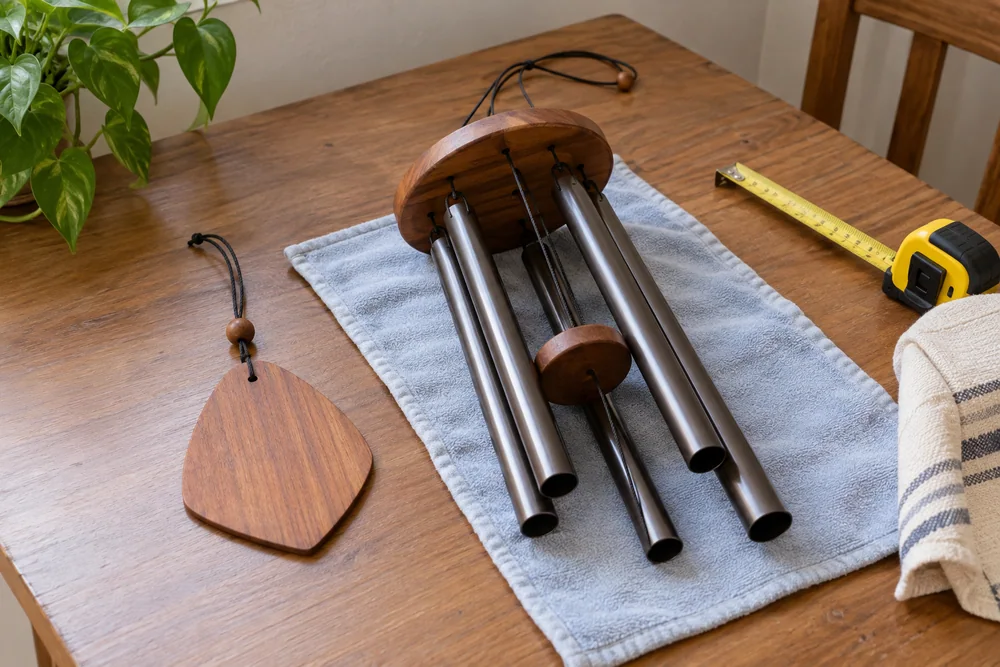
Use a padded dry surface for temporary storage. Keep tubes separated so they do not scratch each other, and preserve the intended cord order rather than making a tight knot. Check the support, ring, striker and wind sail before rehanging. A secure accessible arrangement is easier to manage than an improvised silencing system.
12. Vastu Shastra, Feng Shui and the value of quiet decoration
In Indian traditions, Vastu Shastra concerns the arrangement of built spaces, with attention to orientation, entrances, proportions, light, circulation and concepts such as the Vastu Purusha Mandala and Pancha Mahabhuta. Sound has independent importance in worship and music through the ghanta and nada. These are meaningful contexts, but they do not require every apartment or entrance to have a constantly ringing wind chime.
Some contemporary Vastu-inspired decoration relates moving air to Vayu and sound to Akasha. Chinese Feng Shui has a separate five-phase system, within which metal chimes are sometimes associated with west or northwest areas. Such recommendations vary by school and should not override safe positioning, household preferences and building rules. A quiet, stationary toran or another traditional decorative motif can be appropriate when the household does not want sound.
For broader architectural and traditional background, see Vastu Shastra and the wider Vastu collection. The selection should be a considered choice for the actual home, not a guaranteed financial, astrological or health outcome attributed to a particular chime material.
Frequently asked questions
Which wind chime is the quietest for an apartment?
No single material or tube count is universally quietest. Compare the actual finished model, striker, sustain and wind-sail activity, then assess the intended position and whether it can be silenced or moved.
Is a bamboo chime always quieter than a metal chime?
No. Bamboo and metal designs often sound different, but loudness and ringing frequency depend on dimensions, contact, suspension, location and airflow.
Will fewer tubes make the chime less noisy?
Not necessarily. A small number of bright, frequently struck tubes can be more noticeable than another design with more sounding elements.
Does a low-pitched chime always sound softer?
No. Pitch and sound level are different characteristics. A low tone may be powerful, sustained or audible through a shared courtyard.
Can I remove the wind sail to stop the sound?
Only when that option is supported by the actual manufacturer. Some models offer removable or adjustable components, but an unsupported modification may affect safety or design.
What should I do if a neighbour objects?
Listen to the concern and assess the sound from their perspective. Reposition, use a supported quieting method, remove the chime during sensitive hours or choose silent decoration.
Are wind chimes permitted on every apartment balcony?
No universal answer applies. Review the building's rules and any applicable local requirements, and ensure the fixture is safe and does not obstruct common areas.
Can a gemstone hanging or toran replace a wind chime?
Yes, as a decorative choice. A properly secured stationary hanging can offer visual and traditional significance without deliberate musical ringing, although it must still be safe and appropriately maintained.
Does Vastu require a wind chime to ring continuously?
No universal classical Vastu instruction requires every household to install a continuously ringing wind chime. Contemporary practices vary, and practical comfort is important.
Explore related OmmRudraksha hangings
Browse Metal Wind Chimes for designs with sound-producing tubes or the broader Hangings & Chimes collection for both sounding and primarily decorative options. For more general home arrangement information, read the Vastu Shastra guide. Confirm the actual model’s availability, sound, materials, size and suitability for the intended position before ordering.


