

A hanging or wind chime makes a thoughtful gift when it suits the person, their space and the way they live. A bell with a rich sound can be delightful in a breezy garden but unwelcome beside a quiet apartment bedroom. A fresh-leaf toran may be ideal for a specific griha praveśa ceremony yet unsuitable for a parcel that arrives several days early. A Rudraksha, gemstone or sacred-motif hanging can be personally meaningful, but only when the recipient welcomes its symbolism.
This OmmRudraksha guide helps you compare quiet doorway decorations, textile torans, hand-crafted metal bells, bamboo and metal wind chimes, gemstone mobiles, glass prisms and Rudraksha arrangements. It covers gift occasions, actual materials, sound preferences, measurements, installation, child safety, packaging, delivery timing and after-sale care—without assuming any design is universally auspicious, authentic, tuned or suitable for every household.
1. Begin with the recipient, not the most decorative photograph
Unlike a small greeting card, a hanging becomes part of another person's living environment. The recipient may need to put a hook into a wall, find a position with enough clearance, tolerate occasional ringing and clean a material they have never owned before. A gift that creates unexpected installation work can be less considerate than a simpler design the person can display immediately.
Start with what you know about the home: apartment or independent house, rented or owned, small or generous entrance, balcony or indoor wall, quiet or lively household. Think about the recipient's taste—traditional textile work, minimalist metal, natural wood, gemstones or devotional symbols—and whether they prefer decorative silence to musical sound.
It can be appropriate to ask one discreet question rather than turn a surprise into a burden. “Would a quiet doorway toran or a bell that rings in the breeze suit your home better?” preserves the gift-giving spirit while respecting the person's daily life. If you do not know the home at all, choose something small, quiet, lightweight and easy to place, or allow the recipient to select the design.
Do not assume that every spiritual person wants the same deity motif, gemstone arrangement or Rudraksha classification. Beliefs, family traditions and levels of comfort with religious objects differ. A gift chosen with the recipient's actual preference in mind is more respectful than a generic promise of luck.
2. Sound preference: the most important wind-chime decision
A wind chime is a gift of sound as well as appearance. Manufacturer Woodstock Chimes recommends considering the chime's sound, size, material and location before choosing one as a gift. Some listeners enjoy a low, slow resonance; others prefer bright, higher-pitched notes. Some households want only the occasional gentle sound, while others prefer silence.
A small bell does not necessarily mean quiet. A lightweight bell with a freely moving clapper can ring repeatedly in a steady breeze, and a small metallic chime placed close to a bedroom window can be more distracting than a larger chime positioned further away. Conversely, a large decoration in a still corner may rarely sound. Actual acoustic behaviour depends on construction and placement, not just dimensions.
If the recipient lives in an apartment, works from home, is sensitive to sound or has neighbours close to the balcony, consider a silent textile toran or a decorative stone hanging. A metal or bamboo chime can still be an excellent gift where its sound is welcomed and the home has a suitable location.
Ask for a trustworthy recording of the actual model if available. Recordings vary with microphones and playback speakers, so they offer a useful comparison rather than a perfect guarantee of the experience in the recipient's house.
3. Compare popular gift families before deciding
Different hanging categories solve different gifting problems. The best selection may be a washable or gently maintainable textile for a door, a permanent decorative bell for a hallway, a gemstone hanging for a quiet indoor room or an airflow-sensitive chime for someone with a sheltered porch. Fresh flowers and leaves are special-occasion gifts whose timing and perishability make them a separate category.
| Gift family | Likely recipient or occasion | Sound and display | Before buying |
|---|---|---|---|
| Embroidered toran or bandhanwar | Housewarming, wedding or appreciation of Indian textile craft | Usually quiet, typically displayed above a doorway | Check true width, tassel drop, material, stitching, mirror edges and hanging loops |
| Fresh mango-leaf or marigold toran | Time-specific family or ceremonial observance | Silent, perishable entrance display | Confirm local fulfilment, occasion date, freshness and recipient availability |
| Handmade Kutch-style metal bell | Recipient who enjoys craft and occasional bell sound | May sound when touched or moved | Verify real maker and metal, clapper, complete mass and whether it actually rings |
| Musical metal wind chime | Person with a suitable breezy, sheltered location | Audible; frequency and character depend on the tuned model | Hear model audio, verify full drop, material and weather-care limits |
| Bamboo or wooden chime | Preference for warmer, natural-looking tones | May produce softer hollow or woody timbres | Check indoor/outdoor care, moisture, string life and actual size |
| Gemstone or agate hanging | Quiet visual décor, colour or mineral interest | Usually silent; can show translucent stone colour | Identify genuine stone/treatments, edges, weight and secure fittings |
| Glass-prism suncatcher | Someone who enjoys window light and changing reflections | Silent; possible rainbows in suitable sunlight | Confirm glass, optical shape, actual sunlight position and safety |
| Rudraksha decorative hanging | Recipient who welcomes its Śaiva or personal symbolic meaning | Usually silent unless bells are added | Verify organic bead and any Mukhi claims, cord, identity and care |
These examples are not a guarantee that every product in a family has the same behaviour or quality. A “metal chime” can be a tuned instrument or a group of unpitched bells; a “crystal hanging” can contain natural quartz, coloured glass or both. Choose the actual model, not only the category label.
4. Size, weight and the real installation space
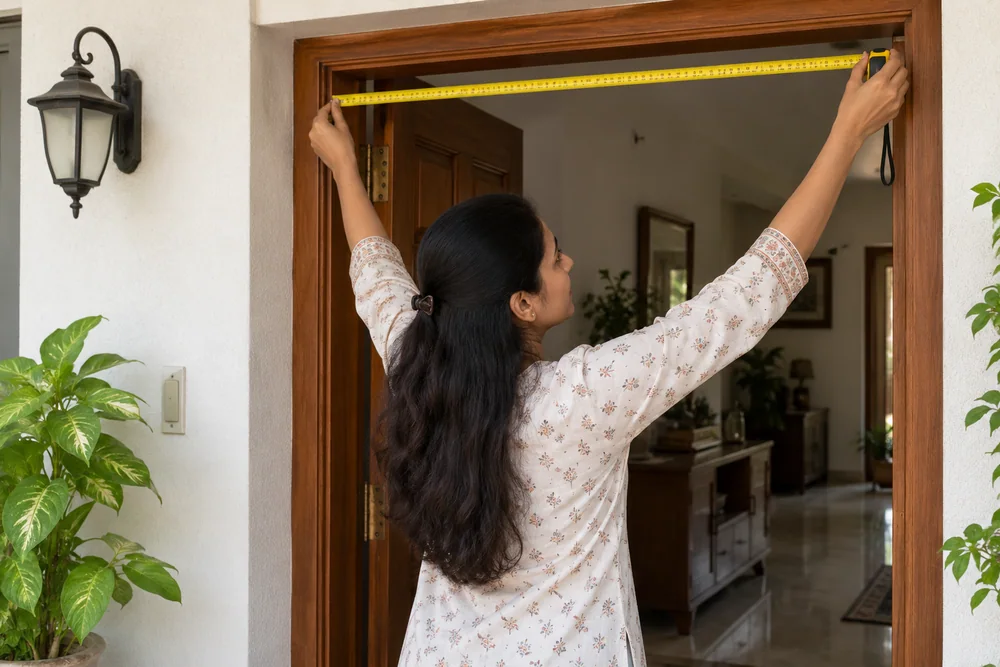
Photographs rarely convey a hanging's complete drop. Retail measurements may refer only to the decorative centre and omit the top suspension cord, lower tassel, sail or bell. A gift that looks petite on a close-up may extend far beneath a doorway lintel. Ask for the total hanging height, maximum width and assembled weight measured from the actual merchandise.
If gifting a toran, the usable width across the top of a doorway matters. A design substantially wider than the frame may sag or crowd hinges, while a too-narrow one can look different from the intended style. If gifting a chime, the full length includes the string below the tubes or bells; the chime also needs space to move without hitting walls, windows, railings or people.
Consider the intended fixing. A heavy mineral or multi-bell hanging cannot safely be assumed to work with a lightweight adhesive picture hook. The correct anchor depends on actual weight, movement and surface. If the recipient rents a home or cannot drill, the gift may need a permitted alternative mounting method—or a different design that can stand independently on a table.
Never modify a fire-rated door or obstruct an emergency exit to display a gift. Door handles, closers, escape signs and passage width must remain usable even when the decoration is especially significant for a festival.
5. Choose tone deliberately: bright, mellow or low resonance
Manufacturers often distinguish wind chimes by tube length, number of notes, material and tonal character. Woodstock's size guidance describes longer tuned metal tubes as generally producing deeper notes, while smaller instruments commonly sound higher. That is a useful rule of thumb for comparing similar constructions, not a universal formula: metal type, wall thickness, tuning, clapper, spacing and attachment also matter.
A tuned instrument may be marketed in a particular pentatonic or other scale. Such claims should come from actual manufacturer or model specifications, not from counting metal tubes or assuming five bells necessarily form five exact musical notes. A group of rustic livestock-style bells can be expressive without being tuned to a specific scale.
For a gift, think about the listener's daily environment. Bright, frequent tinkling near a work desk may be distracting. A deep metallic chime might suit a sheltered garden but feel overwhelming in a narrow indoor corridor. A small wooden chime may sound pleasant yet require more protection from continuous rain or extreme sun.
Where a sound demonstration is not available, describe the tone cautiously. Terms such as “gentle” or “mellow” are subjective. Avoid promises of a particular decibel level, health outcome or sacred frequency that have not been tested on the real model.
6. Indoor, sheltered or outdoor: do not assume all-weather durability
Material descriptions should make the intended display clear. Metal chimes with manufacturer-approved outdoor finishes may suit certain exterior positions, yet cords and wood can still weather. Woodstock's product-care guidance discusses the effects of sunlight, wind and weather and recommends periodic inspection and maintenance. Durability varies by model and exposure.
A bamboo chime may weather more visibly than an aluminium model; copper-coated iron may require different corrosion precautions from solid brass or anodised aluminium. A gemstone or Rudraksha design might contain dyed stones, gypsum, pyrite, organic cord or glued elements that are unsuitable for permanent damp conditions. A covered balcony can still receive wind-driven rain during monsoon season.
If the recipient has only a fully exposed veranda, choose an item whose complete assembly is actually rated for that use. A beautiful product photographed outdoors is not sufficient proof of UV resistance, waterproof adhesives or safe storm exposure. In coastal, humid or high-wind locations, the maker's specific care guidance is especially important.
For many gifts, indoor placement is the easiest conservative choice. A wall toran, silent mineral mobile or small bell hung in a sheltered area may be simpler for the recipient to maintain than a permanently moving piece outside a high-rise apartment.
7. Torans and bandhanwars as culturally meaningful gifts
In western Indian textile traditions, an embroidered toran is a recognised doorway decoration associated with welcoming. Cooper Hewitt's Smithsonian Design Museum describes Gujarati torans that combine colourful stitching, mirrors and hanging pennants, while their connection to entrance symbolism extends beyond contemporary shopping. Such a piece can be a thoughtful gift for someone who appreciates craftsmanship and the meaning of hospitality.
Some households display a bandhanwar year-round; others bring out special pieces for weddings, Diwali, griha praveśa or particular family celebrations. Terms and materials differ among regions, and south Indian thoranam traditions often feature fresh plant material. The giver should consider which form belongs to the recipient's actual practices instead of insisting every Indian family follows one fixed pattern.
A handmade textile toran's value can include labour, skill and connection to a maker. Ask whether it really is hand embroidered, machine stitched, woven, mirrored or assembled with printed motifs. An item inspired by Gujarati craft is not automatically a documented antique or work from a named village.
The gift message can respectfully express welcome and good wishes without claiming the toran guarantees financial prosperity or corrects a building's architecture merely by hanging above a door.
8. Fresh-leaf and flower gifts need exact occasion timing
Fresh mango leaves and marigold garlands can be particularly suitable when the recipient is preparing for a specific family ceremony. Their colour and botanical presence may be valued in regional traditions. But they are living or perishable materials, so shipping and use must be planned differently from reusable fabric or metal ornaments.
Confirm the occasion date, the recipient's presence and a reliable local source that can provide fresh material within an appropriate delivery window. A plant garland sent through an ordinary long-distance parcel network may dry, shed or arrive at the wrong moment. Do not promise freshness or a particular usable lifespan without an actual fulfilment plan.
Some recipients may prefer an artificial-leaf toran for convenience, repeated use or avoidance of plant debris. Others may specifically want fresh botanical material for devotional reasons. A gift should follow that preference, and artificial flowers or leaves should be accurately labelled rather than quietly substituted.
For safety, keep both natural and artificial garlands away from diya flames, incense, hot lamps and electrical connections. Check fresh materials as they deteriorate and remove fallen petals or leaves from the threshold promptly.
9. Hand-crafted Kutch bells: give the craft, not an unsupported story
Metal bells from Kutch, often known as Ghantadi, have a notable craft history. D'source, a design-education resource, documents bells shaped from iron sheet, coated using metal powders, fired and fitted or adjusted for sound. Khamir's craft documentation similarly links the tradition to pastoral use and its later adaptation into home decoration, chimes and hanging gifts.
That process is distinct from casting every bell in solid copper or bronze. A copper-coloured Kutch bell can have an iron core with a copper-rich surface coating. An exact alloy, original maker or village should be attributed only if the actual item's records support it. The appearance of a rustic bell alone does not confirm provenance.
For gift buyers, the distinction matters in three ways: honesty about the craft, understanding care of a potentially coated iron object and realistic sound expectations. A wooden clapper may sound different from a metal one. A bell made individually by a craftsperson can vary in colour, dimensions and tone; that variation should be stated where relevant.
A genuine hand-crafted bell can make an excellent gift for someone who enjoys Indian artisanship. A short description of the verified craft and care information adds more lasting value than an invented statement about rare sacred metal or a guaranteed musical scale.
10. Rudraksha hangings as devotional gifts
Rudrākṣa has profound associations with Rudra–Śiva in Indian traditions. The familiar bead is the hard endocarp of an Elaeocarpus fruit, not an ordinary wooden bead or mined mineral. Its natural longitudinal divisions are used in the traditional Mukhi classification. A recipient may value a Rudraksha hanging because of devotion, family practice or the natural texture of the bead.
However, a sacred object is a personal gift. Some households welcome Rudraksha in a prayer room or doorway, while others follow different observances or do not want religious imagery in their décor. Ask or infer the preference only when supported by the relationship; avoid sending a specialist high-Mukhi ornament solely because someone once mentioned an interest in yoga.
When a product claims five-Mukhi, a higher Mukhi or a named natural form, the identity should be verified for the actual bead. A certificate on an unrelated specimen or a generic image does not authenticate stock. Geographic origins such as Nepal or Indonesia must also be supported separately rather than guessed from size or surface colour.
A thoughtful message can honour the recipient's spiritual interests without promising protection from disease, a changed horoscope, instant wealth or any measurable physical “energy.” Religious significance and careful material documentation can coexist.
11. Gemstone, crystal and glass gifts: verify what is real
Gemstone hangings can create gentle visual interest without unwanted sound. Amethyst adds purple, rose quartz soft pink, red jasper earthy opaque colour, green aventurine reflective inclusions, lapis lazuli deep blue and agate bands that may glow in transmitted light. But colours and photographs alone cannot determine mineral identity.
Clear rock crystal or Sphatik is quartz; a transparent decorative bead may instead be glass, synthetic quartz, resin or another material. A “rainbow crystal” prism sold as K9 or optical crystal is often manufactured glass, not necessarily mined clear quartz. Likewise, vivid agate or other chalcedony may be dyed. An honest gift description should distinguish natural stone, treatment and manufactured decorative pieces.
If the recipient collects gemstones, exact mineral identification and a real-stock photograph can be more meaningful than generic spiritual claims. If they mainly enjoy colour and light, a well-made glass ornament may be ideal—provided it is accurately named rather than sold as an expensive natural mineral.
For heavy, pointed or fragile stones, inspect the wire cage, drilled hole, knots and hanging loop. A mineral's scratch hardness does not guarantee the safety of the assembly or protect a crystal point from chipping if it falls.
12. Suncatchers and the difference between light and sound
A suncatcher is usually chosen for its visual response to daylight. A faceted glass prism may disperse white sunlight into colours when its shape, orientation and lighting are suitable. A translucent agate slice instead shows bands and existing colour. A clear quartz bead may reflect or refract light but should not automatically be promised to cast the same rainbow as a specially designed prism.
Ask where the recipient could display the item. A shaded interior window may make an agate slice luminous yet provide too little direct sun for a dramatic wall rainbow. Reflections also change with season and time of day. Promises of constant rainbow projections or spiritual “light frequencies” are not supported by a generic suncatcher title.
Safety matters: some curved or spherical glass objects can concentrate sunlight onto nearby combustible fabrics or paper. Avoid gifting a heavy glass or crystal ball as a window ornament without clear positioning guidance. A particular dispersing prism and a magnifying sphere are not equivalent optical systems, but mixed designs may contain different shapes.
For a recipient with pets or young children, fragile glass, sharp facets and accessible dangling cords should be considered before choosing any window hanging.
13. Choose for the occasion, without making assumptions
Housewarming or griha praveśa: a tasteful, suitably sized toran or quiet wall hanging can welcome someone to a new home. A wind chime is a better choice when the recipient has a suitable porch or balcony and genuinely likes sound. A gift that requires drilling a rented apartment entrance may be less convenient than a small interior piece.
Wedding or anniversary: choose craftsmanship, lasting quality and the couple's shared taste. A textile toran with verified regional craft may be appreciated; a devotional motif should reflect the couple's own preferences. Avoid labelling an unfamiliar stone set as compulsory for marital harmony or promising a fixed auspicious result.
Diwali or another festival: reusable textile, bells or seasonal garlands may suit the occasion, but confirm the delivery date and what the family normally displays. Avoid decorative fabrics near lamps and open flames; do not require the recipient to install the item while guests are arriving.
Birthday, retirement or thank-you: a small quiet mobile, artisan bell or visually appealing suncatcher can work without being linked to a particular ritual. Attach a modest note describing the craft, colour or your good wishes rather than making a health or wealth claim on the recipient's behalf.
14. A simple gift decision matrix
| Recipient's situation | Consider first | Be cautious about |
|---|---|---|
| Quiet apartment, close neighbours | Textile toran, small silent bead hanging | Frequent metal ringing near bedrooms or shared corridors |
| Sheltered balcony and loves music | Manufacturer-documented wind chime with audible sample | Unverified tuning, excessive length or storm exposure |
| Housewarming with traditional entrance | Recipient-approved toran or bandhanwar | Wrong width, obstruction of door closer or an unwelcome sacred motif |
| Indian craft enthusiast | Traceably made embroidered toran or Kutch Ghantadi bell | Unsupported hand-made, alloy, village or antiquity claims |
| Gemstone enthusiast | Accurately identified, treatment-disclosed stone hanging | Glass sold as quartz, dyed material sold as untreated or generic certificates |
| Rudraksha devotee | Appropriately verified real Rudraksha ornament | Unverified high Mukhi, generic spiritual promises and unknown provenance |
| Young children or active pets | Secure, out-of-reach fabric decoration or alternative gift | Small detachable beads, long loops, heavy bells or fragile glass |
| No suitable installation point | Recipient's choice, smaller freestanding gift or gift credit | Unexpected drilling, heavy mounting hardware or a tall hanging |
These are practical considerations, not rigid rules about personality or belief. A quiet-home owner may love a musical chime; a devotional family may prefer a simple textile over another sacred object. The recipient's actual preference should always outweigh a generic gift-category recommendation.
15. Child safety, pets and accessible installation
A hanging is not automatically a toy. Small bells, beads, stones, glass prisms and detachable charms can become hazards when a connection fails. Long cords or loops may be accessible to children and may snag on furniture or handles. A heavy moving chime can also strike a person's head or hands if placed near a busy passage.
For families with children, prefer short, secure designs installed beyond easy reach, or choose a gift that does not create dangling objects. Consider the full swing path of metal or bamboo tubes, not simply their resting position. A beautifully arranged doorway toran should not reduce usable headroom or obstruct anyone using mobility aids, carrying a child or moving household items.
Pets can chew cords or plant materials and knock down lightweight attachments. Never assume dyes, adhesives, plants or metal finishes are harmless if ingested. Choose an accessible but protected location appropriate to the animals and household. When that is not possible, another gift type may be more suitable.
Keep the recipient's installation effort proportionate. If the item needs anchors for concrete, load assessment or access to a high ceiling, provide accurate mounting requirements and let them decide whether installation is feasible.
16. Packaging is part of the gift experience
Packaging should reflect the material, not merely look decorative. A carved glass prism can chip; a thin agate slice may crack at its drilled hole; a fragile crystal point can pierce soft wrapping; and a bell's clapper or metal rim can strike adjacent parts during transit. Organic Rudraksha beads and textile torans have different protection needs.
Separate fragile pieces with clean, appropriate dividers and secure them inside a suitably rigid outer box. Prevent tangled cords and keep sharp metal edges away from fabric or delicate bead surfaces. A large moving wind chime should not travel with unsupported tubes or clappers banging against one another. The actual packaging method should be selected by the seller for the product's dimensions and weight.
If a product has verified handwritten craft provenance or care cards, these can accompany the gift; do not print false “certified handmade” or “authentic gemstones” badges for materials not assessed. Avoid shipping unnecessary bulky packaging simply to create a premium impression when a properly protective compact box is sufficient.
Before sealing, confirm the correct SKU, chosen material, colour, any personalization, included hardware and a working method for the recipient to contact the seller. A gift message is useful, but it does not replace the order's accurate product and care information.
17. Delivery timing, freshness and surprise logistics
For a dated occasion, the delivery window matters. A parcel may be delayed by transport, weather or a local closure, and a doorstep gift may require the recipient to be present or approve a safe handover. Do not promise next-day arrival, guaranteed festival-day delivery or unrestricted surprise handoff without an actual service commitment and recipient details.
Fresh mango-leaf or flower garlands are especially timing-sensitive. They should be fulfilled through a verified local supply method appropriate to freshness, storage and the recipient's location. If such fulfilment is unavailable, choose a reusable alternative rather than sending fragile natural material through unsuitable long-distance handling.
Be considerate of the surprise. A recipient might need permission from an apartment association to hang exterior items, or may not be allowed to drill a rented doorway. Sending a package with an oversized hanging without checking basic suitability may create an obligation they did not request.
For an important event, consider giving the ornament uninstalled with the correct instructions rather than asking an unfamiliar delivery person to mount it. Installation should be performed only by someone authorised and competent for the intended surface and load.
18. Returns, exchanges and honest product photographs
Gift purchases may involve a gap between ordering and opening the package. Check the seller's actual return or exchange terms, the delivery and inspection process, and any restrictions that apply to personalised, perishable or unique pieces. Do not assume every item is exchangeable after installation or that every seller follows the same policy.
Indian e-commerce consumer-protection policy emphasises providing relevant pre-purchase information about products, pricing and transaction terms. Regardless of which precise obligations apply to a particular seller, clear gift-oriented disclosure is good practice. Provide actual size, materials, representative-photo status, known treatments, damage-report process and the relevant seller's stated return information.
Natural stones and handmade bells can vary from a catalogue photograph. That variation should be explained rather than using one idealised image to promise identical colour bands, surface grooves or sound for every shipped piece. Where an exact high-value Rudraksha specimen or unique gemstone is selected, the invoice and photograph should correspond to the actual item delivered.
For a recipient who might want a different tone or size, a transparent exchange pathway can make the gift more useful than a larger or more expensive object. Verify the terms in the live storefront before mentioning them in a particular product's sale text.
19. After-gift maintenance: make ownership pleasant
A gift should be easy to enjoy after the first day. Include care instructions that match the real materials and intended environment. Manufacturer Woodstock Chimes recommends attention to placement and regular care; tube finishes, strings and wooden components can respond differently to weather. A chime is a moving object, so inspecting support cords and upper rings matters as well as keeping surfaces clean.
For textile torans, check embroidered loops, mirror and bead attachments, and whether colours tolerate water. Do not assume a heavily decorated cloth is machine washable. For a Kutch metal bell, preserve the actual coating and avoid generic harsh brass cleaners if the structural body is coated iron. For a mixed gemstone hanging, gentle dry dusting is the safest starting point when treatments and adhesives are unknown.
Rudraksha is an organic endocarp; do not automatically apply immersion or oil instructions for loose devotional beads to an assembled ornament containing metal caps, glued beads, wood or thread. Gypsum marketed as selenite is water-sensitive; some pyrite specimens can deteriorate in humid conditions. One robust quartz component does not make the whole piece safe for soaking.
If the gift requires a special re-stringing service or replacement sail or clapper, do not promise that support without the current manufacturer's commitment. The care note should describe what can actually be maintained and how the owner can identify unsafe damage before rehanging.
20. Traditional meaning and Vastu without a compulsory prescription
A toran may express welcome; Rudraksha has well-established Śaiva devotional associations; bells have ritual significance in numerous Indian practices; and selected gemstones occupy particular places in ornamentation and Jyotisha traditions. These are not empty decorative labels, and a thoughtful gift message can honour the relevant meaning respectfully.
Yet no one modern wind chime, stone colour or decorative assembly is universally prescribed in every classical Vastu Shastra source for every home. Indian Vastu is concerned with architecture, arrangement, orientation and spatial principles, while a family's selected doorway ornament may also reflect regional festival and devotional customs. Chinese Feng Shui traditions sometimes employ bells or crystals under a different conceptual framework; they should not be conflated with one fixed Sanskrit rule.
A recipient may accept a hanging as a blessing or a reminder of personal values. This does not establish measurable medical treatment, guaranteed prosperity, changes to planetary positions or “energy clearing” as a verified property of an ornament. Express good wishes as sentiment, and describe the actual item truthfully.
For the broader Indian spatial context, read Vastu Shastra or the existing Vastu collection. Product suitability still depends on the recipient's actual space and safe installation.
21. Ten checks before choosing a hanging or chime as a gift
- Ask what they enjoy: quiet visual décor, bells, musical notes, textile craft, gemstones, Rudraksha or a specific festive tradition.
- Confirm a possible location: interior wall, top of doorway, sheltered porch or permitted balcony—not an unverified outdoor spot.
- Know the overall size: full suspension length, maximum width, swing radius and actual assembled weight.
- Choose sound consciously: hear a model sample if sound matters; do not infer pitch or volume from bell count alone.
- Verify materials: real fabric or fresh plants, gem versus glass, organic Rudraksha, actual bell alloy and any treatments.
- Check symbolic suitability: sacred imagery and a specific Mukhi choice should fit the recipient's traditions and preferences.
- Inspect safe installation: loops, cords, hooks, knots, bead holes, clappers and the intended wall or frame.
- Plan delivery and packaging: protect fragile parts and match the event date; arrange fresh plants locally when appropriate.
- Clarify maintenance and returns: include a real care note and verify exchange, damage and delivery terms before ordering.
- Check actual merchandise: Confirm the item identifier, availability, price, actual photographs, maker/origin evidence and included mounting parts.
Frequently asked questions
Is a wind chime a good gift for an apartment?
It can be when the recipient enjoys its sound, has a safe permitted location and neighbours will not be disturbed. If uncertain, a quiet toran or other silent hanging is often easier to place.
Are smaller wind chimes always quieter than larger ones?
No. Tube and bell shape, clapper, material, airflow, distance and mounting affect sound. Size can influence tone, but it does not guarantee low volume or infrequent ringing.
Is a toran appropriate as a griha praveśa gift?
For many families, yes. Check the recipient's regional and religious customs, doorway width, installation options and whether they prefer fresh leaves or a reusable textile decoration.
Can I send a fresh mango-leaf or marigold toran as a long-distance surprise?
Only with a verified fulfilment method suited to freshness and the recipient's availability. For uncertain transit, a well-made reusable toran is often a more practical alternative.
Does a copper-coloured Kutch bell have to be solid copper?
No. Traditional Kutch Ghantadi bells often use shaped iron sheet with a copper-rich surface treatment. Confirm the actual construction and maker before claiming solid copper or a precise alloy.
Is glass crystal the same as natural Sphatik quartz?
No. Clear quartz is a mineral, whereas crystal glass is manufactured. Both can be attractive gifts, but the actual material should be accurately identified.
Should a Rudraksha gift include an authenticity certificate?
Where a particular premium Mukhi or specimen authenticity claim is made, relevant specimen-specific supporting evidence is valuable. A generic certificate graphic is not proof that the actual bead has been examined.
What if the recipient cannot drill or install a heavy hanging?
Choose a lightweight product with an approved installation method suitable for their home, allow them to select another design, or give a non-hanging alternative.
Should I promise a gifted hanging will bring luck or prosperity?
Offer sincere good wishes and describe the relevant tradition, but do not claim a physical product guarantees health, wealth, spiritual outcomes or architectural correction.
Explore gift-friendly OmmRudraksha collections
Browse the Hangings & Chimes collection for gift formats, Crystal & Gemstone Hangings for quiet mineral designs and the existing Vastu collection for related home accessories. Before ordering, confirm the actual merchandise, availability, delivery options and total price.


