

Black tourmaline and white material sold as “selenite” make a striking decorative contrast, but they should never be treated as though they have identical physical properties. Black tourmaline belongs to a comparatively hard silicate mineral group; much black material is the iron-bearing species schorl. Selenite is a crystalline form of gypsum, while many silky-white rods marketed as “selenite” are more precisely satin spar gypsum. Gypsum is very soft, scratches easily and is slightly soluble in water.
For an OmmRudraksha hanging, the difference affects far more than cleaning. Hard tourmaline can abrade a neighbouring gypsum piece, a delicate gypsum rod can crack at its suspension point, and an attractive wire spiral may not reliably retain a heavy or tapering stone. This guide explains material identity, white-stone terminology, contrasts in construction, protected display, dry care, traditional symbolism and the documentation customers should expect before purchase.
1. Two materials with different structures and care needs
The stone names belong to different mineralogical families. Tourmaline is a group of complex borosilicate minerals with numerous possible chemical compositions and colours. Gypsum is calcium sulfate dihydrate, chemically written CaSO₄·2H₂O. Transparent, tabular gypsum crystals are commonly called selenite; a fibrous, silky-looking gypsum aggregate is commonly called satin spar. Both may be used in ornamental objects.
Black and white can look simple in a styled product photograph, but the actual components may include rough black crystals, smooth polished beads, fibrous white wands, thin gypsum slices, wire, thread, glue, metal rings, coloured glass spacers or small charms. Each part brings its own handling limitation, and the safest care method must accommodate the most sensitive part—not merely the toughest mineral.
| Feature | Black tourmaline, often schorl | Selenite or satin spar gypsum |
|---|---|---|
| Mineral family | Complex borosilicate tourmaline group | Calcium sulfate dihydrate, CaSO₄·2H₂O |
| Typical appearance | Opaque to nearly opaque black; commonly lengthwise striations on crystals | Clear glassy plates or crystals (selenite), or silky fibrous white rods (satin spar) |
| Approximate Mohs hardness | About 7–7.5, varying by species | About 2, very easily scratched |
| Moisture consideration | Stone itself generally less moisture-sensitive than gypsum; still assess cracks and setting | Slightly soluble in water; repeated or prolonged wetting risks surface and structural damage |
| Impact concern | Fractured crystal ends, loose fragments and sharp projections | Soft surface, cleavage, splitting and fragile fibrous edges |
| Cleaning starting point | Gentle dry dusting when part of a mixed assembly | Dry and delicate dusting; do not immerse or soak |
| Retail evidence required | Actual tourmaline identity and species if specifically claimed | Verify actual gypsum and whether transparent selenite or fibrous satin spar |
These values and distinctions are established in GIA's tourmaline guidance, National Park Service and university gypsum references, and Mindat's mineralogical discussion of selenite and satin spar. They are not laboratory certificates for individual OmmRudraksha stock pieces.
2. What is black tourmaline?
Tourmaline is a mineral group, not one single chemical formula. Black tourmaline commonly refers to schorl, an iron-bearing member of that group, but a black appearance alone does not prove that a particular piece has the exact chemistry of schorl. Other tourmaline species can be extremely dark or nearly black. Mineralogical Society of America and Mindat sources record the distinctions among tourmaline group species.
Many black tourmaline crystals display long prismatic shapes and grooves or striations along the crystal length. These can make an untreated-looking piece visually distinctive. But a dark, striated rock is not automatically tourmaline: other minerals, glass, painted material or composite pieces can resemble it in a photograph. The mineral name should be supported by real supplier identification or appropriate testing when it materially affects the sale.
The hard exterior of tourmaline helps it resist everyday scratching more effectively than gypsum. Its hardness does not make it unbreakable. Long crystal projections can chip on impact, natural fractures may propagate, and sharp fragments can damage nearby cords or softer decorative material. A heavy rough piece can also work loose from an ornamental wire wrap if it is not mechanically enclosed.
For a black-tourmaline hanging, ask whether the piece is an irregular natural-looking crystal, a polished bead or a carved ornament. Check the actual stone shape, weight, wire attachment and whether any fragile projection can contact a wall, glass or another gemstone.
3. Schorl is the common name—but not a visual certificate
Schorl is an accepted mineral species in the tourmaline group and is often dark black. The name is widely used in mineral collecting, but a retailer should not assert that every dark tourmaline-looking object is verified schorl without identifying it. A black bead can also contain obsidian, onyx-like dyed chalcedony, glass, resin or another material.
Distinguish statements about the mineral group from claims about individual merchandise. “Tourmaline has a Mohs hardness around 7–7.5” is a general property. “This exact stone is untreated schorl from a named deposit with a known chemical analysis” is a claim that requires specimen-level evidence. Colour, weight and grooves alone are insufficient for that stronger statement.
It is also easy for a product listing to confuse a dark tourmaline in quartz with one free-standing crystal. Tourmalinated quartz contains tourmaline inclusions in quartz, which is a distinct composite-looking mineral specimen from a solid schorl point. For a mixed-material hanging, name each genuine stone separately.
4. What exactly is selenite?
Selenite is a common name for clear or translucent gypsum crystals, often with a tabular or bladed habit. Gypsum is calcium sulfate dihydrate, a very soft mineral whose low hardness and cleavage are important for handling. In mineral identification references, gypsum defines approximately level 2 on the Mohs scale, meaning even normal abrasion or a fingernail can mark it.
The white decorative towers and rods sold in many crystal shops as “selenite” are often satin spar gypsum. Satin spar forms closely parallel fibres, giving a silky appearance and sometimes a moving bright band along a polished face. This is another habit or aggregate form of gypsum, not a different chemical substance. “Selenite” is used broadly in the trade, but an accurate educational description should explain the distinction where the supplier can identify it.
The word satin spar has also been used more broadly in older mineral or commercial contexts, so naming gypsum explicitly is sensible. Likewise, decorative white gypsum should not automatically be labelled “selenite quartz,” “white calcite” or “moonstone.” Those names refer to different materials. A photograph cannot prove that an unknown white rod is gypsum rather than a lookalike.
For full-product accuracy, describe a white silky component as satin spar gypsum, commonly sold as selenite when established. If the precise habit has not been verified, a conservative listing can simply say gypsum material sold as selenite pending a supplier check.
5. Clear selenite, satin spar and other gypsum forms
Gypsum appears in multiple habits. Transparent tabular selenite can show a glassy look, while satin spar is fibrous and white or translucent. Some gypsum also forms rosette-shaped desert rose clusters and fine-grained massive material often known as alabaster. These names describe crystal growth, appearance and texture; they are not interchangeable evidence of hardness, origin or treatment.
A satin spar rod may show a luminous narrow band as light interacts with its parallel fibres. That optical appearance does not make it a natural quartz prism or guarantee rainbow projections. A transparent gypsum plate may look like glass but will behave very differently under abrasion and moisture. A desert rose cluster is a fragile sculptural form and generally unsuitable for an unprotected moving hanging.
The U.S. National Park Service discusses selenite, satin spar, gypsum flowers and desert rose as gypsum forms. Mindat explains the difference between transparent selenite crystals and fibrous satin spar. These references are particularly useful when a shop's marketing name is broader than the underlying mineral terminology.
6. Why gypsum and water are a poor combination
Gypsum is slightly soluble in water. It does not instantly vanish when touched by one droplet, but repeated immersion, prolonged wet contact and wet scrubbing can progressively affect exposed surfaces. The FAO's scientific treatment of gypsiferous soils gives gypsum's solubility near ordinary temperatures as a few grams per litre of water, confirming that it is more water-sensitive than many quartz-based ornamental materials.
Its fibrous and cleavable forms bring additional concerns. Water can enter cracks, rough surfaces or spaces between fibres, while mechanical wiping may separate delicate strands. A satin spar piece may lose some of its polished look through careless rubbing, independent of whether moisture is present. Avoid soaking, scrubbing with a damp brush or treating the entire hanging as dishwasher-safe.
Saltwater cleansing, repeated immersion in a bowl, leaving the hanging beneath a dripping plant, or displaying it directly under monsoon rain are unsuitable default recommendations. Water can also damage metal plating, wood spacers, cords, adhesives or colour coatings in the same assembly. When an object contains both tourmaline and gypsum, dry care for the gypsum should govern the whole hanging until reliable product-specific advice establishes otherwise.
If the white stone becomes powdery, flakes, cracks or shows a soft damaged edge, do not attempt to restore its strength with polish. Stop using the piece. Keep people clear of its fall zone, support its weight during removal and seek qualified help for heavy or high installations. Assess the suspension and consider replacement or professional repair.
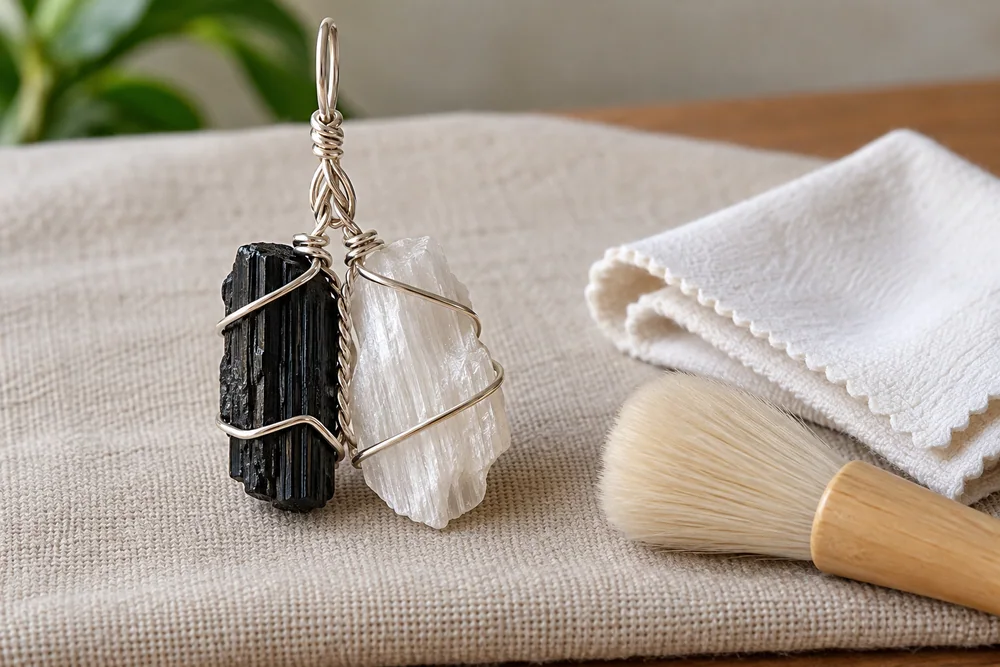
7. Hardness is not toughness, and the hardest stone is not always the safest
Tourmaline's Mohs hardness of approximately 7–7.5 describes scratch resistance. Gypsum's hardness of approximately 2 means it is much more easily marked. Those values do not directly state the resistance of each individual crystal to being dropped, struck or fractured at a drilled hole. Tourmaline can have existing cracks and break across a slender projection, while gypsum has pronounced cleavage and very low resistance to abrasion.
In a mixed hanging, the harder stone can damage the softer one. A rough tourmaline edge swinging repeatedly against a satin spar rod may leave scratches, grooves or chips. Placing the stones face-to-face without spacers can wear the gypsum even under ordinary motion. This risk can be overlooked in styled product photographs that show the elements close together for visual contrast.
Design spacing to keep the materials from colliding in normal use. Consider independent strands, protective separation or a more stationary presentation if the actual assembly permits it. The required gap depends on the real piece, airflow and suspension; do not claim a universal centimetre clearance or a tested dynamic rating without actual engineering evidence.
For a wall ornament that need not ring, a stable interior position may be more appropriate than a freely swinging chime format. A decorative black-and-white contrast can be enjoyed without requiring the fragile white gypsum to strike anything.
8. Construction choices: wire cage, gypsum rod and bead strands
Some mixed hangings place a black tourmaline point inside a wire cage and thread white gypsum beads below. Others use a satin spar wand as a central decorative piece with smaller black stones around it. The visual arrangement is separate from the functional question: can each mineral remain securely supported if the object is moved, bumped or stored?
| Component or design | Potential weakness | Inspection priority |
|---|---|---|
| Rough black tourmaline point | Tapered form can slide from an open ornamental spiral; projections may chip | Fully retaining cage, closed lower support, smooth wire ends, sound top loop |
| White satin spar wand | Fibrous edges, cleavage, soft surface, potentially fragile drilling | Correct gypsum identity, secure holder without crushing, no cracks at support |
| Polished gypsum bead | Soft drilled hole may abrade under tension and contact with harder beads | Hole edges, appropriate spacer, strand material and actual weight |
| Black tourmaline bead | Sharp drill edge or a hidden crack may stress string | Actual mineral, bore condition, knots or crimp and adjacent pieces |
| Metal frame or wire wrapping | Open rings, sharp cut ends, corrosion, excessive pressure on gypsum | Metal identity if claimed, secure settings and contact protection |
| Mixed stone hanging with bell | Repeated ringing contact may damage fragile gypsum | Separate sounding mechanism and ensure no unintended stone impact |
None of the options is inherently safe just because the listing says “handmade,” “strong wire” or “crystal protection.” Inspect the actual product from all sides. A fragile mineral can be well displayed in a supported enclosure, while an attractive but unsecured specimen can be unsuitable above a doorway.
9. Holding gypsum without cracking it
Gypsum's softness and cleavage deserve special attention when creating a hanging. A tight wire loop around a fibrous satin spar rod can press into the mineral, leave a permanent mark or concentrate stress at a weak area. A drilled hole can break out if close to a thin edge or if the suspension rubs against it. Surface coatings may hide some flaws rather than strengthening the stone.
A suitable holder should support the weight without depending on a fragile projection or unverified glue. The manufacturer or skilled maker should choose the retention system for that particular shape. Avoid drilling or cutting the gypsum at home merely to imitate a photographed design; the risk of damaging the stone and producing fine dust can exceed the value of the intended adjustment.
Similarly, do not assume a tourmaline point held only by friction will remain in place as the wire flexes over time. Inspect the bottom opening and upper loop. For any product with a damaged support, the correct response is to take it down until the piece can be safely repaired or replaced.
10. Choosing a dry, protected place in an Indian home
An indoor living-room wall, dry entry alcove or protected shelf-area hanging is generally more manageable than an exposed balcony, damp bathroom or open veranda. The goal is a position where the fragile gypsum can be seen without receiving water, repeated impact, rough cleaning or unnecessary handling. This is a practical recommendation based on material behaviour, not a claim that one compass direction has been scientifically validated for the stones.
Measure the entire hanging drop and the swing span. Check that doors open fully without catching the cord, and that the assembly stays clear of window glass, fans, lights, railings and people. A heavy rough tourmaline point or a brittle gypsum rod should not hang above cots, busy corridors or occupied seats where failure could cause injury.
For apartments in monsoon climates, remember that a covered balcony can still receive wind-driven rain or persistent humidity. A white gypsum wand can also be scratched during cleaning when someone brushes it against a wall. Choose a location that can be safely reached and inspected from the floor without leaning over a railing.
Keep dangling cords and detachable beads out of children's reach. Do not hang a stone arrangement beside the flame of a diya, hot lamp or incense ember; heat and accident risks are especially relevant where a decorative hanging is near a puja shelf.
11. Dry cleaning: the safe default for mixed tourmaline and gypsum
Begin by supporting the whole hanging on a clean padded surface rather than lifting it by one small bead or the end of a white wand. Observe each stone and its metal fittings in good light. Look for loose fragments, opening jump rings, sharp wire ends, frayed cords, hairline cracks and any powder accumulating around the gypsum.
Use a very soft clean dry brush or dry cloth with minimal pressure on sound surfaces. Along fibrous gypsum, work lightly and avoid catching raised strands. If material or treatment is unknown, do not apply vinegar, lemon juice, saltwater, essential oils, perfume, strong detergents or a mineral “recharging” spray. Those practices can damage gypsum or the fittings and have no established role in preserving its physical integrity.
GIA's care guidance supports gentle cleaning for tourmaline as an individual gem, but it does not make wet care safe for a mixed hanging containing gypsum. The presence of a comparatively durable black stone must not be used as permission to soak the entire article. Avoid steam cleaning and ultrasonic cleaning of the combined assembly unless a qualified specialist has assessed every component, treatment and fixing—which is unlikely to be justified for a fragile decorative object.
Cleaning should not alter the shape of a wire setting. When the upper loop, plastery surface or a bead's support shows damage, stop and correct the structural issue before rehanging. A clean object is not necessarily a safe one.
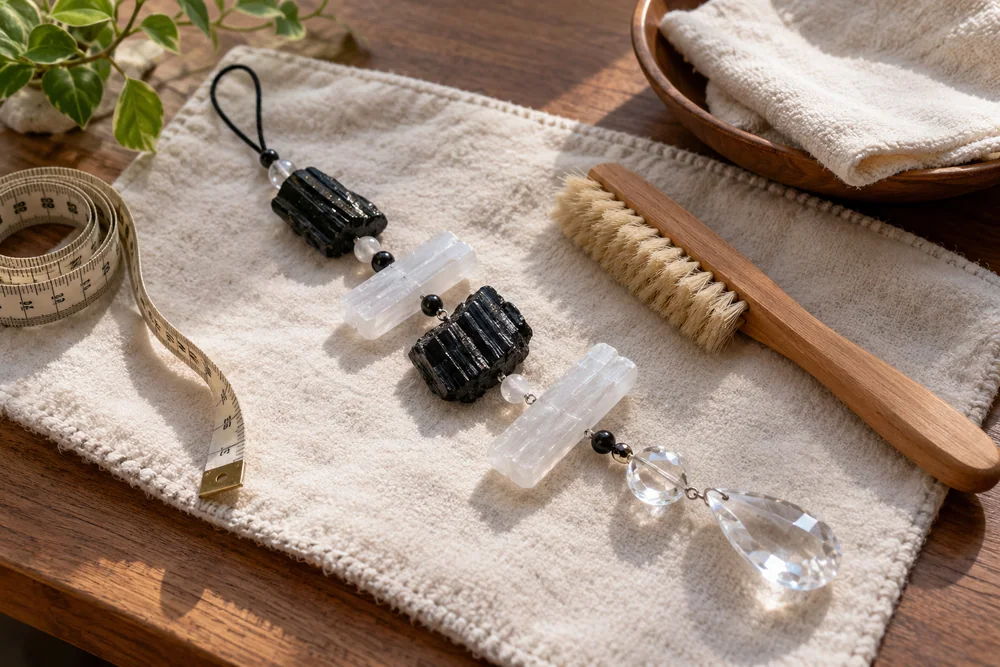
12. Storage and transport without abrasion
Pack tourmaline and gypsum pieces so they cannot strike or rub against one another. Their hardness difference makes direct contact a predictable source of damage. Use individual clean soft separators and avoid heavy pressure on the satin spar fibres or selenite plates. Protect tourmaline points from sudden impacts and keep wire ends from snagging the packing.
Do not leave the hanging in a damp cotton pouch, near a leaking wall or in a sealed container while wet. Even when a dry room is available, inspect the mineral and fittings after a long period of storage. The surface may look intact while a connector is corroded or a cord has become brittle.
Photograph the strand layout before disassembly to avoid introducing wrong bead order, tight knots or metal-to-gypsum contact on reassembly. A repaired assembly must again be assessed for load-bearing security and collision clearance. Do not glue separated mineral chips into an overhead setting without reliable restoration of the intended support.
13. Product authenticity and transparent specifications
For a responsible listing, identify the black stone as tourmaline when verified and the white material as gypsum when established. If the supplier specifically documents schorl and satin spar, use those accurate terms. If a white piece is merely “selenite-style” glass, plastic or another substitute, that must be stated. Likewise, black-coloured obsidian or onyx-like material should not be called schorl merely because it looks protective or dark.
Photographs must represent the real merchandise or clearly indicate that they are educational illustrations. Exact mineral species, mine locality, untreated status, weight, dimensions, country of origin, artisan details or gem-laboratory reports require their own item-specific evidence. A common trade label is not a laboratory result.
Before buying, check the number and type of stones, finish, dimensions, complete weight, connection materials, packaging, availability and price. Ask how any outdoor rating accounts for both gypsum and tourmaline; the durability of tourmaline alone is insufficient.
Explore the Crystal & Gemstone Hangings category for related materials. Confirm actual material and availability for any individual hanging before purchase.
14. Traditional associations, Vastu and claims of “cleansing”
Some contemporary crystal practices associate black tourmaline with protection or grounding and white selenite with cleansing, clarity or purification. Individuals may value these meanings within their chosen devotional or meditative practice. They are symbolic interpretations rather than proof that a wall hanging eliminates electromagnetic fields, filters indoor pollution, destroys pathogens or prevents illness.
Tourmaline does exhibit measurable piezoelectric and pyroelectric properties under specific physical conditions, as documented in materials research. Those properties should not be converted into claims that an ordinary stationary black tourmaline pendant blocks household electromagnetic radiation or creates clinically meaningful air ionisation. A mineral property and an established household health benefit are different kinds of evidence.
The gypsum trade name selenite has a Greek naming history and is not an ancient Sanskrit requirement for an Indian home. Indian ratna, Jyotisha, Tantra and the diverse traditions concerning purity and shuddhi are substantial topics in their own right. A decorative black-and-white crystal hanging is not automatically a consecrated object, a classical navaratna arrangement, or a substitute for religious observance.
Vastu Shastra addresses built-space arrangement, orientation, entrances, circulation, light and wider ideas such as the Vastu Purusha Mandala and Pancha Mahabhuta. There is no universal classical Vastu requirement to place black tourmaline and gypsum at every doorway. Chinese Feng Shui crystal traditions also have a distinct background and should not be merged into a supposed single Vedic instruction.
The family can choose the hanging for its black-and-white contrast, personal symbolism and appreciation of natural minerals while prioritising genuine material identification and a dry, safe location. For architectural background, see Vastu Shastra and the wider Vastu collection.
15. Buying checklist for mixed black-and-white gemstone hangings
- Identify both stones. Is the black piece tourmaline, specifically schorl when verified, or another dark mineral? Is the white material actually gypsum?
- Specify the white gypsum habit. Clear selenite, fibrous satin spar or another form; do not let one commercial label hide the difference.
- Understand hardness. Tourmaline approximately 7–7.5 and gypsum approximately 2; keep them separated from damaging contact.
- Review moisture limits. Do not buy an unidentified gypsum assembly on a promise of all-weather balcony use without evidence.
- Inspect the real stones. Check tourmaline tips and fractures, gypsum fibres and cleavages, powdering, chips and drilled holes.
- Inspect retention. Secure wire cage, top loop, rings, knots, crimps, supports and absence of sharp exposed ends.
- Check complete dimensions. Overall drop, widest movement span, true stone sizes and full assembled weight.
- Confirm cleaning instructions. A dry, soft approach suitable for the gypsum is the safe default for the mixed assembly.
- Check the display space. Dry interior location, clearance from doors, glass, children, moisture and hot fixtures.
- Validate sales claims. Actual SKU, stock, authentic images, origin/treatment details, laboratory report if advertised, price and included mounting hardware.
Frequently asked questions
Is every black tourmaline crystal the species schorl?
No. Schorl is a common black tourmaline species, but black appearance alone does not establish the precise species or authenticate the mineral.
Is satin spar a different mineral from selenite?
No. Both names commonly describe forms of gypsum. Transparent tabular gypsum is often called selenite, while fibrous silky gypsum is satin spar; retail usage sometimes broadens the name selenite.
Can I wash a black tourmaline and selenite hanging together?
Do not soak or wash the full assembly as a default. Gypsum is soft and slightly soluble in water, so gentle dry cleaning should govern the combination unless reliable product-specific advice establishes otherwise.
Is gypsum hardness 2 evidence that a selenite rod is fake?
No. Approximately Mohs 2 is a characteristic of genuine gypsum. Do not deliberately scratch a purchased specimen to test it; request identification evidence instead.
Can black tourmaline scratch satin spar gypsum?
Yes. Tourmaline is much harder than gypsum, and repeated contact can damage soft gypsum surfaces. Separate the pieces in both display and storage.
Can a fibrous gypsum wand safely hang by a narrow wire loop?
Only when the actual maker's retention system safely supports the piece without crushing or cracking it. A narrow decorative loop alone does not establish that an overhead installation is safe.
Does “selenite” automatically mean natural white quartz?
No. Selenite is a name associated with gypsum, not quartz. A white rod or crystal-like object should be identified from actual material evidence rather than its appearance alone.
Does black tourmaline scientifically shield a room from Wi-Fi radiation or purify the air?
A tourmaline crystal's physical electric properties do not establish that a decorative hanging measurably shields a room or provides an air-purification health benefit. Such claims require independent evidence for the specific effect and use.
Does Vastu require this pair of stones at every entrance?
No universal classical Vastu rule requires a black-tourmaline-and-selenite combination at every entrance. Contemporary symbolism may be personally meaningful, but material authenticity and safe dry installation remain separate requirements.
Explore related OmmRudraksha gemstone hangings
Browse the Crystal & Gemstone Hangings collection for other mineral types and the parent Hangings & Chimes collection for decorative alternatives. For Indian spatial traditions read Vastu Shastra. Confirm mineral identity, current price and availability before ordering.


