

Bamboo, coconut shell and wood can appear together in a single wind chime, but each material may have a different job. Hollow bamboo sections are often the sounding pieces. A cut coconut shell may form the upper support, while wood may be used for a striker, wind sail, decorative carving or—in some designs—the sounding bars themselves. Calling the whole object a “wooden wind chime” without identifying its parts can mislead buyers about its sound and construction.
This guide compares these natural-material designs through botanical identity, physical structure, sound, craftsmanship, Vastu-inspired use, humidity, cleaning and seasonal storage. It also explains why a natural appearance does not prove untreated material, sustainably sourced stock, an outdoor weather rating or guaranteed musical tuning.
1. A natural-material chime is an assembly, not a single substance
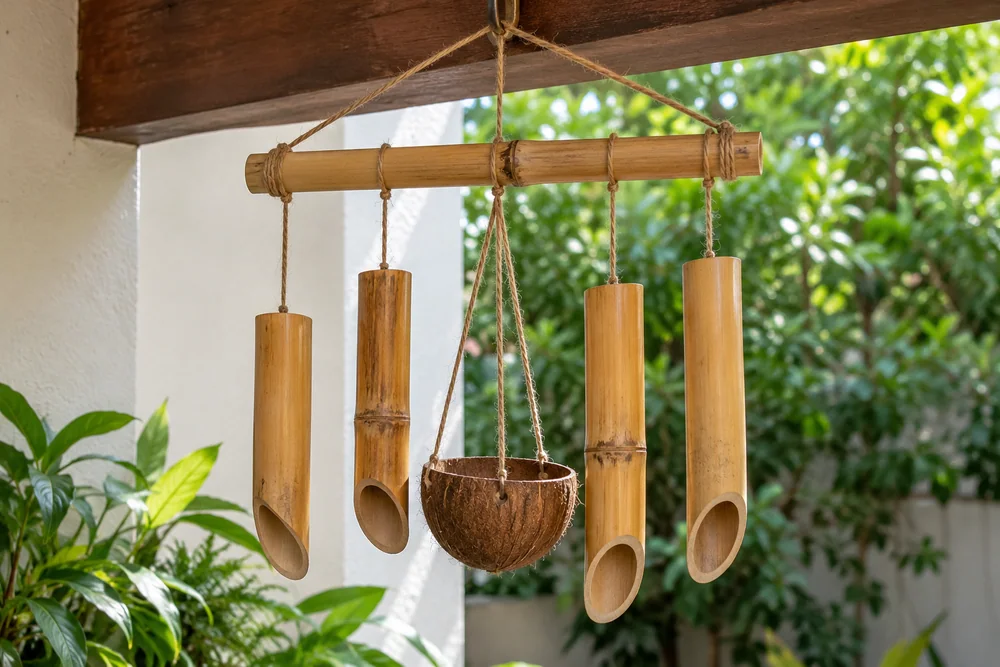
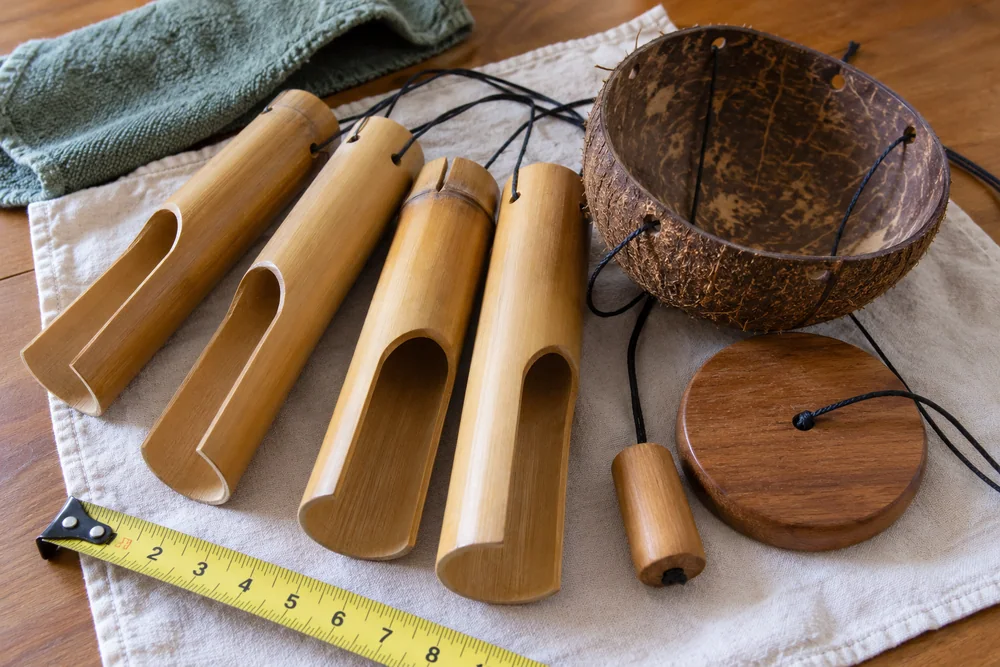
Look at the hanging from the upper loop to its lowest piece. A typical bamboo chime may contain an overhead ring, a coconut-shell or wooden top, individual strings, bamboo tubes of different lengths, a central striker, a wind-catching sail, and possibly beads or carved motifs. Those parts work together, but they are not interchangeable.
The sounding material is the part that vibrates after impact. The support holds everything in the correct arrangement. The striker makes contact and starts the sound, and the wind sail helps the assembly respond to airflow. Decorative carvings, beads, shell shapes and painted surfaces contribute appearance but need not produce a note.
| Component | Possible natural material | Primary role | What to confirm |
|---|---|---|---|
| Bamboo tube or section | Hollow or partly enclosed bamboo culm | Often the sound-producing element | Actual bamboo construction, length, condition and suspension |
| Coconut-shell cap | Hard coconut fruit endocarp | Commonly an upper support or decorative housing | Shell identity, cracks, drilling, treatment and attachments |
| Wooden bar | Cut or shaped wood | May be a sounding element when deliberately constructed as one | Whether the bar actually rings and how it is suspended |
| Wooden striker or sail | Wooden disc, clapper or wind-catching piece | Initiates contact or catches moving air | Fit, finish, wear, alignment and loose connections |
| Threads, rings and fasteners | Natural fibres, synthetic cord, metal or mixed material | Carry the weight and maintain spacing | Strength, knots, abrasion, exposure limits and replacement options |
A product may contain only one of these natural materials. A metal chime with a decorative wooden top is still principally a metal-sounding design. A coconut-shell cap does not automatically mean the strings or tubes are made from coconut. Ask for a component list and photographs of the actual model.
2. What bamboo actually is: culms, nodes and hollow sections
Bamboo belongs to the grass family, although many species form strong, woody-looking culms. A culm is the above-ground bamboo stem. It is typically divided by solid nodes into internodes that are often hollow. This natural segmented structure provides convenient lengths and shapes for craft and sound-producing pieces. The wall thickness, diameter and distance between nodes vary by species, growth conditions and position along the culm.
Indian bamboo resources and botanical descriptions document this node-and-internode anatomy. A hollow section may be left open at one or both ends according to how the maker cuts it, and an intact node can form a natural closed end. The finished sounding geometry should be described from the actual product; not every piece of bamboo is automatically a uniformly open pipe.
Handmade bamboo tubes may differ visibly in grain, colour, growth marks and slight shape. Such variation can be part of the appeal, but it does not excuse undisclosed splits, unstable suspension, unsuitable finishes or inaccurate measurements. A product's supplier should distinguish legitimate natural variation from defects in a delivered item.
3. How a bamboo tube makes sound
When a striker or nearby tube hits a bamboo sounding piece, the bamboo wall vibrates. Tube length, diameter, wall thickness, stiffness, density, natural nodes, suspension and striking position all influence the result. The hollow space and the exact cut geometry may also affect the resonance, so a bamboo chime should not be assigned one note or timbre merely because it is “natural.”
Bamboo chimes are often described as having a softer, wood-like, percussive character relative to certain long metal tubes. That is a useful broad listening impression, not a universal loudness guarantee. One hard-struck bamboo arrangement may create prominent knocks, while another carefully tuned set can produce pleasing notes. The same chime may ring only occasionally in a sheltered veranda yet become repetitive in a windy apartment corner.
For a manufacturer to call a model musically tuned, it should have a real design or documented note relationships. Different tube lengths alone do not prove a pentatonic scale, a particular raga or a healing frequency. Listen to an authentic recording of the actual model where available.
Compare other constructions in the Metal Wind Chimes collection. The contrast with metal tubes concerns geometry and actual sound—not an unverified claim that bamboo is always quieter, more spiritually beneficial or more suitable to a specific direction.
4. Coconut shell: a hard fruit layer, not coconut coir
The hard, dark shell of a coconut is the fruit's endocarp. It is distinct from the fibrous outer mesocarp, commonly associated with coir, and from the edible flesh within. Botanical references on Cocos nucifera make this distinction explicit. A product made with a coconut-shell top therefore should not automatically be labelled “coconut-fibre” or “coir” craft.
A half coconut shell is used as an upper support in some bamboo chime constructions. It can gather the suspension cords into a rounded cap while providing a recognisable natural appearance. It may also be carved or polished. In such a design, the shell is not necessarily a sounding element: the hanging bamboo pieces may produce the principal sound.
Inspect shell thickness and condition around drilled holes. Natural shell can have variations of colour and texture, but cracks around load-bearing connections are not simply decorative details. A top cap should hold all connected tubes, striker and sail securely. If the cap or attachment is damaged, polishing it will not restore the lost strength.
5. Wooden chimes: sounding bars, supports or ornaments?
The word wooden is especially broad. One product may have a wood top and metal tubes; another may feature carved wooden birds attached to small bells; a third may use genuine wooden bars designed to sound when struck. These are different constructions. An accurate retail listing should identify which wooden parts are merely decorative and which, if any, are the main sounding elements.
Wooden sounding bars must be properly selected and suspended for their intended response. They should not be described as interchangeable with cylindrical bamboo sections: solid bars, hollow culms and metal tubes have different geometry and material behaviour. The timber species, moisture condition, dimensions, mounting and striker affect the tone.
Wood may also form a central disc, canopy, clapper or decorative sail. If the item instead contains bamboo tubes beneath a wood cap, a more precise description is bamboo-tube wind chime with a wooden support. That communicates what customers will hear and what they may need to maintain.
6. Natural grain, paint, lacquer and carving
Natural materials can have beautiful irregularities: bamboo growth marks, coconut-shell grain, carved wood, colour transitions and handmade joinery. But a craft object may also be stained, dyed, painted, sealed, varnished, glued or assembled with synthetic components. “Natural-looking” does not establish that a piece is untreated, free from coatings or completely biodegradable.
A lacquered bamboo tube should not be cleaned in exactly the same way as raw bamboo. Likewise, a painted coconut-shell cap might have a finish that reacts differently to prolonged rain than the shell itself. Ask for the relevant treatment and recommended care. A shell printed with a motif remains a shell support; the motif does not establish its origin or ritual status.
Where sustainability is important, request material-source and manufacturing information rather than assuming a short-life decorative object is environmentally benign simply because it contains bamboo. Coatings, adhesives, metal rings and synthetic string may need separate waste handling at end of life.
7. Bamboo versus coconut shell versus wooden bars: buying comparison
| Question | Bamboo sounding design | Coconut-shell-top design | Wooden sounding-bar design |
|---|---|---|---|
| What actually rings? | Usually bamboo tubes when struck | Depends on attached tubes, bells or other elements | Intentionally suspended wooden bars if genuinely present |
| What does the name describe? | A likely sounding material | Often the upper cap or support, not the whole chime | Could describe sound, decoration or support; verify |
| How is the sound verified? | Real recording, maker notes, tube construction | Check the separate attached sounding elements | Actual bar design and striker demonstration |
| What is vulnerable to weather? | Moisture, cracking, finish, suspension and fittings | Drilled shell, paint/coating, knots and attached parts | Wood movement, splitting, finish and suspension |
| Is the material naturally uniform? | No; species and internodes vary | No; shell curvature and thickness vary | No; wood grain, species and cut vary |
| Can it be called all-weather? | Only with full-product evidence | Only with full-product evidence | Only with full-product evidence |
The table is a construction guide, not a ranking of guaranteed pitch, tone or service life. A well-made particular model may suit the intended setting, while an unverified item with attractive material names may not.
8. Moisture, monsoon exposure and why shelter matters
Repeated wetting, high humidity, drying and prolonged sun can change natural materials. Bamboo may develop surface cracks, fading or degradation around holes and joints. Wood may swell, split or lose a protective finish. Coconut shell can also crack or show damage at load-bearing points. Strings, metal fasteners and any glue or paint may deteriorate at a different rate from the visible natural pieces.
Woodstock Chimes explains that its own bamboo-and-coconut-shell models are handmade and require appropriate outdoor care, and it provides guidance for certain wood finishes. Those are manufacturer-specific instructions, not proof that every OmmRudraksha bamboo item lasts the same number of seasons or should receive a particular oil or varnish. Confirm the materials and finish of your own chime before choosing a treatment.
For Indian monsoons, a covered balcony or veranda is often a more practical starting point than a fully exposed rooftop. But covered locations can still receive wind-driven rain, especially near corners. If the full assembly is not explicitly suited to the expected exposure, bring it indoors before severe weather, while it is safe to access. Do not lean over a wet railing or climb during dangerous gusts.
When something looks damp, assess it instead of hiding the issue with polish. Dark marks may be surface staining, moisture-related damage or fungal growth, and these possibilities need different handling. If extensive contamination, structural decay or a weak support is suspected, stop using the hanging and seek suitable advice.
9. Safe cleaning without damaging the natural material
- Check the real construction. Identify the bamboo, coconut shell, timber, paints, glues, metal rings and cords.
- Inspect before cleaning. Look for splits, soft spots, loose knots, sharp holes, cracked caps and damaged connections.
- Dust gently while supporting the parts. A soft dry cloth or clean gentle brush may be suitable for unknown finishes.
- Avoid soaking. Do not immerse the full hanging or permit water to remain trapped in drilled holes, the cap or knots.
- Use wet cleaning or finish treatments only when approved. Maker-specific guidance should decide whether damp wiping, renewal of a coating or particular products are appropriate.
- Do not treat all “natural” surfaces alike. Oil for one finished wood product may be inappropriate for lacquered bamboo, shell, paint or glued ornaments.
- Inspect after cleaning. Check that every tube can move without hitting a sharp edge or causing a strained connection.
Strong solvents, bleach, acidic kitchen mixtures, abrasive scraping and aggressive metal polish should not be applied indiscriminately to a mixed-material hanging. A clean appearance is not evidence that a cracked structural cap or deteriorated cord is safe.
10. Cords, drilled holes and suspension safety
The chime's load-bearing connections deserve as much attention as its visible tubes. A half shell or wooden cap can contain drilled holes that concentrate stresses around each hanging cord. Look for widening holes, sharp edges, small fractures, slipped knots, loose rings and fibres that have become frayed or brittle. An individual light tube can still fall when its line fails.
For a maker-tuned bamboo chime, suspension points and tube order may affect the sound. Replacing strings by guesswork can change the relationship between striker and tubes. Record the original construction before any repair, and use a manufacturer-supported method and suitable replacement material. A heavy or complex hanging may need expert repair rather than a makeshift knot above a doorway.
Use a sound mounting point and fixings suitable for the complete hanging, its supporting surface and the loads from movement. If the overhead fixing or substrate is uncertain, seek qualified installation advice. An adhesive hook intended for a small stationary indoor decoration is not automatically suitable for an exposed, moving outdoor chime. Check full door swing, glass, railings, branches, fans and headroom; avoid hanging above beds, seats or busy walkways. Before removing a heavy or high-mounted chime, support the whole assembly and use safe access or seek assistance.
11. Choosing a location for sound and household comfort
Natural-material chimes can produce pleasant intermittent sounds, but they can also become intrusive when placed in a gusty position or close to neighbouring flats. Observe how the actual model responds to light airflow. A long bamboo section with a strong striker may sound more prominent than a compact metal model, so the description “natural” or “mellow” should not be treated as a measured quietness guarantee.
A sheltered veranda, private courtyard or an interior window that opens occasionally may provide controlled movement. Avoid placing the hanging beside sleeping rooms, an active door, a fragile glass window or a puja space where repeated sound interferes with prayer or japa. The best position for visual enjoyment is not necessarily the best position for continuous ringing.
For alternatives and other hanging types, explore the Hangings & Chimes collection and the wider Vastu collection.
12. How to store a bamboo or coconut-shell wind chime
Storage should prevent accidental impacts, trapped moisture and tangled lines. Inspect the chime and clean it only as permitted for its materials. Ensure the object is dry before packing, especially inside the coconut cap and around bamboo holes. Let the individual sounding pieces settle and protect them with a soft, clean separator so they cannot strike one another.
Do not tie all the cords into a tight knot or wrap the complete chime around a sharp object. That can bend or abrade suspension threads and make it difficult to restore the original arrangement. Place the chime in a sheltered, dry area away from leaks and extreme heat or sunlight. Avoid sealing a damp natural object in a bag where moisture remains trapped.
When the hanging is brought out again, inspect the shell cap, bamboo tubes, wooden parts, mounting ring, knots, striker and sail before rehanging. If it has split or the support is unstable, repair or replace the affected part rather than relying on a cosmetic treatment.
13. Bamboo, nature symbolism and Vastu Shastra
Bamboo and coconut have many uses in Asian and Indian cultural life, including household craft, daily materials and ritual contexts that vary by community. Coconut, for example, has a significant place in numerous Hindu offerings and auspicious ceremonies. This does not establish that a decorative wind chime containing a coconut-shell cap has been ritually consecrated or functions as a replacement for a coconut offering.
Vastu Shastra concerns built-space arrangement, orientation, entrances, light, airflow and traditional spatial concepts such as the Vastu Purusha Mandala. Contemporary decorative practice may connect a moving chime to Vayu (air) and its audible sound to Akasha (space), two of the Pancha Mahabhuta. These associations are not proof that classical texts universally require bamboo or coconut-shell chimes in a particular direction.
In Chinese Feng Shui, wood is one of the five phases and is sometimes associated with eastern and southeastern sectors in modern guidance. That Chinese framework is distinct from classical Indian Vastu. A practitioner may suggest a decorative position within a particular tradition, but sound comfort, safe support and weather suitability remain relevant regardless of symbolic direction.
For broader Indian architectural context, read Vastu Shastra. The natural materials and craftsmanship can be valued on their own merits without promising guaranteed financial, medical or planetary outcomes.
14. Buying and product-description checklist
- Identify the actual sounding parts: Are they bamboo tubes, wooden bars, small bells or something else?
- Identify the top and support: Is it coconut shell, solid wood, painted resin or another material?
- Check the genuine finish: Bare material, lacquer, paint, stain, treatment, carved surface or mixed components?
- Request complete measurements: Full hanging drop, widest span, tube sizes and complete item weight.
- Verify the sound: Obtain an authentic demonstration and a real tuning declaration if the model is advertised as tuned.
- Inspect load-bearing details: Look at knots, drilled holes, rings, shell cracks, striker connections and sail clearance.
- Confirm outdoor limits: Does the maker support sheltered use, direct rain or another defined exposure?
- Check provenance claims: Origin, handmade status, species, sustainability and certification should have separate evidence.
- Check purchase details: Check current price, availability, actual photographs, included fittings, packaging and care instructions before ordering.
Frequently asked questions
Is bamboo a wood?
Bamboo is botanically a grass, although its culms can be hard and woody in appearance and are widely used in crafts. A bamboo tube should not automatically be called a wooden sounding bar.
Does a coconut-shell wind chime make sound from the shell?
Not necessarily. In many designs a half shell acts as the upper cap, while separate bamboo tubes or bells provide the main sound. Inspect the actual mechanism.
Is coconut shell the same material as coir?
No. The hard shell is the fruit's endocarp, while coir is associated with fibres from the husk or mesocarp. A coconut-shell cap does not imply coir strings.
Are bamboo wind chimes always quieter than metal chimes?
No. Actual loudness and ringing frequency depend on the tube geometry, striker, suspension and local wind. Compare complete model recordings.
Can bamboo tubes be tuned to musical notes?
Yes, makers can select or adjust sounding pieces for an intended note arrangement. However, a specific scale or pitch must be verified for the actual model, not inferred from a general bamboo label.
Should I apply oil or varnish to every natural chime?
No. Suitable treatments depend on the exact finish and manufacturer instructions. Oil for one wooden model can be unsuitable for another coated bamboo or shell design.
Can I leave a bamboo and coconut chime outdoors during the monsoon?
Only within the maker's verified exposure limits for the full assembly. Sheltered placement and safe removal before severe weather are sensible when its rating is unknown.
Is an entirely natural-looking wind chime fully biodegradable?
Not necessarily. Synthetic cords, paints, glues, coated fasteners and other components may require different end-of-life handling.
Does Vastu require a bamboo or coconut-shell chime in the east?
No universal classical Vastu rule requires these modern decorative chimes in that direction. Some modern guidance uses Feng Shui wood-phase associations; that should be distinguished from Indian Vastu tradition.
Explore related OmmRudraksha hangings and materials
Browse Hangings & Chimes for natural and metal designs, compare construction with Metal Wind Chimes, and read the Vastu Shastra guide for traditional spatial principles. Before choosing a bamboo, wooden or coconut-shell model, confirm its materials, fittings, actual appearance and permitted weather exposure.


