

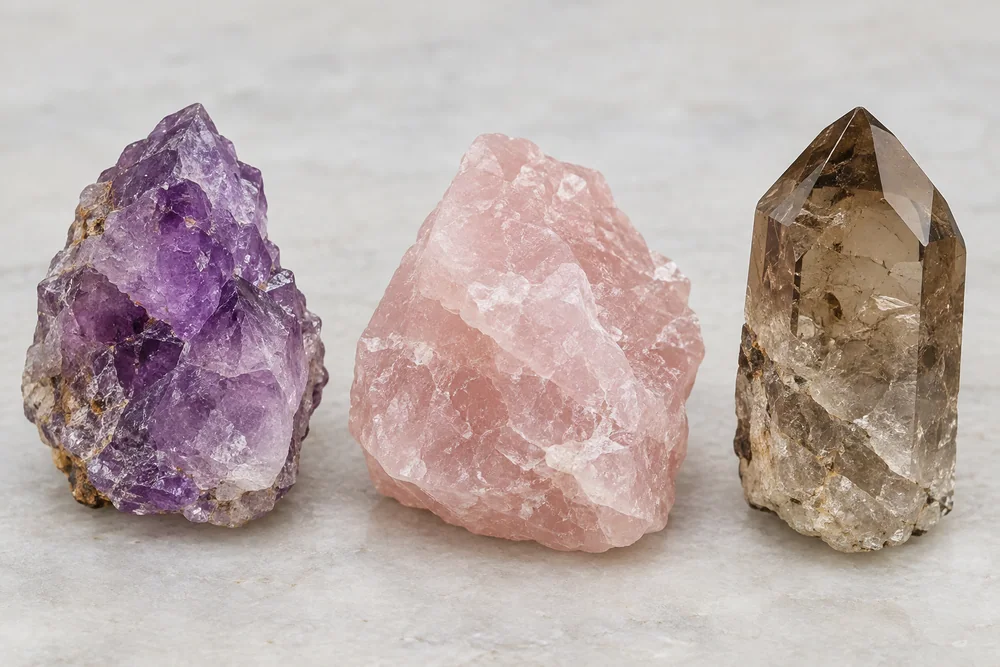
Amethyst, rose quartz and smoky quartz are three appealing expressions of the same mineral species—quartz—but their colours and typical visual character are different. Purple amethyst can provide a striking accent, rose quartz often has a gentle pink, cloudy translucence, and smoky quartz ranges from pale grey through brown to nearly black. These appearances help buyers select a design, but they do not verify whether the stone is natural, whether its colour has been treated or whether its wire wrapping is safe.
This detailed comparison focuses on three related quartz materials used in suspended decorative points, polished beads and other hanging ornaments. It explains why their colour develops, how clarity and cut influence appearance, what sunlight can change, how to assess genuine stones and treatments, and what to check in the cords, settings and complete weight. Indian traditions of ratna, Jyotisha and Vastu are discussed in their own context rather than being confused with modern retail claims.
1. All three belong to quartz: what is shared and what differs?
Quartz is crystalline silicon dioxide (SiO₂). It has a Mohs hardness of approximately 7, a vitreous lustre on suitable surfaces and a rich range of varieties that differ in colour, inclusions and optical appearance. Amethyst, rose quartz and smoky quartz all share this mineral species, but their colour-causing processes are not identical.
Hardness measures resistance to scratching under a particular scale; it does not mean the stone cannot chip, fracture or be damaged by heat. A pointed quartz termination may break when it hits a window frame, and a drilled bead can crack at the hole. The condition and design of the whole hanging, including its wire, rings, thread and hook, determine whether it can be displayed safely.
Quartz is not an automatic certificate of authenticity. A purple faceted bead could be amethyst, coloured glass or another material. A pink bead may resemble rose quartz even if it is dyed stone or resin. Grey-brown glass may look smoky in a photograph. Ask for real product identification information rather than relying on a name or a flattering studio light.
| Feature | Amethyst | Rose quartz | Smoky quartz |
|---|---|---|---|
| Mineral | Quartz (SiO₂) | Quartz (SiO₂) | Quartz (SiO₂) |
| Characteristic colour | Violet to purple, sometimes zoned | Delicate to richer pink, commonly pastel | Smoky grey, grey-brown, brown to near-black |
| Typical visual style | Often transparent to translucent, may show colour zoning | Often cloudy translucent, sometimes transparent or with star effect | Frequently translucent to transparent with variable depth of tone |
| Important colour consideration | Some material fades after prolonged strong light or heat | Common cloudy rose quartz generally stable; rare transparent pink crystal forms may behave differently | Colour associated with irradiation-related centres, whether naturally formed or induced |
| Common hanging forms | Polished points, crystal forms, beads and carvings | Rounded beads, polished cabochons, hearts and carved pieces | Points, polished pendants, beads and crystal clusters |
| Main mounting concern | Secure point cage, protect ends and avoid long strong sunlight | Secure heavy beads/carvings and protect drilled holes | Secure point or cluster, avoid collision and unverified heat treatment |
These are material-family observations, not verified specifications for a particular OmmRudraksha item. Dimensions, species identity, stone treatment, bead size, origin and physical construction should be checked for each actual SKU.
2. Amethyst: purple quartz and its colour variation
Amethyst is the purple variety of quartz, ranging from pale lavender to rich violet and reddish-purple hues. Natural specimens may show bands, colour zones or uneven saturation. Some polished stones exhibit slightly different tones under different lighting, and an illustrated purple crystal can look dramatically darker than the actual item received.
GIA identifies amethyst as quartz and documents both natural colour variation and treatment methods used in the gem trade. Some light-coloured quartz or lesser-coloured amethyst has been dyed to increase the purple appearance, and some quartz is subject to heat or irradiation treatments. The presence of a saturated purple colour does not by itself prove a stone is untreated, unusually rare or from a named mine.
In a home hanging, amethyst can work as a single wire-enclosed point, a bead strand or a carved ornamental shape. A faceted or polished surface can show bright reflections, but the stone does not automatically disperse room-sized rainbows like a purpose-cut glass prism. The exact cut, window angle and illumination determine its optical effect.
Sunlight caution matters. GIA notes that some amethyst may fade after prolonged exposure to strong light. This is a reason to avoid treating an exposed south- or west-facing window as universally harmless simply because quartz has good scratch resistance. For a hanging intended to remain displayed for years, a protected interior location with comfortable indirect light may be a more conservative choice.
3. Rose quartz: why the pink often looks cloudy
Rose quartz is the pink variety of quartz. Many specimens are translucent and have a soft cloudy appearance because of microscopic inclusions. This differs from the clearer transparent appearance often associated with polished crystal points. A cloudy rose quartz bead is not necessarily defective: translucence is a common characteristic of the material and can be desirable in jewellery and decorative carving.
GIA's descriptions explain that typical rose quartz often contains microscopic features responsible for its appearance. Some carefully cut material can show an optical star, or asterism, when properly oriented and illuminated. A seller should not imply that an ordinary hanging bead or polished heart will necessarily display a six-rayed star; this is an effect of particular material and cutting conditions.
Rose quartz is often fashioned into rounded beads, hearts, smooth pendants, cabochons and carvings. A polished point can also be offered, but a carved pointed silhouette is not proof of a naturally grown crystal termination. Buyers interested in geological form should distinguish a natural crystal shape from a carved decorative point.
GIA states that common rose quartz is generally stable to ordinary light and heat, while gemological research distinguishes some transparent pink quartz crystal material with less stable colour. The practical conclusion is neither “every pink quartz will fade immediately” nor “every possible rose quartz form can withstand indefinite harsh sunlight.” Identify the real material and its care instructions.
4. Smoky quartz: grey, brown and very dark varieties
Smoky quartz is quartz showing grey, brown or nearly black coloration. The mineralogical database Mindat explains that its colouring involves irradiation-related defects associated with aluminium impurities in the quartz structure. In nature, radiation in the geological environment can form these colour centres; exposure to irradiation can also be used as a treatment.
Therefore, a dark smoky appearance is not evidence that the colour is untreated or that the specimen is more valuable than a lighter one. Natural and treated examples can resemble one another, and the degree of darkness is affected by the material and its history. A listing claiming “untreated natural smoky quartz” needs suitable sourcing or identification evidence rather than an assertion based on hue.
Very dark smoky quartz is sometimes marketed as morion. Names vary across mineral and commercial usage, so a responsible description should identify actual quartz material first and describe its colour clearly. It should not use a dramatic name to suggest a separate species or a guaranteed spiritual effect.
Smoky quartz can look warm and transparent when backlit but almost black against a dark wall. For home décor, compare a photograph under ordinary daylight, another under diffuse interior light and the actual hanging against the intended background. That gives a better idea of its visual presence than a single image taken with a spotlight behind the stone.
5. Colour does not establish origin, treatment or quality
Customers often compare gemstone hangings first by colour. That is reasonable for décor, but colour has several possible causes and different materials can create similar shades. A strongly purple stone might be natural or dyed amethyst, glass or a different mineral. A vivid pink bead could be quartz, dyed chalcedony or manufactured material. A grey-brown pendant could be smoky quartz, glass or another stone.
GIA's treatment resources describe how heat, irradiation, dyeing, coatings and fracture filling can affect gemstone appearance or care. This does not mean that every example of these three quartz varieties has received an artificial treatment. It means that claims of natural colour or complete absence of treatment require more than a commercial photograph.
For an OmmRudraksha hanging, separate a gemological statement about quartz from an claim about a specific item. “Amethyst is purple quartz” is established material knowledge. “This exact item is untreated, mined in a certain country, weighs a specified number of carats and has a laboratory report” is a product-specific assertion that needs its own records.
Do not rely on household scratch tests, flame tests, solvent tests or home irradiation experiments to authenticate purchased crystals. These can damage the specimen or its finish and do not substitute for competent testing when origin or treatment materially affects the purchase.
6. Points, polished beads, hearts and crystal clusters
The three quartz varieties can be presented in numerous suspended forms. A polished point offers a directional silhouette, but the tip is vulnerable to hard impact. A beaded strand can show several shades of one material and may move freely. A rose-quartz heart or carved disc places more weight in one piece, while a cluster has multiple natural projections that may chip if knocked together.
In retail descriptions, distinguish a naturally terminated crystal, a cut and polished point, and a carved decorative shape. They can all be genuine quartz but are not the same physical form. Natural crystal growth marks do not prove a country of origin; polished symmetry does not mean a stone is imitation.
When a heavy rose quartz carving or a cluster is suspended, examine whether it is attached through a secure drilled fitting, a properly designed basket or a full enclosure. A slender wire coil touching only a smooth surface may not prevent the stone from slipping out. A hole near a natural fracture can be more vulnerable than a sound portion of the material.
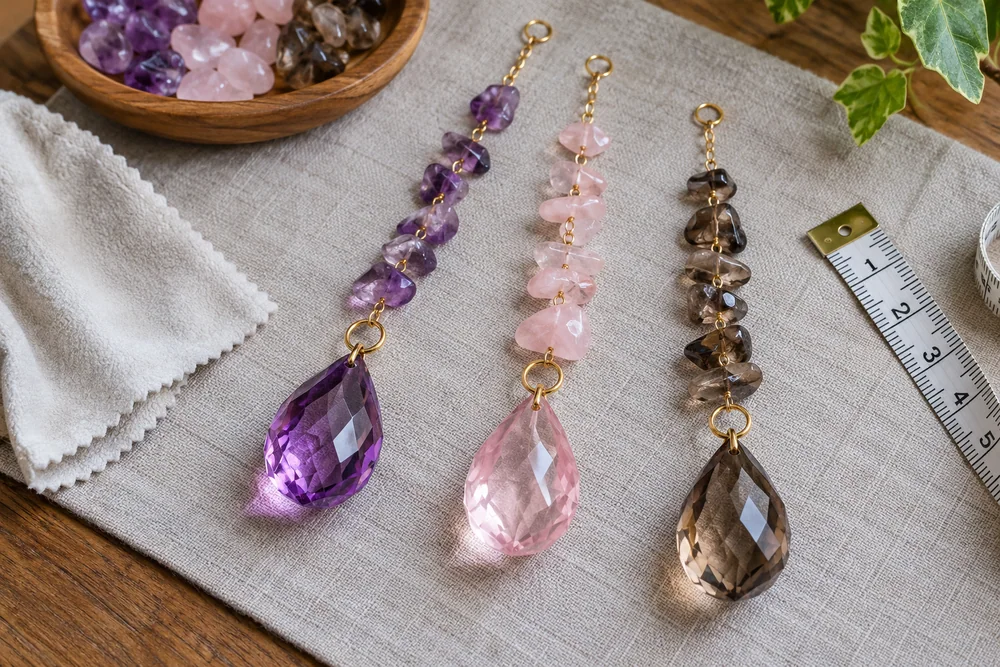
The overall hanging length should be measured from the top attachment to the lowest point, separately from the stone's own height. For a multi-bead strand, confirm the actual bead size and count; a photograph of several beads is not proof of the delivered number.
7. Wire cages, drilled holes and attachment safety
A secure wire wrap is a retaining system, not merely a design flourish. The cage should hold a tapered point without depending entirely on friction near the narrowest section. The upper loop should be firmly integrated with the cradle, and sharp wire ends should be tucked in. Examine the bottom of the stone as well as the front: an elaborate spiral may leave an escape path if a smooth crystal slides downward.
For drilled beads, the thread or wire must resist abrasion at the hole edges. A broken crimp, slipped knot or opened connecting ring can release an entire strand. When one large polished stone hangs below many small beads, its weight affects the whole assembly; the weakest part may be the small upper connector rather than the stone itself.
Ask for the material of the wire or fittings only when verified. Copper-coloured wire may be coated or made from another metal, and a silver appearance need not mean sterling silver or stainless steel. Real material declarations matter for corrosion, surface care and customers with specific preferences.
Keep people clear of the fall zone of a damaged hanging and arrange safe removal rather than relying on a decorative knot or glue over a load-bearing fracture. Support the assembly and use stable access; seek qualified assistance for a high, heavy or complex hanging. Avoid overhead positions where a falling point could strike people.
8. How do the stones look in light?
For a suspended quartz object, light changes what you notice. Purple amethyst may seem richer against a pale wall; cloudy rose quartz can glow softly when light passes through thin parts; and translucent smoky quartz can shift between a subtle brown and a nearly black silhouette depending on its thickness and backlighting.
The effect of transmitted light differs from coloured reflections. A smooth quartz sphere, rough crystal and faceted point may behave differently, even when made from the same mineral. Do not promise that these three quartz varieties automatically scatter rainbows on the wall. That visual effect is more strongly associated with appropriate faceted optical designs such as certain glass prisms in direct sunlight.
Before choosing a window, consider the stone's exposure tolerance, the distance from the pane and the likely movement of the hanging. Protect the crystal against collision with window frames, door handles, fan blades and adjacent ornaments. If a piece has sharp points or a heavy lower weight, use a fixed, secure and reachable position rather than an exposed dangling arrangement.
9. Display choices: amethyst, rose quartz or smoky quartz?
Choose by actual appearance, interior setting and the form of hanging, not by a claim that one colour is objectively best for all houses. Purple amethyst may create a distinctive contrast against warm wood or pale walls. Pink rose quartz often suits a softer colour scheme. Smoky quartz can introduce a muted grey or brown accent that coordinates with earthy materials and darker finishes.
| If your priority is... | Amethyst | Rose quartz | Smoky quartz |
|---|---|---|---|
| Strong colour contrast | Purple tones can stand out against pale backgrounds | Pink can appear gentle unless richer in colour | Dark grey-brown can look bold against light walls |
| Diffuse or soft-looking stone | Varies with clarity and internal features | Frequently cloudy and translucent | Varies from clear smoky to very deep tone |
| Displaying a visible crystal point | Possible in natural or shaped points | Carved points common; natural crystal forms should be identified correctly | Points can highlight transparency and zoning |
| Direct-sun window | Prolonged intense sunlight may fade some specimens | Typical material often stable, but care depends on form and treatment | Avoid harsh heat and confirm treatment and full assembly |
| Easy-to-inspect suspension | In all three cases, secure enclosure, sound loop, adequate clearance and correct fixing matter more than colour | ||
This is a design-selection aid, not a laboratory ranking. An actual product's clarity, colour, treatment, cut, weight and support must be verified before it is labelled suitable for a particular room or exposure.
10. Care differences: colour, mineral and mixed-material fittings
All three are quartz, but a complete hanging is not made solely of quartz. The cords, adhesives, beads, wire plating and finish can be more sensitive than the stone. Begin with a soft dry cloth or brush while supporting the hanging above a padded surface. If material identity and treatment are known, follow the maker's specific care instructions before any damp cleaning.
GIA's amethyst care guide explicitly notes the risk of fading in prolonged strong light and advises against steam cleaning. Its rose-quartz care guidance warns against ultrasonic and steam cleaning for that material, notwithstanding its general durability. These differences show why a shared hardness of 7 does not justify one aggressive cleaning method for every quartz hanging.
Do not immerse an assembled bead strand merely because individual natural quartz pieces can tolerate ordinary water. Moisture can remain trapped in knot holes, dyed surfaces, poorly sealed metal rings or wood elements. Avoid solvents, abrasive powders, bleach and household acid mixtures unless a qualified specialist has approved them for the exact stone and finish.
Direct sun should not be used casually as a universal “charging” or cleansing treatment. An owner may follow a devotional practice, but the physical risk of fading, thermal stress or damage to cords and coatings still applies. If the item is used during prayer or meditation, separate symbolic intent from what is appropriate for the actual mineral and construction.
11. Indoor versus outdoor hanging and seasonal storage
For Indian homes, the monsoon, dust, balcony winds and bright sun can affect a hanging in different ways. The stone may remain intact while the upper loop corrodes, a fabric cord weakens or a painted bead loses colour. An attractive catalogue image beside a balcony railing does not demonstrate that the full assembly is safe for permanent outdoor exposure.
Choose an accessible location sheltered from repeated hard impacts and extreme conditions. If the maker's weather limits are unknown, an interior or protected display is generally easier to manage. Before strong monsoon winds, take vulnerable items down while it is safe to do so; never lean over a balcony or climb unstable furniture during severe weather for a decorative ornament.
For storage, inspect every loop, hole and strand. Use soft separators so a quartz point cannot chip a neighbouring bead or scratch a coated component. Preserve the layout of multi-stone arrangements and avoid tangling cords around pointed terminals. Make sure permitted damp-cleaned parts are dry before packing, then recheck the fixing before rehanging.
12. Gemstone certification, documentation and honest stock images
A generic statement that “quartz has Mohs hardness 7” is not a certificate of the stone in one hanging. When a seller promises natural origin, no treatment, mine provenance, an exact weight or laboratory authentication, the information should match the individual stone or a clearly defined documented batch.
For expensive or origin-sensitive pieces, appropriate identification by a competent gem-testing facility can help. Not every decorative quartz bead requires an expensive report, but it must still be described correctly. Where an image is an educational illustration, identify it as such rather than representing it as a photograph of the exact supplied specimen.
Natural colour and inclusion variation are expected in many stones. That does not justify replacing the purchased mineral with a different material, adding undisclosed dye or changing the bead count. A fair product listing should explain whether buyers receive the exact pictured hanging or another specimen within a stated range, with real dimensions, composition and care instructions.
When comparing amethyst, rose quartz and smoky quartz hangings, check the actual stone identity, dimensions, weight, wire material, suspension design and availability of the individual item before purchase.
13. Ratna, Jyotisha and contemporary crystal symbolism
Indian traditions contain substantial discussion of ratna, gemstone adornment, gifts, royal ornament and, within certain Jyotisha practices, gemstones associated with planets. These traditions should be described faithfully rather than dismissed. At the same time, a decorative quartz hanging is not automatically the same as a prescribed gemstone worn on the body or a complete classical graha-shanti ritual.
Amethyst sometimes appears in modern astrological commerce as a substitute linked with Shani (Saturn), while rose quartz is commonly described in contemporary crystal practice through themes of affection and harmony. Smoky quartz is often given modern associations with grounding or protection. Such uses are not proof that these three varieties have one uniform classical Sanskrit prescription as home hangings, or that an ornamental display provides measurable medical effects.
Some readers value chakra-colour associations, mantra japa or personal devotional symbolism. These can form part of a household's chosen practice. Yet a purple or pink hanging should not be represented as a scientific measurement of the Sahasrara or Anahata chakra, nor as a guaranteed remedy for anxiety, sleep disturbance or planetary affliction. The specific lineage or interpretive system should be identified when making traditional claims.
Vastu Shastra addresses built space, orientation, entrances, proportions, airflow and concepts such as the Vastu Purusha Mandala and Pancha Mahabhuta. A gemstone hanging may be selected for beauty or symbolism, but no universal classical rule mandates one of these quartz colours in every house. Some “crystal cure” placement conventions are drawn from distinct modern Chinese Feng Shui practices and should not be presented as identical to Indian Vastu.
For wider architectural context see Vastu Shastra and the Vastu collection. Their relevance can be explained respectfully while keeping genuine mineral facts separate from individual belief or consultation.
14. Buying checklist for the three quartz hangings
- Verify the species: Confirm actual quartz, not coloured glass, resin, dyed substitute or another mineral.
- Identify the variety: Amethyst purple, rose quartz pink or smoky quartz grey-brown; inspect the real stock's natural shade and clarity.
- Ask about treatment: Natural or artificially altered colour, dye, heat, irradiation, filling, coatings or composite construction where relevant.
- Specify the form: Natural crystal, shaped point, bead strand, sphere, carved heart or cluster rather than assuming every point grew naturally.
- Inspect actual colour: Ask for representative neutral-light views and clarify whether the image is of the exact stock item.
- Check all load-bearing parts: Wire cage, loop, crimp, knots, bead holes, rings and any adhesives.
- Measure the complete piece: Total drop and width, actual stone dimensions, approximate weight and number of beads where counted.
- Plan the light: Avoid prolonged intense light on potentially fading amethyst; keep heavy pendants clear of glass and hard impacts.
- Confirm care and exposure: Identify coatings, cord type and whether the whole item is suitable only indoors or for sheltered outdoor use.
- Check retail accuracy: SKU, price, availability, included mounting pieces and any certificate or origin claim must be supported.
Frequently asked questions
Are amethyst, rose quartz and smoky quartz different minerals?
No. They are different colour varieties or appearances of quartz, with the same main chemical composition, silicon dioxide. Their colour mechanisms and typical clarity can differ.
Does a dark purple amethyst prove the highest quality or stronger spiritual effects?
No. Colour preferences and grading depend on the specific gem and application. Darkness alone does not prove natural origin, treatment status, price or spiritual efficacy.
Is cloudy rose quartz fake?
No. Typical rose quartz is often translucent or cloudy because of microscopic inclusions. Some other materials can imitate the appearance, so an actual authenticity claim still needs evidence.
Is every smoky quartz specimen naturally coloured?
No. Smoky colour centres can form naturally through irradiation in the geological environment, and treatment can also create or alter similar colour. Appearance alone cannot establish that a particular specimen is untreated.
Can amethyst fade if hung in a bright window?
Yes, some amethyst can fade with prolonged strong light and heat. Choose a protected position and follow the care guidance for the actual stone and finish.
Does rose quartz always show a six-rayed star?
No. Asterism occurs only in certain suitable specimens cut and illuminated appropriately. Most simple hanging beads do not promise this effect.
Does a quartz point hanging work as a wind chime?
Not necessarily. Quartz points are generally visual ornaments; a functioning wind chime needs an actual design that causes a sounding component to be struck or contacted.
Can I clean every quartz hanging with water or an ultrasonic cleaner?
No. Treatments, cords, metal finishes and adhesives differ. GIA cautions against ultrasonic and steam cleaning for rose quartz, and a mixed hanging should use care suitable for its most sensitive part.
Does Vastu prescribe amethyst, rose quartz or smoky quartz in one mandatory direction?
No universal classical Vastu mandate applies to every household for these modern decorative hangings. Contemporary spiritual or Feng Shui interpretations should be identified separately from traditional Indian spatial principles.
Explore related OmmRudraksha gemstone hangings
Browse Crystal & Gemstone Hangings for the larger mineral-decoration family and Hangings & Chimes for other formats. See Vastu Shastra for architectural and traditional background. Compare the documented material, treatment and construction of each available hanging before choosing.


