

Aluminium, copper, brass or stainless steel: which wind chime should you choose? The best answer depends on the actual sounding components, the kind of tone you prefer, where the chime will hang and how much maintenance the complete assembly requires. A silver, copper-coloured or golden finish is not proof of the underlying alloy, and no metal is automatically acoustically superior in every design.
This guide compares the four material families in detail, shows how length and suspension influence sound, explains surface finishes and weathering, and separates practical selection from contemporary Vastu and Feng Shui placement advice. The aim is to help you ask the right questions before buying, especially when listings omit exact specifications.
1. First identify the sounding metal, not the visible colour
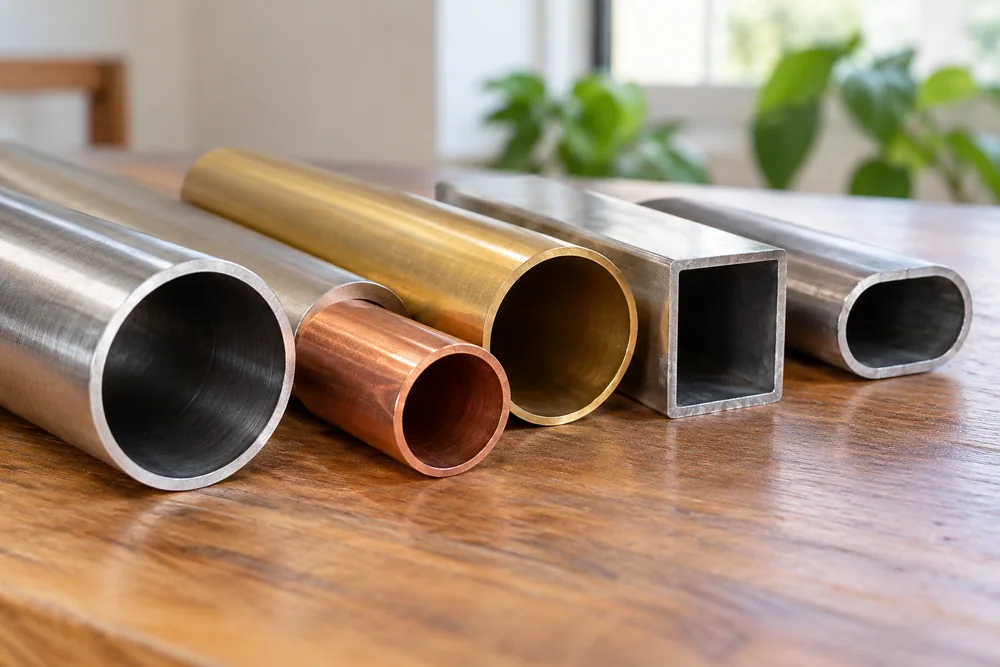
A wind chime can contain several materials. The metal sounding tubes may differ from the top frame, hanging ring, central striker, wind sail, decorative beads and connectors. A manufacturer's description of a “brass finish” may refer only to colour. A chime with aluminium tubes and copper-coloured coating is still an aluminium-tube chime; a copper-plated base metal is not the same as a solid copper tube.
Read the claim literally. “Brass tubes” identifies a component and implies a copper–zinc alloy, subject to supplier verification. “Gold-tone chime” names a visual appearance but does not establish its composition. “Stainless steel look” likewise describes an appearance, not a documented corrosion-resistant steel grade. This distinction matters for sound expectations, pricing, cleaning and how surfaces may change outdoors.
If the listing lacks a material breakdown, ask separately about the sounding tubes, striker, upper support, cords, and any decorative finishes. A photograph, weight estimate or home magnet test alone cannot conclusively identify every alloy.
2. Aluminium, copper, brass and stainless steel: quick comparison
| Material family | Appearance and construction | Ageing or maintenance considerations | Ask the supplier |
|---|---|---|---|
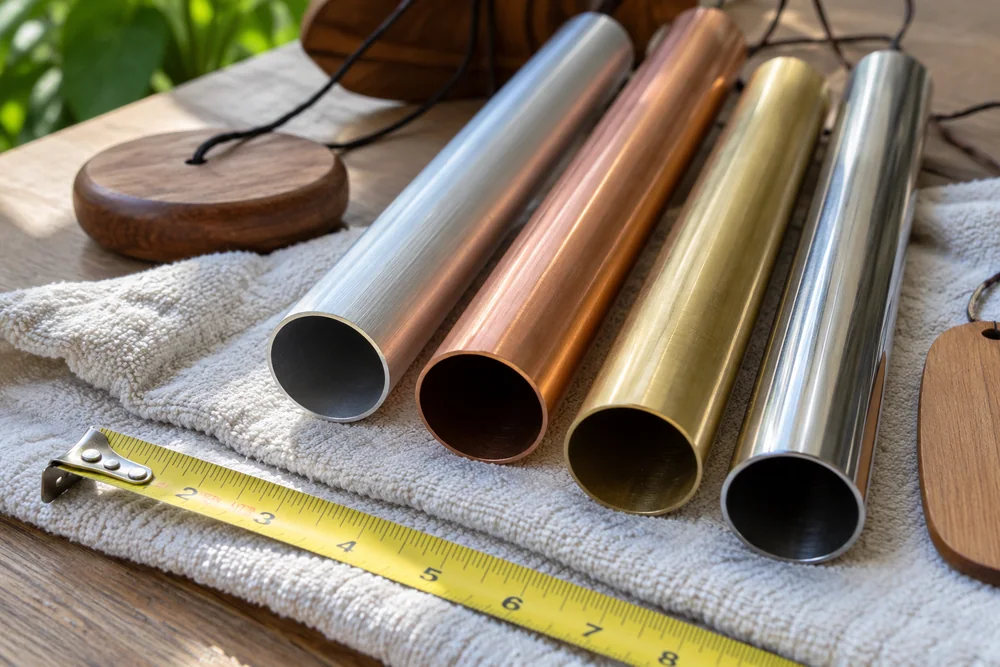
| Aluminium | Often used for lightweight hollow tubes; may be anodised, painted or coloured to resemble other metals. | Surface coatings can scratch or fade; fittings and suspension may need different care from the tubes. | Is the base tube aluminium? What is the finish, note set and complete weather rating? |
| Copper | Naturally reddish; copper tubes differ from copper-plated or copper-coloured items. | Bare copper may darken and develop patina; bright polish can remove the existing surface character. | Are the sounding pieces actually copper, or a finish over another metal? |
| Brass | A copper–zinc alloy commonly having a yellow or golden appearance; composition and finish vary. | Can tarnish or develop patina; lacquered or plated surfaces need different cleaning methods from bare brass. | Is it genuine brass, brass plating or merely a gold-tone finish? |
| Stainless steel | A family of corrosion-resistant iron-based alloys; tubes may be polished, brushed or coated. | Not universally rust-proof; surface staining and pitting can occur, particularly in chloride-rich conditions. | Which steel grade is used, if specified? Are the fittings and suspension equally suitable? |
This is a materials comparison, not a claim that one family makes a predetermined note, volume or spiritual effect. The actual model's dimensions, striker and suspension are critical. For available categories and designs, browse Metal Wind Chimes.
3. Aluminium wind chimes: light construction and intentional tuning
Aluminium has a relatively low density compared with copper alloys and steel, making it practical for tubular designs. Manufacturers can produce consistent hollow sections and choose tube dimensions to achieve desired sound relationships. Some specialised aluminium models have documented musical scales, while others are made primarily for decorative, untuned ringing.
Aluminium tubes may be finished in silver, bronze, copper or many other colours. An applied paint or anodised finish affects appearance and care, but it does not change the base metal into copper or brass. Inspect suspension holes and tube ends where moving parts may cause wear, and avoid assuming that every surface is suitable for abrasive polishing.
Aluminium's resistance to corrosion is useful, but it does not make a complete hanging maintenance-free. Strings, wooden caps, connectors and painted decorative features may deteriorate earlier than the tubes. Sounding quality must be assessed from an exact model, not generalisations such as “aluminium is always high-pitched.”
Compare the Aluminium Tube Wind Chime and, where a verified tuning declaration exists, a tuned aluminium model. Do not infer the notes or scale from tube count or a product name.
4. Copper wind chimes: reddish metal and changing patina
Copper has a warm reddish appearance. Bare copper exposed to air and moisture can gradually change in colour, often darkening before any other surface effects occur. In some long-term outdoor environments, more complex greenish patinas may develop. The timing and colours vary with atmospheric conditions, pollution, coatings and the actual metal; a small sheltered chime is not guaranteed to turn green.
The sound of copper tubes depends on their geometry and construction, just as with other metals. Copper's identity alone cannot tell a buyer that a chime will ring more deeply or longer than a particular aluminium model. For comparisons, listen to the exact design and verify the sounding material rather than judging by the reddish photograph.
Cleaning requires thought. Owners may want to preserve an even patina rather than return the object to a bright factory appearance. Aggressive polishes and acidic household mixtures can remove surface material or affect a plated finish, while the attached cords and frame may require entirely different care. Begin with a soft dry cloth and the confirmed manufacturer's instructions.
The Copper Tube Wind Chime is a related design; ask the supplier which parts are copper and whether any are plated or made from another metal.
5. Brass wind chimes: copper–zinc alloy and warm appearance
Brass is principally an alloy of copper and zinc, not another name for elemental copper. There are numerous brass compositions, finishes and fabrication methods, so the visual appearance and behaviour of an actual bell or tube will vary. A golden chime could be solid brass, brass-plated metal, lacquered brass or a completely different base with coloured finish.
Brass is historically familiar in bells, decorative metalwork and fittings. In a wind chime it may provide a pleasing warm-toned appearance, but the note, sustain and loudness still depend on tube dimensions, suspension, striker and construction. A gold finish does not establish a special frequency or devotional function.
Like copper, exposed brass can change colour. Some pieces acquire a patina that the owner wants to retain, while plated or lacquered examples can be damaged by inappropriate metal cleaners. First distinguish genuine brass, coating and plating. The Canadian Conservation Institute advises considering the finish and desired surface before abrasive polishing of copper alloys.
See the Brass Tube Wind Chime for related placement and care considerations, and ask the supplier to confirm the sounding material and finish.
6. Stainless steel wind chimes: corrosion resistance is conditional
Stainless steels contain chromium and form a protective surface film that helps resist corrosion. They are a family of alloys rather than a single composition. Grade, fabrication quality, finish, deposits, crevices and weather exposure determine performance. For instance, grades 304 and 316 are common in many applications, with 316 generally offering improved resistance in chloride-rich situations. A shiny wind chime, however, is not evidence that it contains either grade.
Stainless steel is not guaranteed rust-proof. Coastal salt, trapped moisture, damaged fittings or inappropriate cleaners can promote brown tea staining, usually a cosmetic surface discoloration, or separate forms of localised corrosion. Regular appropriate cleaning and the right grade for the location remain important, as stainless-steel industry bodies explain.
Check that the sounding elements really are stainless steel rather than plated ordinary steel. Also examine the ring, screws, connectors and cords, which may not share the same material or durability. An outdoor-sounding product name is not a complete weather rating for all components.
For a model-specific comparison, see the Stainless Steel Tube Wind Chime. Ask the supplier for evidence of any claimed 304 or 316 grade for the actual sounding components.
7. What actually determines wind-chime sound?
A chime's principal ringing often comes from vibration of the suspended tube or rod after impact. The resulting sound is shaped by its length, diameter, wall thickness, material properties, suspension points, striker and mounting. For otherwise comparable freely vibrating tubes, longer elements generally sound lower; however, length alone is not enough to compare arbitrary products made with different geometry and materials.
A soft striker may produce a gentler attack than a hard one. Where tubes are suspended matters because support near certain vibration nodes can allow a desired bending mode to ring more freely. The position of the wind sail affects when movement produces contact. A long sustained tone can be pleasant, yet it can also be intrusive where the chime faces a bedroom or neighbouring balcony.
Manufacturers that produce musically tuned chimes often specify a scale, named notes or key. A five-tube chime is not necessarily pentatonic and a six-tube model has no guaranteed note relationship. Likewise, copper is not automatically deeper-sounding, brass is not automatically louder and stainless steel is not automatically brighter than every aluminium chime. The only meaningful evaluation is of the complete model, preferably with an authentic sound sample.
Comparing two recordings also requires care: microphones, playback volume and surrounding walls can affect the impression. Do not rank metals from unrelated short videos recorded under different conditions.
8. Choosing between them: priorities that matter
| Your main priority | What to favour | Why that matters |
|---|---|---|
| Documented musical tuning | A model with identifiable notes or scale, regardless of metal family | Tube material alone does not prove a musical tuning |
| Lightweight hanging | Check aluminium designs, but verify entire assembly weight | The frame, striker and other parts can change total mass |
| Reddish or gold appearance | Compare copper and brass, or honestly labelled coloured finishes | Appearance and material identity are different things |
| Minimal appearance changes | Ask for finish and realistic maintenance guidance, including steel grade | No finish is maintenance-free under every exposure |
| Coastal or humid setting | Prioritise a proven complete-assembly exposure rating and suitable components | Metal choice is only one part of outdoor durability |
| Quiet home or shared apartment | Choose a smaller, controllable or silent ornament where appropriate | Even pleasant metal sound can disturb others |
9. Vastu Shastra and modern Feng Shui: do different metals require different directions?
In Hindu cultural life, sound has a valued place through nada, the ghanta used during puja and the shankha in specific devotional settings. Traditional Indian metalcraft also includes copper, brass and alloy objects. These associations can contribute to a household's appreciation of a decorative metal chime, but the modern tubular object is not automatically a ritual bell or a classical architectural remedy.
Vastu Shastra deals broadly with the arrangement of built space, directions, proportion, openings, light, circulation and traditional ideas such as the Vastu Purusha Mandala and Pancha Mahabhuta. The five great elements include Prithvi, Jala, Agni, Vayu and Akasha. A contemporary Vastu-inspired interpretation may discuss a breeze-operated chime in connection with Vayu and audible sound in connection with Akasha, but that does not establish a universal Sanskrit prescription for a metal-specific rod count or location.
Some popular guidelines recommending metal chimes in west or northwest areas are derived from Chinese Feng Shui, where “metal” is one of the five phases. The Chinese system and Indian Pancha Mahabhuta are different frameworks. Nor does the price or colour of a metal chime establish a particular graha remedy. If following a practitioner, clarify which tradition and compass method are being applied.
For broader architectural context, explore the Vastu Shastra guide. A decorative chime cannot replace attention to the house's safety, moisture, ventilation or appropriate access.
10. Placement, safety and maintenance in Indian homes
A covered entrance or veranda with intermittent airflow can be a practical place for a metal chime. Check the complete hanging length from top hook to bottom sail and allow room for all moving elements. The chime should not strike glass, door frames, walls, railings, other ornaments or people passing beneath it. Use a fixing rated for the complete assembled weight and suitable for the supporting structure and expected wind loads. Keep the hanging clear of people; if safe access or the support is uncertain, use a qualified installer.
In shared apartment buildings, listen at different times, especially when night breezes may make a chime ring repeatedly. For a puja, meditation or sleeping space, quiet may be more valuable than a decorative sound. Keep hanging metal and strings away from fans, incense, diyas and accessible small parts.
Monsoon and coastal conditions deserve extra attention. Bare copper and brass can show changes in surface patina; stainless steel can stain if chloride exposure exceeds its resistance; a painted aluminium tube may remain sound while its coating or suspension deteriorates. The most vulnerable material in the whole assembly often sets the cleaning and outdoor-use limits.
11. How to inspect a wind chime before purchase
- Actual sounding material: Identify the tube or rod alloy separately from decorative finishes and supporting hardware.
- Finish: Confirm bare, lacquered, painted, plated or anodised surfaces and the correct cleaning method.
- Acoustic evidence: Obtain a representative model recording and, when claimed, a maker's tuning sheet.
- Dimensions: Record total drop, widest span, sounding-element size and complete assembled weight.
- Suspension: Inspect smooth tube holes, sound striker contact, cord wear, knots, top ring and wind sail.
- Outdoor rating: Check the finished object, not just one metal part; include salt, rain, wind and sun exposure.
- Visual truthfulness: Compare actual product photographs and avoid equating a golden colour with brass or a copper colour with copper.
- Purchase checks: Check price, stock, packaging, mounting hardware, return conditions and any supplier-specific claims.
Frequently asked questions
Which metal sounds best for a wind chime?
There is no universal best. Compare the actual tube geometry, tuning, striker, suspension, representative sound and the listener's preferences rather than ranking a whole metal family.
Are aluminium wind chimes always high-pitched?
No. Long aluminium tubes can be designed for lower notes. Dimensions and construction matter alongside material.
Is brass the same as copper?
No. Brass is mainly a copper–zinc alloy; copper is the elemental metal. Surface coatings can further complicate what a photograph appears to show.
Will a copper wind chime turn green?
Not necessarily. Patina depends on exposure and finish, and a sheltered chime may simply darken without developing visible green colour.
Is stainless steel completely rust-proof?
No. Grade, surface condition, maintenance and chloride exposure matter. Some stainless parts may develop tea staining or pitting.
Can I identify the metal from its colour alone?
No. Plating, paint, anodising and lacquer can produce colours similar to entirely different metals. Ask for accurate supplier details.
Do more rods create a better musical scale?
Not automatically. A scale requires identifiable pitch relationships; the number of sounding pieces alone does not confirm tuning.
Which metal wind chime is recommended for northwest Vastu?
Metal chimes in northwest or west are commonly discussed in modern Feng Shui and blended Vastu practice. The direction is not a universal classical Sanskrit instruction and should not override safe installation.
Should copper or brass patina always be polished away?
No. Some owners value an aged surface, while other pieces have protective lacquer or plating that can be damaged by abrasives. Confirm the finish and follow suitable care guidance.
Related OmmRudraksha products and reading
Browse the Metal Wind Chimes collection, explore Hangings & Chimes for other decorative styles, or visit the Vastu collection. Compare the Aluminium Tube Wind Chime, Copper Tube Wind Chime and Brass Tube Wind Chime as separate product design families, and verify the real supplied materials for each.


