

An agate slice, a faceted glass prism and a clear quartz hanging may all look beautiful beside a window, but they are not interchangeable materials or identical optical devices. Agate is usually appreciated for its natural or treated bands and varying translucency. A suitably cut glass prism may separate sunlight into visible colours. Clear rock-crystal quartz can transmit and reflect light, but a rounded bead or rough quartz point does not automatically produce the same rainbow pattern as a designed prism.
These distinctions matter when choosing a gift, a suncatcher, a home entrance ornament or a Vastu-inspired hanging. They also matter for honest gemstone identification, dye disclosures, mounting safety and window placement. This guide explains agate and chalcedony, manufactured crystal glass, natural or synthetic rock crystal, Sphatik terminology, realistic optical effects and the often-overlooked risk of strong sunlight concentrated by some curved glass objects.
1. What is a suncatcher, and must it contain a gemstone?
A suncatcher is a decorative object arranged to interact visually with daylight. It may be a coloured transparent disc, a stained-glass panel, a faceted clear drop, a translucent mineral slice, a glass-bead mobile or a mixture of materials. Some designs create coloured shadows; others reflect highlights, allow light through coloured layers or produce a separated spectrum. The name describes a decorative purpose rather than one specific gemstone species.
A wind chime, by contrast, has an intended sounding mechanism. Suspended metal tubes or bells may ring when struck, while an isolated agate slice or quartz bead is usually a silent visual ornament. A product that combines a gemstone strand, a glass prism and a bell should identify the material and function of each part separately. The gemstone should not be credited for a rainbow made by the attached glass or for music produced by a metal bell.
Accurate cataloguing starts with the material and the construction: natural gemstone, dyed stone, manufactured glass, resin or mixed components. Descriptions such as “crystal hanging” or “rainbow crystal” are too broad to authenticate a mineral without further evidence.
2. Agate is a form of chalcedony, valued for banding
Agate is a commonly banded variety of chalcedony, a fine-grained silica material associated with microscopic quartz and sometimes moganite. GIA's chalcedony discussion identifies agate and jasper as familiar gem forms made of silica crystals too small to distinguish individually by eye. The bands may be curved, concentric, parallel, irregular or naturally interrupted, depending on the piece.
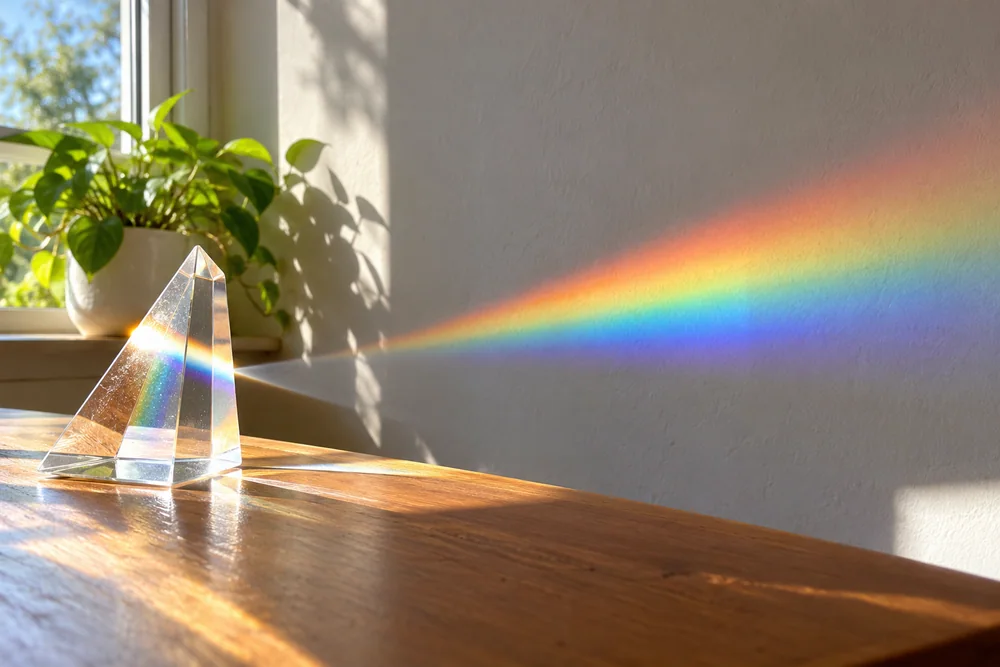
An agate slice can reveal contrasting layers and translucent areas when held in front of diffuse light. Some bands transmit more illumination than darker or more opaque layers, making the internal pattern visible. The effect is different from the dispersed rainbow made by an appropriately cut optical prism: agate generally displays its existing colour and pattern rather than separating a broad spectrum across the room.
A slice is only part of a larger nodule or geode-like specimen. Cutting orientation affects what bands appear. The edges may retain rough natural material, while the broad faces can be sawn and polished. A polished disc with a crisp outline is not necessarily imitation; shaping is a common part of lapidary craft. Equally, a naturally irregular outline does not prove that a vivid pink, purple or blue hue is untreated.
Actual thickness, internal cracks, drilled hole position and polishing quality influence whether the slice suits overhead hanging. A thin section that shows light beautifully may also have a vulnerable edge. For retail descriptions, distinguish the stone's own dimensions from the total height of the cord or metal frame.
3. Dyed agate and natural colour: disclose the difference
GIA notes that chalcedony and agate are often dyed in gem commerce. Bright fuchsia, electric blue, saturated green or other uniform and vivid colours may come from treatment, although appearance alone is not a decisive identification test. Some natural agates are colourful too. The supplier should state what is actually known about the chosen material and any dye, coating, stabilisation or filling.
Dyed agate can be an attractive decorative choice when honestly described. The problem is not that a coloured slice exists; it is claiming the dye is a rare natural mineral colour, or selling a glass or resin disc as a genuine agate. GIA's treatment guidance explains that dyes and coatings may change care needs, including sensitivity to chemical solvents and prolonged sunlight.
Natural stone patterns also vary from one slice to another. A customer seeing a photograph with perfectly centred rings and dramatic illuminated borders may not receive a duplicate specimen unless the exact photographed item is sold. A product page should state whether its hero image is the actual piece or a representative illustration, and explain the range of colour, banding and dimensions.
For a dyed agate suncatcher, avoid placing it in continuous direct sunlight without first confirming colourfastness. A window location that produces an attractive backlit look may also accelerate fading in a sensitive dye or coating. A shaded bright position can display pattern while reducing direct exposure.
4. Faceted glass prisms: manufactured glass, not mined crystal
A faceted glass prism is intentionally shaped so that light entering and leaving angled surfaces can be refracted. Glass is a manufactured amorphous material; it is not the same physical substance as a naturally grown quartz crystal. Clear glass and clear quartz can look similar, but their composition, crystal structure, refractive properties and trade descriptions differ.
Decorative glass may be sold as crystal glass, optical crystal or K9 crystal. In ordinary lighting and ornament commerce, these phrases can refer to types of manufactured optical glass, not to a mined mineral species. An optical-glass label alone does not establish an exact chemical composition, glass grade, refractive index or certified manufacturing standard for a specific stocked ornament.
It is correct to describe a genuine glass object as a glass prism or optical-glass suncatcher. It is misleading to imply a glass drop is natural rock crystal or Sphatik merely because a seller calls it “crystal.” GIA documents manufactured glass as a long-standing imitation of gem materials; material-specific identification is required when a natural gemstone claim matters.
A cut-glass hanging may still be beautifully made and durable when appropriately mounted. Its value can come from design, clean facet edges, craftsmanship and attractive optical behaviour, without pretending it was formed geologically.
5. How a prism separates sunlight into colours
White sunlight includes different wavelengths of visible light. When it enters a suitable transparent material at an angle, it changes direction—a process called refraction. The refractive index varies with wavelength, so the colours may bend by different amounts. With appropriately arranged, nonparallel surfaces, the emerging light can spread into a visible spectrum. Physicists call this dispersion.
OpenStax's college-physics explanation describes why violet is generally refracted more strongly than red in common prism materials, producing a spectrum. The visual pattern made by a decorative suncatcher depends on the prism's real geometry, material, sunlight direction and the surface receiving the transmitted light. A small hanging near a shaded north-facing window may never produce the dramatic wall rainbow shown in a studio demonstration.
Not every glass shape is an effective dispersive prism. A flat transparent pane may pass and reflect light without noticeably separating a rainbow. A round glass ball can act as a lens and concentrate rays instead, raising a different safety concern. Faceted drops can produce reflections and coloured fragments rather than one textbook triangular spectrum.
A rainbow effect is possible under suitable illumination and positioning, but safe placement takes priority. Do not assume a fixed duration, measurable healing frequency or identical optical performance in every room.
6. Clear quartz, rock crystal and the meaning of Sphatik
Clear quartz is crystalline silicon dioxide (SiO₂). Colourless transparent quartz is often called rock crystal, a genuine mineral material used historically for ornaments, carvings, pendants, beads and devotional objects. GIA's gemological descriptions distinguish natural and synthetic rock crystal, and explain that a transparent appearance can also be imitated in glass.
Sphatik or sphaṭika is an Indian term commonly used for clear crystal, particularly clear quartz in contemporary spiritual and jewellery trade. A crystal glass prism or clear plastic bead should not be sold as natural Sphatik merely because it is transparent. When a product claims verified natural quartz, that claim needs an appropriate material declaration or gemological identification tied to the actual item.
Quartz generally has Mohs hardness near 7, but that measures scratch resistance rather than resistance to breakage. A quartz point can chip, a round bead may be cracked at the drilling, and a thin polished quartz component may fail in an unsuitable fitting. The stone's comparatively good hardness does not establish the strength of its cord, bail or upper hook.
Transparent quartz may show inclusions, veils, internal fractures or cloudiness. These features can be natural, but their presence or absence is not a definitive test of origin. Clear quartz may also be lab-grown. Do not authenticate a component using only air-bubble folklore, a photograph or potentially destructive scratch tests.
7. A clear quartz bead is not automatically an optical prism
A rounded quartz bead, a polished quartz sphere, a rough crystal point and a purpose-cut faceted prism have different geometries. Their interaction with sunlight is not identical. A round bead may refract or focus some light, while a naturally terminated crystal may produce bright reflections or local colour effects. Neither should be guaranteed to cast the same repeatable rainbow as a well-oriented dispersive prism.
Clear quartz can appear almost invisible against a pale wall, while inclusions may become visible against darker backgrounds or with transmitted light. A strand of beads often contributes gentle highlights and transparent shapes rather than a continuous spectrum. Someone seeking a clearly visible rainbow should ask for a genuine light-performance demonstration of the stocked model and evaluate its safety in the intended room.
Crystal quartz and clear glass cannot be separated reliably by simply calling one “cold to the touch” or noticing small visible imperfections. Material identification, any treatment and the exact manufacture of the polished form require suitable evidence when important for the purchase.
A spiritual term such as Sphatik does not itself establish that the item has been ritually consecrated, used in japa or verified as natural quartz. Material, ritual status and decorative design are independent claims.
8. Side-by-side comparison of agate, glass and clear quartz
| Buying question | Agate slice | Faceted glass prism | Clear quartz hanging |
|---|---|---|---|
| Underlying material | Fine-grained silica-rich chalcedony, usually with visible banding | Manufactured glass, potentially marketed as crystal glass | Crystalline quartz, SiO₂, if genuinely identified |
| Main appearance | Bands, natural or dyed colours, translucent areas | Transparent facets, reflections and possible spectral dispersion | Clear or cloudy mineral beads, polished points, inclusions and reflections |
| Will it cast a rainbow? | Not usually its defining effect; highlights colour and bands | Can, when facet geometry and direct sunlight are suitable | Not guaranteed; depends on cut and optical geometry |
| Identity concern | Dyed stone, glass/resin imitation and source accuracy | “Crystal” marketed ambiguously as natural quartz | Glass or synthetic substitutes, unsupported natural-quartz claims |
| Structural weakness | Thin slice edge, drilled hole or weak frame | Chipped facets, sharp edges, upper bail and impact | Point chips, bead-hole cracks or insecure wire cage |
| Important light/care issue | Colour fading if dyed; protect coatings | Potential glare and, with certain curved forms, concentrated sunlight | Protect against impact; care for mixed cords and other parts |
These are technical distinctions, not a ranking of spiritual value or proof that an individual OmmRudraksha item possesses the listed material. A category image and a retail name cannot establish untreated status, source, exact dimensions, glass formulation or the full installation safety of one piece.
9. Fire safety: not every suncatcher should sit in a sunny window
Window decoration requires a specific safety check. Fire and rescue services in the United Kingdom have documented fires involving sunlight concentrated or reflected by glass ornaments and magnifying mirrors. Dorset & Wiltshire and Hereford & Worcester services advise caution with curved glass ornaments, paperweights, lenses and similar objects near windows, because they can direct concentrated sunlight onto flammable material.
A typical dispersing triangular prism and a curved magnifying object are not the same optical system. Not all prisms focus light to a dangerous point. Nevertheless, a hanging may combine a faceted drop, spherical beads or other curved transparent components, and the direction of sunlight changes during the day and across seasons. A product photograph alone cannot establish safe optical behaviour.
Do not position sunlit clear or curved ornaments where intense bright patches can fall on curtains, paper, upholstery, bedding, cardboard, fabric lampshades or other combustible objects. Keep glass balls, magnifying shapes and crystal paperweights out of direct sunlight, even during brief display. Check where beams and bright spots move as the sun changes position, and choose a safer location if you cannot establish an appropriate position.
Keep decorations away from a diya flame, incense embers and hot lamps as well. If a specific product's optical behaviour is unknown, avoiding direct sunlight is the more conservative choice; a hanging can still be attractive in diffuse daylight. A manufacturer-specific light and fire-safety assessment takes precedence over a generic suggestion to put all suncatchers into strong sun.
10. Which window actually receives the right light?
A prism may need direct sunlight at a useful angle to cast a visible separated spectrum onto a wall or floor. In an Indian apartment, the result depends on orientation, balcony shading, building setbacks, nearby towers, season, window glass, the size and cut of the prism, and the angle of the receiving surface. It can change from morning to afternoon or disappear entirely under cloud.
Before installation, assess the location from a safe, reachable position. Do not promise constant rainbow projections from a north-facing, heavily shaded or screened window. A coloured agate slice may instead look beautiful under gentle backlighting, while clear quartz beads can be displayed on a stable interior hook without requiring direct sun.
Think about glare into a neighbour's window, onto a work monitor or into someone's eyes. Strong reflections can be distracting even when they are not a fire risk. Where direct sunlight would illuminate combustible furnishings, choose indirect light or move the ornament away from the window rather than chasing a dramatic rainbow effect.
Do not repeatedly reposition a heavy hanging by standing on a window ledge or leaning out of a balcony. The visual benefit never outweighs mounting or fall hazards.
11. Hanging construction: drilled agate, glass bails and quartz wire cages
The gemstone or prism is only part of the assembled object. An agate slice may be pierced near an edge, held in a protective metal frame or captured by wire around its perimeter. A glass prism may have a small drilled hole, a factory-fitted loop or a detachable metal bail. A quartz point may be drilled or wrapped in a cradle. Each method has its own potential points of failure.
| Construction | Function | Inspect before hanging |
|---|---|---|
| Thin drilled agate slice | Shows bands with transmitted light | Distance from the edge, fracture around hole, secure cord and slice weight |
| Wire-framed agate disc | Protects or supports a slice | Full perimeter retention, sound joint and no wire pressing into cracks |
| Faceted glass drop | Produces reflections and possibly dispersed colour | Chipped facets, sharp corners, original bail and actual optical shape |
| Clear quartz round beads | Creates a transparent bead strand | Drilled holes, string wear, crimp, knots and combined weight |
| Quartz point in a wire wrap | Displays a natural-looking or carved crystal form | Fully retaining lower cage, stable loop and protected pointed tip |
| Mixed suncatcher with beads and bells | Combines visual and possible sound elements | Identify materials, verify movement clearance and actual sounding parts |
A decorative wire spiral is not evidence of safe mechanical retention. If a smooth stone can slide through the lower opening when the upper loop flexes, it is not securely held. A tiny bail on a heavy prism may be the weakest point. Avoid testing a suspected weakness by hanging the object over a hard floor or occupied space.
Ask for the actual thickness, weight and cord type rather than estimating them from an illustration. A long hanging may swing through a much wider area than its still-photo width suggests.
12. Secure placement near glass, doors, children and pets
A hanging beside a window must be kept far enough from the pane and frame to avoid repeated collisions during wind, door movement or routine cleaning. Glass-on-glass impact can chip facets or break a suspended ornament. An agate slice may fracture at its drilled hole, while a quartz point may scratch another softer component or chip at its tip.
Choose a hook or fixing designed for the actual complete load and substrate. A light adhesive hook may be adequate for some stationary interior decorations when the manufacturer expressly approves that use, but cannot be assumed suitable for a heavy stone assembly, dynamic wind load or an exposed balcony. The attachment method must not obstruct a window lock or escape route.
Keep small detachable beads, pointed crystals, glass fragments and long cords out of reach of children and pets. Do not suspend heavy or fragile pieces above cots, sofas, occupied desks or busy walkways. In a high-rise apartment, any hanging near an open balcony or exterior window needs additional fall-risk consideration; a dropped ornament can endanger people below.
For a family puja area, consider a position away from flames, heated lamps, incense and regular movement. A decoration can be meaningful without interfering with worship or creating avoidable hazards.
13. Cleaning by material and finish—not by a single “crystal” rule
Agate and clear quartz are both silica-based gem materials, but the treatment of an individual stone may influence what cleaners are suitable. Dyed agate can be sensitive to solvents or prolonged sunlight. Glass may chip or carry a coating that scratches. A mixed hanging may include plated metal, dyed beads, leather, glue or threads with still other requirements.
GIA's treatments guidance cautions that dyes can be affected by certain solvents and that some coatings are vulnerable to abrasion. It is therefore inappropriate to recommend vinegar, bleach, acetone, metal polish, saltwater immersion or ultrasonic cleaning for an unidentified mixed assembly. Cleaning the stone as if it were loose and untreated ignores its fitting and other attached pieces.
Begin with a soft dry cloth or gentle brush while supporting each component above a padded surface. Inspect the edges, drilled holes, metal rings, cord, jump rings and coatings before applying even a small amount of moisture. If the manufacturer documents safe damp cleaning for that exact item, follow the complete assembly instructions rather than general quartz advice.
Prevent abrasive contact during cleaning. A rough agate edge may scratch an adjacent coating; a hard quartz point can damage glass or a softer bead; a chipped glass prism can cut thread or skin. If a critical crack, weakened bail or loose connector is discovered, keep people clear of its fall zone and arrange safe removal; seek qualified help for high or heavy installations.
14. Storage, monsoons and travel
During monsoon weather, wind-driven rain and humidity may reach a covered veranda. Natural agate or quartz may tolerate many ordinary environmental conditions, but dyed finishes, adhesives, cords, metal hardware and applied glass coatings could behave differently. Do not interpret the phrase “natural stone” as an all-weather certification for the full hanging.
When removing the object, support its weight rather than pulling from the lowest prism or bead. Separate agate slices, glass prisms and quartz points with clean soft dividers so edges cannot strike one another. Avoid tightly winding cords around sharp facets and protect vulnerable drilled holes from pressure. Store the assembly dry, away from leaks or heavy objects.
For transport, use a rigid padded container suited to the real material and weight, not simply a thin cloth pouch for a heavy glass or stone ornament. Preserve photographs of the assembly when disconnecting complex strands, then inspect rings and knots before reinstalling.
Plan safe removal before storms rather than attempting to retrieve a decorative item while strong winds or lightning are present. An indoor display may be easier to maintain for a heavy mixed-material suncatcher than a fully exposed balcony installation.
15. Sphatik, devotional context and Vastu-inspired choices
Clear quartz, commonly called Sphatik in Indian spiritual commerce, is used in some forms of devotional jewellery and japa mala practice. These traditions have meanings beyond the decorative look of a suspended bead. A glass prism may be beautiful but is not therefore natural Sphatik, nor does a clear quartz bead automatically become a consecrated ritual object.
Indian traditions of ratna, Jyotisha and gemstone ornamentation are substantial and varied. A particular devotional lineage may use quartz or other gem materials in specified ways. A modern mixed agate-and-glass window hanging should not be presented as an ancient mandatory ritual instrument or a substitute for prescribed spiritual practice.
Vastu Shastra relates to the organisation of built space, including orientation, entrances, proportions, circulation, light and traditional frameworks such as the Vastu Purusha Mandala. A pleasant window ornament can contribute to visual ambience, but there is no universal classical rule requiring every house to install an agate slice or rainbow-producing glass prism in a specific compass direction.
Some contemporary Feng Shui descriptions discuss crystal ornaments and coloured light in distinct Chinese traditions. Those ideas should be attributed accurately rather than treated as one identical instruction from Sanskrit Vastu texts. Personal symbolism can coexist with an honest material description and safe window placement.
For traditional Indian architecture, read Vastu Shastra or browse the Vastu collection. Neither physical dispersion of light nor gemstone composition establishes a guaranteed medical, financial or planetary outcome.
16. Buying checklist: which kind of light-catching hanging fits your goal?
- Define the intended effect. Agate banding, prism rainbows, quartz transparency or a silent ornamental composition?
- Identify the actual materials. Banded chalcedony, manufactured glass, genuine rock crystal or clearly declared substitutes.
- Disclose treatments. Dyed agate, surface coating, resin, assembled material or marketed crystal glass should be described correctly.
- Ask for real-stock photographs. Show front, back, edge, drilled hole and actual daytime lighting; label generated illustrations.
- Verify the light effect. Obtain a model-specific demonstration rather than promising constant rainbows or uniform brightness.
- Assess sunlight safety. Keep direct sun and concentrated bright spots away from combustible fabrics, paper and furnishings; check curved glass parts.
- Inspect the load path. Examine hooks, glass bail, wire cage, drilled agate edge, quartz bead cord and knots.
- Measure the whole object. Full drop, widest span, slice or prism dimensions and assembled weight should be documented.
- Confirm the environment. Indoor versus sheltered use, window and door clearance, direct-sun colour stability and weather limits.
- Check commercial facts. Confirm price, availability, included hardware, care advice and treatment disclosures.
Frequently asked questions
Is an agate suncatcher made of natural quartz?
Agate is a fine-grained silica-rich chalcedony material. It may be natural agate, but the slice could also be dyed or otherwise treated; the exact product must be identified and disclosed accordingly.
Will an agate slice cast a rainbow like a glass prism?
Usually not in the same way. Agate commonly displays its existing bands, colours and translucence; a suitably cut prism can separate white sunlight into a visible spectrum.
Does “K9 crystal” mean natural rock crystal quartz?
No. The K9 designation is commonly used for a manufactured optical-glass material. It does not establish that an ornament is mined crystalline quartz.
Can a clear glass prism be sold as natural Sphatik?
Not accurately. A natural Sphatik quartz claim should correspond to genuine identified rock crystal, not clear manufactured glass or plastic.
Does every faceted prism produce rainbows at all times?
No. The optical effect depends on the actual facets, material, angle and presence of suitable direct sunlight. Some windows and seasons will not show the expected result.
Can a hanging glass ornament start a fire in sunlight?
Some glass objects, particularly curved or magnifying shapes, can concentrate sunlight onto combustibles. Fire services have documented this risk. Check the actual optical shape and avoid unsafe direct-sun placement.
Are perfectly clear quartz beads necessarily fake?
No. Transparent colourless quartz exists naturally and can also be synthetic; glass may resemble it. Visual clarity alone cannot authenticate the material.
Can I clean agate, glass and quartz together with saltwater?
Not as a universal recommendation. Dyes, coatings, adhesives, metal rings and cords can be damaged. Begin with gentle dry cleaning and follow material-specific instructions.
Does Vastu require a specific agate or prism hanging in every window?
No universal classical requirement applies to all houses. Decorative and symbolic choices can be personal, while accurate material identification and safe mounting remain essential.
Explore related OmmRudraksha materials and hangings
Browse the Crystal & Gemstone Hangings category for mineral and mixed-material ornaments, or the broader Hangings & Chimes collection. For Indian home-planning principles read Vastu Shastra. Check actual materials, mounting instructions and availability before ordering.


