

A seven-chakra gemstone hanging is a modern decorative expression of chakra symbolism, not a standardised ancient set of seven authenticated stones. It often uses red, orange, yellow, green, blue, indigo and violet beads in sequence. Those colours can be represented by natural gems, treated minerals, glass, resin or other craft materials. A beautiful arrangement may be meaningful to its owner, but its colours alone cannot establish the identity of the pieces, their origins or a measurable healing effect.
This guide offers two kinds of accuracy together: respect for Indian yogic and Tantric chakra traditions, and transparency about the actual materials and construction of a hanging. It explains the six-centre and Sahasrara framework found in a well-known Sanskrit text, the historical development of the modern rainbow palette, familiar stone choices, gem treatments, beading, sound, mounting and care. Check the actual bead materials and any disclosed treatments for the individual hanging before buying.
1. What makes a hanging a “seven chakra” design?
Most contemporary seven-chakra hangings are identified by a sequence of coloured components. Some use exactly seven beads; others use seven groups of chips, large stones separated by small spacers, a circular frame, carved symbols, coloured tassels or gemstones attached to bells. The number seven usually describes the symbolic arrangement, not a universal requirement for how many individual mineral pieces must be used.
A hanging may also incorporate a lotus motif, an Om symbol, a tree form, a wooden disc or a glass prism. Each is an additional decorative or symbolic element and should be described separately. A metal chime with seven coloured beads is primarily a sound-producing metal chime if its tubes or bells are the parts that ring. The beads do not become musical notes merely because seven colours are present.
When describing a product, identify whether it is a silent gemstone strand, a bead mobile, a wall ornament, a light-catching suncatcher or a chime with an actual striker. That distinction helps a customer know how it will behave in a bedroom, entrance or sheltered veranda.
2. The traditional chakra concept is deeper than a rainbow chart
Cakra or chakra means “wheel” and is used in varied Indian religious and philosophical settings. In several yogic and Tantric traditions, chakras are subtle centres associated with meditative or ritual understandings of the body. Detailed systems describe lotuses, petals, Sanskrit letters, bīja mantras, deities, elements, nāḍī channels and practices involving kuṇḍalinī. Different texts and lineages do not always number, depict or interpret the centres identically.
One influential source is Pūrṇānanda's Ṣaṭ-cakra-nirūpaṇa, the “description of the six centres,” composed in the sixteenth century and widely known through the English presentation in Arthur Avalon's The Serpent Power. The six principal centres are described with Sahasrāra, the thousand-petalled lotus, situated above. Modern popular diagrams commonly present these as seven main centres by counting Sahasrāra as the seventh.
The Sanskrit material should be treated as meaningful spiritual literature, not reduced to coloured consumer beads. For example, the traditional images may specify petal numbers, letters, yantras and deity symbolism, whereas a retail hanging may simply place seven different colours in a vertical row. Both can be discussed without claiming they are historically identical representations.
A family may appreciate the hanging as a reminder of yoga, meditation or personal devotion. Its material composition should still be stated truthfully, and it should not be represented as an automatically consecrated instrument or a replacement for a lineage-specific spiritual practice.
3. Why the familiar seven rainbow colours are a modern convention
The red-to-violet chart is now so common that it can appear timeless. Historical research by Kurt Leland, published through the Theosophical Society in America, traces the present Western chakra system through changing interpretations, including colour therapy, occult literature and twentieth-century popularisation. The specific pairing of a full rainbow sequence with widely repeated psychological associations became especially influential during the 1970s.
That history does not imply that Indian chakra ideas were invented recently. It means the particular commercial chart of red, orange, yellow, green, blue, indigo and violet is a later synthesis, not a fixed spectrum of gemstone correspondences stated in every Sanskrit Tantra. Traditional texts can have richly coloured lotus imagery without prescribing this identical seven-colour arrangement.
The more accurate label is commonly used modern chakra-colour association instead of asserting that each stone or colour was prescribed by all ancient rishis. This gives due respect to traditional yogic teachings while accurately describing the modern decorative marketplace.
4. Seven names, seven familiar colours and several possible materials
The following table is a practical reference for a contemporary decorative sequence. The Sanskrit names refer to traditions of subtle centres; the rainbow colours and example stones are common modern design choices. The stones are examples, not a compulsory classical list or a test of whether someone's practice is authentic.
| Centre in modern seven-part list | Common modern colour | Possible decorative material | Identification caution |
|---|---|---|---|
| Mūlādhāra — root | Red | Red jasper, red agate or red glass | Opaque red does not authenticate jasper; some agate is dyed |
| Svādhiṣṭhāna — sacral | Orange | Carnelian, orange calcite or glass | Colour may be natural, heat-altered, dyed or manufactured |
| Maṇipūra — navel/solar plexus | Yellow | Citrine quartz, yellow jasper or glass | Some commercial citrine is heat-treated amethyst or smoky quartz; ask for disclosure |
| Anāhata — heart | Green | Green aventurine, nephrite or other accurately named green material | Aventurine is not jade; “green jade” needs real identification |
| Viśuddha — throat | Blue | Sodalite, lapis lazuli, blue glass or another verified blue stone | Lapis is a multi-mineral rock; colour alone does not distinguish it from sodalite |
| Ājñā — brow | Indigo | Amethyst, sodalite, dark blue glass or a known dyed stone | Indigo is a colour category, not a unique mineral species |
| Sahasrāra — crown | Violet, sometimes white or clear | Amethyst, clear quartz or a clearly identified glass component | Violet or clear appearance does not prove untreated quartz or a ritual property |
A chakra-themed maker might select a different stone for any row, or use the same mineral in multiple colours. A seven-chakra design can be visually coherent without claiming that seven uniquely prescribed natural gems exist. What matters commercially is that the supplier names the actual material used in each position.
The table does not equate the modern colour chart with the lotus-petal colours, elements or mantras found in a specific Sanskrit source. Readers who practise within a particular lineage should refer to that lineage's teaching rather than treating a generic online shopping chart as a textual authority.
5. Mūlādhāra to Maṇipūra: red, orange and yellow materials
Red jasper is often opaque and fine-grained, with red and red-brown coloration commonly associated with iron-bearing impurities. Carnelian is a translucent to opaque orange-red variety of chalcedony. The two may be chosen for different effects in a bead strand, but an opaque red bead is not automatically jasper and a bright orange bead is not necessarily carnelian.
Yellow quartz marketed as citrine requires careful treatment disclosure. GIA explains that some citrine on the market is produced by heating amethyst or smoky quartz. Heat-treated quartz can still be gem material, but calling an altered piece “completely untreated natural yellow citrine” is a different claim requiring evidence. Yellow jasper, calcite, dyed agate and glass may also supply a yellow decorative position.
These first three colours are commonly described in modern chakra guides as relating to foundational qualities, personal creativity and purposeful activity. Their meanings are interpretive and should not be converted into promises of improved blood pressure, reproductive health, digestion or income. The mineral names and the claimed physical benefits are separate subjects.
A strand with several small red jasper beads and one large orange bead should be described by the real number and arrangement of components. Do not infer that a fixed seven-colour sequence establishes a particular bīja mantra or sacred sound frequency.
6. Anāhata and Viśuddha: green and blue materials
Green aventurine is commonly a quartz-rich material containing microscopic reflective inclusions such as fuchsite mica. It is distinct from jadeite and nephrite, the principal traditional jade materials. A light or dark green bead may instead be dyed chalcedony, serpentine, glass or another stone. A seller should avoid vague “green jade” language when the supplier only knows that an item resembles jade.
Sodalite is a blue mineral frequently mixed with white areas in decorative pieces. Lapis lazuli is a rock composed chiefly of lazurite with variable calcite and pyrite, not a single pure-blue mineral. Both may provide appealing blue beads, but should not be sold under one another's names. GIA documents lapis dyeing and treatment issues, which can affect both authenticity disclosures and cleaning.
Some modern chakra colour maps describe Anāhata as green and Viśuddha as blue, while devotional images and traditional Sanskrit descriptions are more diverse. Neither choice implies that a blue sodalite bead has been individually tested for therapeutic action or that the position of a green bead automatically corrects a building's Vastu.
In a mixed hanging, consider the stone's weight and its surface finish. A relatively heavy lapis bead, delicate coated turquoise-like ornament or rough green stone needs a secure attachment. Polished opaque beads should not be promised to project rainbow light like faceted optical glass.
7. Ājñā and Sahasrāra: indigo, violet, clear and white
Designs commonly use dark blue or purple for the brow area and violet or clear material for the crown. That choice is not universal. Some modern makers use amethyst twice; others use sodalite for a darker blue, clear quartz for the final bead or a manufactured transparent prism as an ornament above the strand. Repetition of quartz or other materials is not an error when the actual composition is disclosed.
Amethyst is purple quartz. Some amethyst can fade under prolonged strong light, so a bright sun-facing window should not automatically be prescribed for years of display. Clear quartz is crystalline silica, while a clear faceted bead can also be ordinary glass, manufactured crystal glass or resin. The appearance alone does not establish the material.
White silky rods are sometimes sold as “selenite.” If present in a hanging, the component may be satin spar gypsum, a very soft mineral with different water sensitivity from quartz. Do not substitute a gypsum or selenite-care instruction into the description of clear quartz, or recommend soaking a mixed set because one quartz bead is relatively durable.
The modern association of Sahasrāra with white or violet can be valued as design symbolism, but the thousand-petalled lotus has a much richer contemplative meaning in its traditional setting than an instruction to attach one particular commodity gemstone.
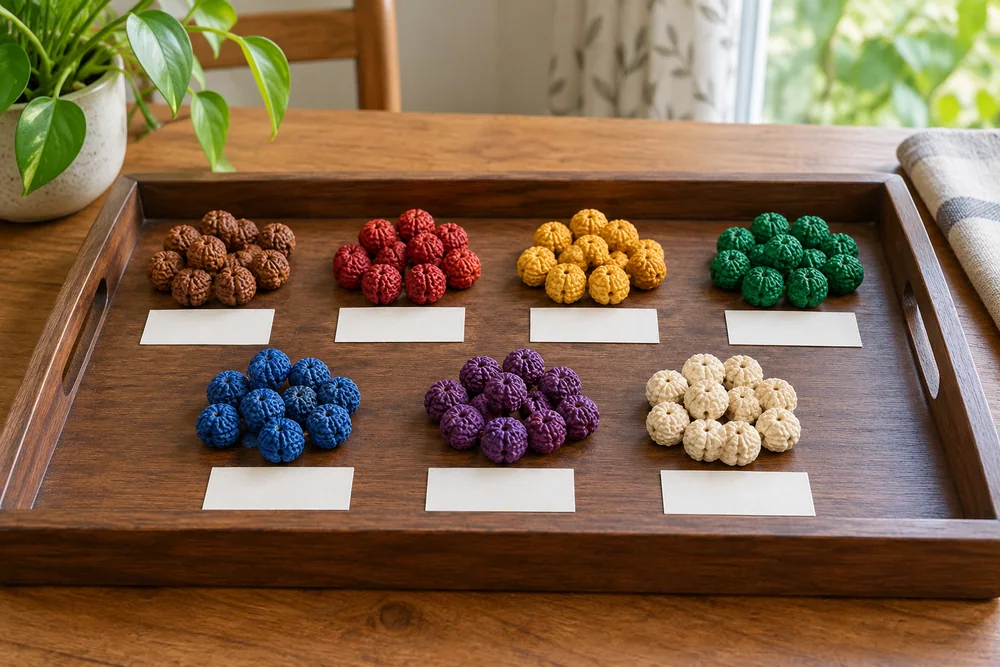
8. Natural gems, treated stones and manufactured beads
Seven colours do not prove seven natural gemstones. Common alternatives include dyed agate, coloured glass, synthetic or composite stones, painted resin, plated metal, imitation turquoise, manufactured “opalite” glass and products described under broad names such as “crystal.” Many are attractive craft materials; their use becomes misleading only when the retail description falsely claims a natural gem identity or undisclosed treatment.
GIA documents gemstone treatments including dyeing, heating, irradiation, coatings, filling and impregnation. Some treatments are common in legitimate trade, but the relevant facts should be disclosed where they affect identity, value or care. Gem-laboratory reports identify the stone and treatments within the scope of the report; a certificate attached to one bead does not authenticate six others.
For a seven-part hanging, create a component-level record: position one through seven, material name, colour, shape, known treatment, bead size and any coating or metal spacer. If one component remains unidentified, the description should say so or hold the product for verification rather than calling the entire item a certified natural seven-gem set.
A generated illustration showing a tray of coloured beads is useful to explain a sequence, but it is not evidence that the exact stones in a stocked OmmRudraksha hanging have those identities. Ask for photographs of the actual item and documented material descriptions.
9. Why two “seven chakra” hangings may contain different stones
There is no one universally mandated retail bill of materials. One supplier may use red jasper, carnelian, yellow calcite, green aventurine, lapis lazuli, amethyst and clear quartz. Another may select dyed agate or glass for some colours, or build the entire piece from identical painted wooden beads. Their colour sequences may look alike but their mineral, care and pricing statements are different.
When comparing options, ask whether “seven stones” means seven individual stones, seven colours across several dozen small chips, or seven decorative panels. A design can contain twenty-one beads arranged as seven groups, or one bead for each colour. The title alone cannot establish count, dimensions or weight.
Do not require all makers to use the same seven minerals as though the selection came from one fixed Vedic list. A supplier can offer a meaningful design by explaining the chosen materials and interpretation, without inventing an ancient text specifying that exact jewellery assembly.
Keep the word natural specific. A hanging can include five natural stones, one dyed agate bead and one glass piece; it should not be marketed as “all seven certified natural untreated gemstones.” A clear product table can handle this honestly and is more informative than repeating “pure chakra energy” in every line.
10. From coloured beads to a safe hanging: construction matters
Most seven-chakra hangings are built from individual beads or chips on thread, cord, wire, chain or a combination. Some use a wood or metal top frame, a central ring, a hanging loop, tassels or a pendant below. A mechanical connection must safely carry the total weight and tolerate any intended movement. The most delicate element may be a small crimp or a sharp-drilled bead, not a large visible central stone.
| Construction | What it does | What to inspect |
|---|---|---|
| Seven-colour bead strand | Displays a vertical or circular sequence | All bead identities, number of pieces, drilled holes, thread and end knot |
| Chip-stone tree or mobile | Uses many smaller irregular stone pieces | Sharp chip edges, multiple joins, wire ends and falling small parts |
| Large stone focal pendant | Adds a central heavy component | Retaining cage, bail, balance, drop and full load of the assembly |
| Wood or metal canopy | Holds several dangling strands | Top loop, frame integrity, exposed edges and full suspension points |
| Seven-colour chime with tubes | Combines symbolic accents and audible chime | Which components actually ring, striker/sail, clearance and accurate tuning claims |
| Glass suncatcher with chakra beads | Adds a refracting or reflective ornament | Actual glass identity, secure prism loop, glare and collision with windows |
A decorative wire spiral should not be treated as a structural guarantee. If a point is tapered, the lower wire cage must actually stop it from slipping. For beads, check abrasions around the drilled holes, knots and crimps; for a chime, ensure the striker cannot damage a fragile gemstone during gusts.
Manufacturer claims about “high-strength cord” or “premium brass” must match the real component. Colour cannot confirm wire alloy or a specific load rating. Do not infer a model is approved for permanent outdoor hanging because its hero image was staged against a balcony railing.
11. Seven beads are not seven measured musical frequencies
Colour and sound are two different physical phenomena. The arrangement of seven differently coloured stones does not generate seven defined audible notes by itself. A conventional wind chime's notes come from its vibrating tubes, rods or bells and the way a striker contacts them; beads may be there for appearance rather than to function as tuned sounding bodies.
A claim that an ornament produces a particular scale, specific frequency in hertz or healing vibration should be supported by model-specific acoustic information and appropriate evidence for the stated effect. Merely counting beads or matching a rainbow chart does not establish a musical raga, a bīja mantra or a medical outcome.
Traditional nāda and mantra practices have deep spiritual significance within Indian thought. That should not be confused with an arbitrary number printed on a retail tag. The owner may enjoy bells or gentle chime sounds as part of an ambience, while the seller accurately names the actual sound-making components.
12. Best display locations in a home
Choose placement based on the object's weight, light, sound and household circumstances. A fixed vertical bead strand may work on a stable interior wall where its order is visible. A light-catching prism may benefit from appropriate window light and angle. A chime with metal tubes requires airflow but should not disturb occupants or neighbours with frequent ringing.
Keep any hanging clear of doors, ceiling fans, glass, hot lamps, railings and repeated hard impacts. Do not hang dense minerals, sharp crystal points or glass directly above cots, busy walkways or occupied seating where a falling item could cause injury. Long cords and small detachable beads should remain out of reach of children and pets.
For a puja or meditation area, select a location that does not obstruct asana, japa, lamp use or household movement. A hanging should be kept away from open diya flames, incense embers and heat. A family's devotional preference can influence where a decoration is seen, but mounting safety and material limitations remain relevant.
For broader styling, the Crystal & Gemstone Hangings collection presents the wider material family. Check the actual materials and availability before buying.
13. Gentle cleaning for seven different materials
A mixed hanging can combine materials that tolerate moisture differently. Quartz-rich beads may be relatively durable, while dyed lapis, soft gypsum, porous stones, coated surfaces, timber spacers, adhesive joints and certain metallic finishes may require caution. GIA advises checking the gem type and any treatment before selecting a cleaning process. A single immersion or ultrasonic-cleaning recommendation cannot be applied safely to every seven-colour assembly.
Begin by supporting the ornament on a padded clean surface and gently dusting with a soft dry cloth or brush. Inspect drilled holes, loops, thread, glue joints and coatings before cleaning. Avoid assuming that vinegar, lemon juice, saltwater, strong soap, essential oils or repeated direct sunlight physically “purifies” all stones without risk. Some treatments and materials can be harmed.
Amethyst can fade with excessive strong light, as GIA notes. Soft gypsum sold as selenite or satin spar is easily scratched and slightly soluble in water. Pyrite, if added as a metallic-looking spacer, can be sensitive to humidity in some specimens. Dyed stones may lose colour or stain adjacent material when exposed to unsuitable liquids. These are specific physical concerns, not universal proof that every stone is unstable.
If a maker approves a limited damp cleaning for the actual stones, consider the complete hanging's cord, frame, coatings and adhesives before proceeding. Do not submerge an unverified assembly. When a bead cracks, the upper support loosens or the wire becomes sharp, keep people clear of the fall zone and arrange safe removal while supporting the full weight. Seek qualified help for high or heavy installations.
14. Sunlight, storage and seasonal exposure
The colours in a seven-chakra hanging may depend on mineral colour, added dyes, glass tint or surface coating. These respond differently to UV exposure, heat and moisture. Do not display a whole set in continuous strong sunlight just because one stone is quartz, especially when amethyst, dyed components or vulnerable cords are present.
Indian monsoons and coastal or humid conditions can also affect the attachment system. Cords can fray, metal rings corrode and wooden caps degrade. An indoor hanging may survive in a protected position even when it is inappropriate for an open balcony. A sheltered veranda is not necessarily rain-free during wind-driven storms.
For storage, photograph the bead order before disassembly; separate stones so hard surfaces cannot scratch softer pieces; protect fragile glass, gypsum and carved points with clean soft dividers. Do not tie the strand into a knot or pack it while damp. After seasonal storage, inspect every connector and the top fixing before rehanging.
If a manufacturer's instructions are unknown, a dry, protected interior location is a conservative display choice. Do not promise that a natural or handmade label implies UV resistance, waterproof construction or an outdoor service life measured in years.
15. Respecting mantra, yantra, Kundalini and sacred practice
A hanging with coloured beads can be a thoughtful decorative reminder of a family's spiritual interests. However, traditional chakra practice can involve disciplined contemplation, prāṇāyāma, mantra, nyāsa, visualisation, deity worship or instruction within a lineage. A consumer ornament is not automatically an authorised ritual instrument or proof that a specific spiritual practice has been performed.
Indian chakra traditions should be described using accurate vocabulary. The familiar names Mūlādhāra, Svādhiṣṭhāna, Maṇipūra, Anāhata, Viśuddha, Ājñā and Sahasrāra do not imply that every modern maker uses the same petals, syllables, yantras, diagrams or gemstone correspondences. Some systems describe six centres and a crown lotus; others differ in number and structure.
There is also an important distinction between a navaratna arrangement and a seven-chakra colour scheme. Navaratna has its own traditional and astrological associations involving nine gemstones in certain Indian contexts. A seven-colour strand should not be marketed as an authenticated navaratna set or a substitute for an individually evaluated Jyotisha recommendation.
A customer may appreciate the symbolism of colour, a lotus motif or a prayer space without expecting the hanging to cure disease, open a measured physiological centre or change a planet's influence. Respect for genuine spiritual significance and accuracy about what a product does are compatible.
16. Chakra hangings, Vastu and Feng Shui are not identical traditions
Vastu Shastra addresses built-space planning, including orientation, entrances, arrangement, proportion and principles interpreted through Indian architectural and cosmological frameworks. A chakra diagram, by contrast, belongs primarily to yogic and Tantric understandings of subtle anatomy. Their themes can coexist in a modern home's decor, but they are not the same classical system or a universal requirement for a doorway.
Contemporary Feng Shui recommendations sometimes refer to crystals, colours and spatial sectors within Chinese systems. These interpretations should be attributed to that distinct tradition instead of being merged into an alleged Sanskrit rule. A seven-chakra hanging does not become an obligatory Vastu correction merely because a product page displays compass directions or element symbols.
Some modern readers relate colours to personal intention, meditation or mindfulness. Those are meaningful choices for many households; they should not be presented as verified financial, medical or environmental performance claims. The practical placement of a hanging still depends on light, weight, movement, sound, humidity and safe support.
For wider Indian architectural context, read OmmRudraksha's Vastu Shastra guide and Vastu collection.
17. A transparent product description: sample checklist
A good listing should explain the item without making the customer guess at its content. An accurate description might say it is a seven-colour bead hanging with seven groups of assorted stones, identify each verified bead material in sequence, and then specify whether the upper ring is metal or wood and whether any glass decorations are included. If the assortment varies, clearly state the variation and do not imply customers receive seven specific stones when supply can change.
- State the form. Wall hanging, window mobile, wind chime or suncatcher—with the actual sound or light mechanism identified.
- List each material. Record all seven positions by verified mineral, rock, glass, resin or another accurate substance.
- Disclose known treatments. Dye, heat, coating, irradiation, impregnation or composite assembly when relevant.
- Clarify bead count. Seven individual pieces, seven groups, chips or a larger strand should not be conflated.
- Provide actual measurements. Full hanging drop, widest swing span, stone dimensions and combined weight.
- Show real merchandise. Label a generated diagram as educational, and verify actual-stock photographs and colour variation.
- Check every connection. Ring, knot, crimp, frame, wire cage, drilled hole and sharp edge.
- Describe intended placement. Indoor, sheltered or other use should follow verified full-assembly limits.
- Explain safe care. Use the most sensitive component to decide water, sunlight and cleaner restrictions.
- Separate tradition from evidence. Identify modern colour symbolism honestly; support certification, origin, sound-tuning or performance claims independently.
Before ordering, check the actual bead materials, item photographs, price, availability and included hardware. A label such as “seven chakra natural gemstones” requires evidence of the mineral identities and accurate treatment disclosure.
Frequently asked questions
Are the seven chakra colours ancient and identical in every Indian tradition?
No. Chakra traditions have a long Indian history, but the familiar red-to-violet retail rainbow arrangement is a modern synthesis. Sanskrit textual descriptions and practices vary.
Does a seven-chakra hanging always contain seven natural gemstones?
No. It may contain natural stones, treated beads, glass, resin or mixed materials. The seller should identify the actual components instead of using colour as proof.
Must every maker use the same seven stones?
No. There is no single universally prescribed ancient shopping list of seven mineral species for modern decorative hangings. Makers should disclose their chosen materials.
Is the six-chakra Sanskrit text incompatible with seven modern chakra names?
Not necessarily. The Ṣaṭ-cakra-nirūpaṇa describes six centres with Sahasrāra above; popular modern charts often count the crown as a seventh. Other traditional systems also exist.
Can dyed stones or glass be used honestly in a seven-chakra hanging?
Yes, as decorative materials when properly declared. Problems arise when dyed agate or glass is sold falsely as a specific untreated natural gemstone.
Are seven coloured beads equivalent to seven musical frequencies?
No. Colour and musical pitch are different physical properties. A chime must have a real sound-producing mechanism, and specific tuning or performance claims need separate evidence.
Can I soak a seven-chakra hanging in saltwater for cleansing?
Not as a general care method. Mixed stones, gypsum, dyed beads, cords, finishes and metal parts have different sensitivities. Gentle dry cleaning is a safer default when components are unverified.
Is a seven-chakra hanging the same thing as navaratna?
No. Navaratna refers to a nine-gem arrangement within particular Indian traditions and should not be confused with a modern seven-colour decorative sequence.
Does Vastu require a seven-chakra gemstone hanging in every home?
No universal classical Vastu rule requires it. A family may value the decoration and symbolism, but the product's materials and installation must still be accurately assessed.
Explore related OmmRudraksha hanging designs
Explore Crystal & Gemstone Hangings for other mineral and bead arrangements, or Hangings & Chimes for sound-producing and silent decorative choices. For traditional spatial context, see Vastu Shastra. Confirm the material description and availability of the individual item before purchase.


