

A Rudraksha-and-gemstone hanging combines two different classes of natural material: an organic sacred fruit stone and mineral or rock ornaments. Rudraksha has its own botanical structure and Mukhi terminology; quartz, amethyst, agate, jasper, lapis and other stones each have separate identities and care requirements. The combination can create a distinctive piece of home décor, but mixing the materials does not automatically authenticate them, make every bead a gem or confer a scientifically measurable spiritual benefit.
For OmmRudraksha buyers, an informative description should identify each component, state which Rudraksha bead carries any claimed Mukhi count, disclose known gemstone treatments and explain how the pieces are safely held together. This guide compares common combinations, decorative layouts, physical durability, installation, gentle cleaning and traditional Śaiva and Vastu context. It distinguishes personal spiritual meaning from specific evidence about the stock actually supplied.
1. Why combine Rudraksha with gemstones?
The rough, deeply textured surface of a Rudraksha endocarp contrasts with the smoother polish of many gemstones. Clear quartz can make that texture more noticeable, amethyst contributes violet, rose quartz brings a gentle pink tone, and dark tourmaline or blue lapis may create more pronounced contrast. The appeal can be visual, devotional, personal or a blend of these.
Some pieces are single-bead pendants with one mineral spacer. Others are longer hanging strands, bead clusters, framed doorway ornaments or mobiles carrying bells, tassels or glass drops. Their component counts, weight and movement vary. A design with one genuine five-Mukhi Rudraksha and three accurately identified quartz beads is different from an ornament with seven unknown coloured glass beads and a resin imitation of Rudraksha.
Neither arrangement is intrinsically unattractive; the commercial problem occurs when the listing calls every element a verified natural untreated gemstone or claims a specific premium Mukhi without evidence. Well-designed combinations allow individual bead materials to be identified, visually inspected and safely maintained.
2. Rudraksha is an endocarp, not a mineral crystal
Rudraksha comes from fruits of Elaeocarpus trees. The name Elaeocarpus ganitrus remains common in Indian literature and retail descriptions. Kew's Plants of the World Online currently places it under the accepted name Elaeocarpus sphaericus. This botanical naming distinction matters for accuracy, but does not diminish the bead's long-standing identification in Indian devotional traditions.
The dry hard bead is primarily the lignified endocarp of a fruit. It should not be called an ordinary timber sphere or a mineral gemstone. Its longitudinal natural grooves are central to familiar Mukhi classification, while a drilled channel is made or used for stringing and is not an additional face.
As a plant-derived material, Rudraksha may have pits, surface ridges, slight natural variation in size or colour and regions where a thread contacts the hard shell. These observations can be useful in description but are not complete authentication tests. The actual bead still needs specimen-specific inspection where material identity or a special Mukhi claim affects the purchase.
The combination therefore involves distinct material families: botanical endocarp plus mineral, rock or manufactured decorative components. Its care should not be based on a vague claim that all the parts are “natural crystals.”
3. Five-Mukhi and specialist Rudraksha in a combined hanging
Five-Mukhi Rudraksha is a widely used type in common Rudraksha products, including many bead strands. A seller should describe the natural grooves and show an adequate view of the actual stone. A photograph of one side cannot demonstrate the entire circumferential count, and the number of beads in a hanging is not the same as the number of Mukhi faces on a bead.
Specialist designs may feature higher-Mukhi beads or named natural formations such as Gauri Shankar. Such forms should not be automatically added to a generic bead assortment through marketing language. Each high-value claim belongs to a particular specimen and requires careful examination, traceability and an accurately interpreted report if certification is advertised.
A mixed hanging could contain one verified higher-Mukhi focal bead and smaller common five-Mukhi beads. That arrangement should be described precisely rather than calling all pieces the higher number. Likewise, two Rudraksha beads tied together should not be advertised as one naturally grown Gauri Shankar unless the jointed formation has been established.
For the source context, consult OmmRudraksha's existing five-Mukhi Rudraksha guide.
4. What is Sphatik, and why is clear glass different?
Sphatik or sphaṭika is commonly used in Indian spiritual and jewellery commerce for colourless rock crystal. Rock crystal is crystalline quartz, chemically silicon dioxide (SiO₂), and is a genuine mineral. A transparent bead, however, can also be glass, resin or synthetic quartz. Clear appearance alone does not prove natural geological origin.
GIA distinguishes manufactured glass imitations from gemstones based on physical properties and composition. A colourless decorative glass bead can be beautifully made and appropriate in a reasonably priced hanging, but it should not be labelled natural Sphatik if it is not quartz. Likewise, the word crystal on a product tag can refer ambiguously to natural quartz or commercial crystal glass.
A combined design might use one Rudraksha with polished clear quartz beads as a devotional-looking ornament. If the item has been authenticated, say Rudraksha with clear quartz; if the material is manufactured glass, say Rudraksha with clear glass beads. Do not imply that either has been ritually consecrated or made into a japa mala solely because the beads are transparent.
True rock crystal can be natural or laboratory-grown, and other clear stones can resemble it. Claims about untreated state, origin or a natural quartz gemstone should rely on appropriate supplier information or gemological identification when relevant to price and customer expectations.
5. Amethyst and rose quartz combinations
Amethyst is purple quartz, while rose quartz is a pink variety of quartz. Both may contrast attractively with a brown Rudraksha, especially when shaped as smooth round beads, polished drops or small pendants. Their relatively good scratch resistance does not protect a fragile drilled hole, an exposed wire end or the organic bead beside them.
GIA advises care with sunlight and heat for certain gem materials, including amethyst, which can fade after prolonged intense exposure. This is pertinent to a long hanging placed in a bright window. The Rudraksha cord or surrounding coatings may also deteriorate in strong light even when the gemstone remains sound.
Uniform purple colour does not authenticate amethyst, and a clear-pink bead is not automatically rose quartz. Dyed chalcedony, glass or other materials can create the same decorative palette. A retailer should describe known material identity, treatment and the distinction between actual-product images and generated educational illustrations.
Choose the arrangement based on real appearance and construction rather than assuming amethyst must always appear above rose quartz or that the sequence has a universally prescribed ancient meaning. Contemporary decorative colour choices and specific traditional gem prescriptions are different matters.
6. Carnelian, jasper and agate with Rudraksha
Carnelian is generally a reddish-orange chalcedony material. Jasper is often an opaque fine-grained silica-rich rock, sometimes with iron-bearing pigment; agate is familiar for its banding. These earthy colours can complement Rudraksha's brown surface and can be used in compact strings, decorated wall panels and bead mobiles.
A mix with red jasper can look deliberately rustic, while translucent carnelian or a banded agate slice can add light transmission. Some agate and chalcedony products are dyed or otherwise treated, so the exact colour cannot automatically be described as natural untreated pigment. A dramatic orange bead may be glass, calcite or another stone rather than carnelian.
Agate slices drilled near their edges require careful suspension: an opening close to a thin natural band can weaken the slice. Hard polished beads can rub against the thread, so knots or suitably designed spacers may be useful. Do not claim that a simple strand produces tuned chime notes without an independently identified sounding element.
A product can truthfully state that these stones are chosen for earthy colours and traditional associations where relevant. It should not promise that attaching them to Rudraksha creates a new material with proven healing or financial effects.
7. Lapis lazuli, sodalite and other blue stones
Lapis lazuli is a multi-mineral rock, usually containing lazurite with variable calcite and pyrite; it is not a single chemically pure blue crystal. Sodalite is a distinct mineral that often appears blue with lighter areas. They can be confused in jewellery and decoration, particularly when only a small bead is shown.
Blue lapis may be dyed, waxed or impregnated, and that treatment history affects care and retail accuracy. Not every lapis specimen contains obvious brassy pyrite flecks, so their absence alone does not prove the material is sodalite. Colourful glass and dyed agate can also resemble either blue stone.
A Rudraksha-and-blue-stone hanging may combine matte brown texture with polished blue beads. Examine whether the blue beads are all the same mineral or an assortment. The product name should not call the complete strand “lapis” because one bead happens to be genuinely lapis while the others are unidentified.
For cleaning, dry gentle methods are preferable for a combined assembly whose lapis treatments and organic cord are not established. Do not apply aggressive solvents, prolonged water immersion or acidic solutions without confirming the material and treatment.
8. Green aventurine, jade and other green materials
Green aventurine is a quartz-rich material often coloured by mica inclusions such as fuchsite. Jade is a different gem category, principally including jadeite or nephrite. A bead described as “jade-colour green crystal” may express a colour preference without establishing that it is a jade mineral.
The physical distinctions matter commercially. Treatment descriptions, hardness, density and typical value may differ significantly, and a dyed glass or serpentine bead can also appear green. Ask for accurate material names rather than accepting “green stone” as proof of premium jadeite or an untreated gemstone.
In a hanging, polished green beads are commonly separated by knots, smaller spacers or metal rings. Check the points where rigid beads contact organic endocarps or delicate string, especially if the assembly will swing. A premium jade claim should not be inferred from colour or a generated image.
The symbolic choice of a green stone can be meaningful in modern colour-based spiritual practice, but those associations are not a substitute for verifying the stone or the quality of the suspension.
9. Black tourmaline, pyrite and other material-specific concerns
Black tourmaline is commonly marketed for its deep colour and textured crystal habit; much genuine black tourmaline is the species schorl. The actual stone may have angular ends that can scratch nearby beads or abrade cord. An ornamental wire spiral must retain the specimen mechanically, not merely decorate its face.
Pyrite is iron disulfide, often recognised by a brassy metallic colour. Some specimens can undergo moisture-related oxidation and progressive deterioration. A mixed hanging containing pyrite should therefore not be routinely immersed, displayed in continuous dampness or treated with acid or household metal polish. An otherwise stable quartz bead does not remove the need for pyrite-specific care.
White material sold as selenite is often transparent or fibrous gypsum, including satin spar. Gypsum is soft and slightly soluble in water; a Rudraksha-and-gypsum hanging should be handled as a delicate dry-display object, especially around narrow drilled holes and brittle ends.
Distinct stone properties must be disclosed even when they make a combination less suitable for an outdoor balcony. The product title should not promise all-weather durability just because one of the components is a hard silicate gem.
10. Compare materials and care before selecting a combination
The table below is a buying and maintenance reference, not a certification of OmmRudraksha's individual stocked beads. Actual stone identity, treatments, country of origin, coatings and safety must be checked against the physical merchandise.
| Material paired with Rudraksha | Main visual character | What to verify | Combined-hanging care concern |
|---|---|---|---|
| Clear quartz / Sphatik | Colourless transparent mineral | Genuine quartz versus manufactured glass; natural or synthetic claim | Drilled holes, cord and any organic-bead conditioning |
| Amethyst / rose quartz | Violet or pink quartz | Actual identity, any treatment and real-stock colour | Amethyst light exposure; impacts and strand abrasion |
| Carnelian / agate / jasper | Warm orange/red or banded silica | Correct type, dye and coating disclosures | Thin agate edges, dyed finishes, drilled beads |
| Lapis lazuli / sodalite | Deep blue with possible pale or brassy patterns | Rock versus mineral identity, wax/dye and other treatments | Solvent and immersion sensitivity of treatments |
| Green aventurine / jade | Green polish, sometimes small reflective inclusions | Actual aventurine, jadeite, nephrite or substitute | Impact on carved projections; correct treatment care |
| Black tourmaline | Dark mineral, rough point or polished bead | Verified mineral, real fractures and holding method | Sharp edges and a cage that really retains the stone |
| Pyrite | Brassy metallic geometric pieces | Genuine pyrite, specimen condition and source | Keep suitably dry; inspect for oxidation or powdering |
| Gypsum / satin spar | White fibrous or transparent material | Gypsum rather than quartz or glass | Soft, fragile and water-sensitive; dry cleaning preferred |
The correct maintenance rule for an entire hanging is set by the most vulnerable relevant component, including threads and coatings, not just its strongest stone. If an assemblage includes Rudraksha, selenite and metal wire, quartz-specific cleaning instructions alone are insufficient.
11. One focal bead or a long alternating strand?
The number and order of the components influence both appearance and physical behaviour. A single five-Mukhi Rudraksha combined with a small quartz pendant has a different load path from a 50-centimetre strand of repeated organic and mineral beads. A framed hanging with multiple chains adds another set of connections, while a bell-and-gemstone ornament may move more frequently than a fixed wall decoration.
Alternating bead designs benefit from clear counts. If a listing promises five Rudraksha and five amethyst beads, those counts should match the actual article. If the design varies naturally, say what variation the customer should expect. The word “handmade” does not justify delivering a different mineral or an unverified Mukhi in place of the selected choice.
Consider the orientation of each component. A polished labradorite pendant may need a particular viewing angle; a wide agate slice may be delicate at a drilled edge; an angular tourmaline point should not swing into a softer bead. A long strand needs enough separation from a door and window to prevent repeated impacts.
The construction should be chosen to support the actual mass and dimensions of the product, not a generic template used for a lighter design. A new heavy focal stone can change the safe mounting requirements even if the decorative pattern remains otherwise identical.
12. Construction comparison: where failure can occur
| Design or connection | Visual benefit | Critical physical check |
|---|---|---|
| Single Rudraksha with quartz drop | Organic brown against transparent mineral | Upper ring, drilled ends, strong loop and no load on fragile projections |
| Alternating Rudraksha/gemstone beads | Regular rhythm of texture and colour | Real bead count, separated materials, holes, cord wear and end knots |
| Rudraksha with wire-wrapped rough crystal | Exposes natural crystal shape | Fully retaining lower wire cage, smooth cut ends and correct total weight |
| Framed mixed-material wall ornament | Displays several strands and motifs | Strong frame joints, independent load paths and suitable substrate fixings |
| Rudraksha, gemstone and bell | Combines religious motif and audible decoration | Sounding component, clapper movement, separate secure connections |
| Rudraksha and glass suncatcher | Transparent highlights and possible prism rainbows | Glass identity, facets, sunlight safety and impact clearance |
| Special joined Rudraksha form | Displays distinctive naturally shaped bead | Actual specimen verification and cradle that protects the junction |
A bead can be authentic but incorrectly mounted. A thick metal cap that obscures natural Mukhi grooves may make it difficult to verify a premium claim, while a large polished bead hanging from one weak adhesive may endanger people below. A sensible design balances visible identification with safe retention.
13. Inspect the cord, drilled holes, wire and hardware
Follow the physical load path from the top fixing to the lowest component. The support may include a hook, bail, jump ring, cord, knot, crimp, jewellery wire and one or more drilled stones. Each interface matters. A high-quality bead cannot compensate for a cracked loop, and a polished gemstone should not be allowed to cut a soft thread at an unprotected edge.
Natural cotton, silk, synthetic fibres and metal wire have different responses to abrasion, moisture and prolonged sunlight. Avoid assuming that a visually thick cord has a known working-load rating. If a design combines heavier stones with organic Rudraksha, the maker should establish an appropriate cord and closure for the actual assembly rather than using one decorative knot for everything.
Sharp edges at drilled holes can wear thread during normal motion. A wire-wrap cage must retain a smooth or tapered stone beneath the widest point, and exposed cut-wire tips must be controlled so they cannot snag clothing or scratch people. Metal fittings may be solid copper, brass, other alloys or plating; appearance alone does not determine their composition.
Inspect top and bottom connections from several angles, preferably while the ornament rests on a padded surface. If a connector is spreading, a bead has cracked at the drill opening or the cage permits slipping, keep people clear of the fall zone and arrange safe removal while supporting the full weight, with competent help for high or heavy installations. Have the damaged component repaired or replaced before rehanging.
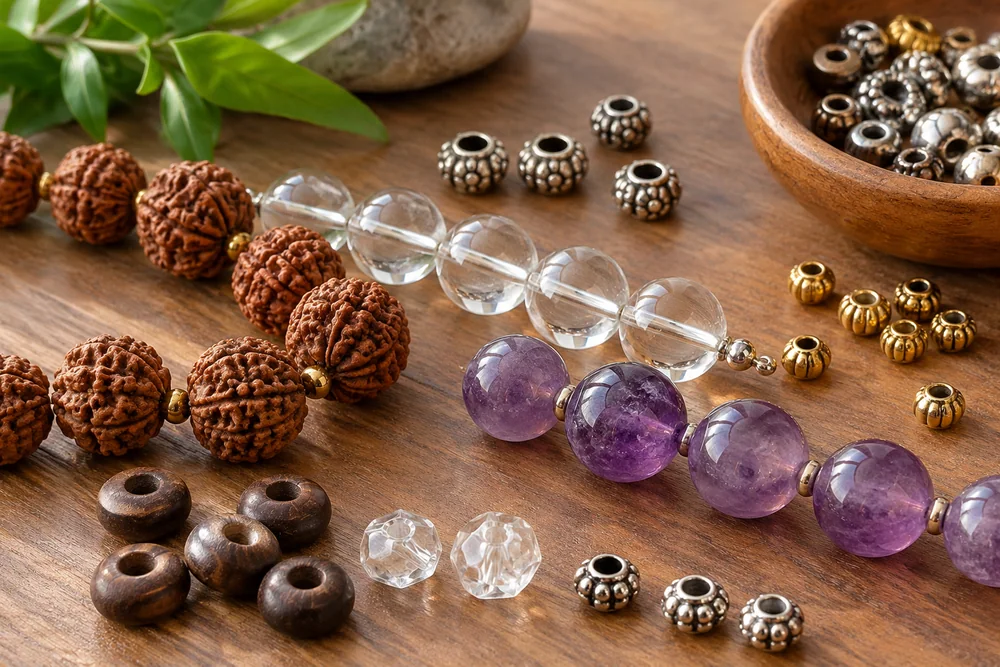
14. Accurately record each gemstone and Mukhi bead
For a mixed-material hanging, a small inventory table at the product level can prevent mistakes. It should name the Rudraksha type and count, each distinct gem or decorative material, any known treatment, number of pieces, dimensions or allowed variation, and full hanging size and mass. If a particular component is not verified, the description should say so rather than quietly assuming it is genuine mineral material.
The main product photograph should show the actual or clearly representative complete hanging. Where a specialist Mukhi or high-value gemstone is advertised, record the individual specimen before it is partly covered by a cap or wire. A generated educational illustration can support an article, but cannot authenticate the actual stones in a shipped product.
For a premium Rudraksha bead, a report may address natural morphology or a Mukhi count. A gem laboratory may identify a quartz or other mineral separately. A report for one component does not automatically cover the whole strand, its metal alloy, its mounting strength or every other bead. The report's scope and its connection to the actual item should be explained.
If a customer orders a particular verified Mukhi-and-gemstone combination, substitutions should not occur without agreement. Choosing a variant from several available patterns is different from replacing a premium bead with a cheaper unknown one while keeping the original title.
15. A realistic approach to Sphatik, gemstone and origin claims
The words natural, untreated, genuine, Nepal, Indonesia and certified each express distinct facts. A genuine botanical Rudraksha may have uncertain geographical provenance; a genuine amethyst can still be treated; clear glass may be an honestly made decorative material but not natural quartz. Combining the objects does not erase those distinctions.
A bead sold as Nepal-origin Rudraksha should have traceable sourcing appropriate to the claim. Its large size or deep surface lines alone cannot reliably establish geography. A green gemstone sold as jade needs actual gemological identification; polished green aventurine is not the same material. A purple bead in a spiritual arrangement needs confirmation before it is called untreated amethyst.
Be wary of descriptions such as “all beads individually X-ray certified” when only a generic report graphic appears. A particular test can support a particular conclusion about a particular specimen. It does not prove divine origin, planetary suitability, exact growing location or the absence of treatment in adjacent mineral stones.
Customers should be able to see clear naming and the evidence actually available. A responsible listing often has greater lasting value than dramatic statements that cannot be verified from stock records.
16. Are Rudraksha-and-gemstone combinations suitable for a doorway?
An interior entrance can be a suitable decorative place for a well-made hanging, but the object should not obstruct movement, catch on a handle or be at risk of being pulled. Measure the complete drop and width, including bells and tassels. Check the door's full swing and allow clearance for wind-driven motion.
A fixed indoor wall position may be more manageable for a heavy mixed strand than an open balcony. Exterior areas can expose organic material, dyed stones, plated fittings and cords to humidity and rain. Some pyrite pieces are especially vulnerable to unsuitable dampness and gypsum is water-sensitive. Material-specific limitations should influence location rather than an unverified all-weather claim.
Choose mounting hardware approved for the actual mass, surface and movement. A small adhesive picture hook is not necessarily appropriate for a heavy, swinging stone ornament. Do not hang sharp, heavy or detachable components directly above cots, occupied seating or busy passages; keep long cords and small beads away from children and pets.
Near a puja area, leave adequate space from open diya flames, incense embers and hot lamps. An ornament can be displayed respectfully without compromising safety or interfering with devotional practice.
17. Gentle care for Rudraksha plus minerals
The safest general starting point for an unidentified mixed-material hanging is a soft clean dry cloth or very gentle dry brush. Support the assembly on a padded surface, inspect the joins and clean one accessible component at a time without pulling on small spacers or loosening the cord. If material flakes, dye transfers or a mineral begins shedding powder, stop rather than scrubbing harder.
Gem care must be chosen by actual species and treatment. GIA notes that light, heat and cleaning methods can affect amethyst and other materials, and that some treatments are sensitive to solvents or ultrasonic methods. Drying a Rudraksha-plus-gemstone hanging after a wholesale water soak can also leave moisture trapped in knots and metal fittings.
Some devotional maintenance traditions apply oil or ghee to certain loose Rudraksha beads. Such practices should not automatically be extended to an assembled ornament containing dyed lapis, glued spacers, metallic coatings or porous materials. Excess oil may affect some finishes and attract dust. The physical care of the whole product should follow its maker's verified recommendations.
Do not soak a mixed hanging in saltwater, lemon juice, vinegar, perfume or other household solutions as a universal spiritual or cleaning treatment. Gypsum may suffer water damage, pyrite can deteriorate under unsuitable moisture and coatings or cord may be compromised. If any part needs special conservation care, the whole arrangement should be managed accordingly.
18. Monsoon, sunlight, storage and seasonal inspection
India's monsoon seasons make sheltered-but-wet locations especially relevant. A covered veranda may still receive wind-driven rain, condensation and splash from plants. After substantial weather exposure, check the organic beads, cotton or synthetic cord, metal joiners and delicate gemstone surfaces for discoloration, corrosion, cracked holes and loosened components.
Prolonged strong sunlight can fade certain gem colours, damage some treatments and degrade vulnerable cords or organic finishes. A Sphatik-and-Rudraksha hanging need not be placed in full sun to be appreciated. If glass prisms are included, assess the real light path and avoid positions where curved glass could concentrate sunlight onto combustible fabric or paper.
For storage, photograph the order of beads and the position of each named specimen. Separate hard and soft components with clean padded dividers. Do not wrap sharp mineral points directly against a delicate Rudraksha projection, gypsum wand or glass ornament. Avoid damp storage, pressure on wire frames and tangled strands.
After transport or a long period in storage, inspect every upper and lower connector before rehanging. A strand can look intact from the front while a ring has opened or a cord has been abraded at one stone hole. Maintenance should prioritise safe structural condition over cosmetic shine.
19. Traditional Rudraksha, ratna and japa meanings
Rudrākṣa is closely connected to Rudra–Śiva and is praised in Śaiva literature. The Śiva Purāṇa contains passages on its greatness, Mukhi forms and use in devotional practice. Indian ratna traditions likewise assign importance to gemstones in varied ornamental and Jyotisha contexts. A household can sincerely value those meanings without treating a modern shop display as a textually identical ancient ritual arrangement.
A japa mālā serves mantra repetition and may have specific counting arrangements, a meru bead and a method of use depending on the tradition. A decorative wall hanging with Rudraksha and quartz is not automatically a wearable japa mala, a Siddha mala or an individually prescribed planetary gemstone combination. The structure and purpose should be named accurately.
Some modern interpretations connect particular Rudraksha Mukhi counts with deities or grahas and choose gemstones for complementary symbolism. Such statements should be attributed to the relevant lineage, text or practitioner rather than copied as a universal guarantee. A specialist recommendation may take personal context into account; an ordinary home hanging is a different product journey.
Spiritual significance should not be reduced to a bland decorative claim, but nor should it be converted into promises of disease prevention, assured wealth, “measured energy amplification” or a change to someone's birth chart. The meaningful traditional terms can remain while material claims are documented honestly.
20. Vastu Shastra, house design and personal symbolism
Vastu Shastra is an Indian architectural tradition addressing spatial arrangement, orientation, circulation, proportion and symbolic frameworks such as the Vastu Purusha Mandala. Rudraksha's major textual significance belongs principally to sacred-bead and Śaiva devotional traditions, while different gems have their own historical, astrological and ornamental roles.
A contemporary designer may incorporate Rudraksha and gemstones into a Vastu-inspired entrance decoration. That is a valid description of its intended symbolism when presented appropriately. It is not evidence that all classical Sanskrit Vastu treatises prescribe one fixed set of combined beads at every door, or that a household can correct an architectural problem simply by adding a certain colour of quartz.
Chinese Feng Shui colour and crystal-sector systems have distinct roots and should not be conflated with Indian Vastu as if they use identical classical instructions. Some buyers may appreciate elements from more than one tradition; clear attribution avoids historical confusion.
For broader context, see the existing Vastu collection and Vastu Shastra guide. The practical location should still be chosen according to stable mounting, household use, humidity and safe clearances.
21. Ten-point buying checklist
- Verify Rudraksha identity. Confirm real organic endocarps and identify the natural Mukhi of each specially advertised bead.
- Identify every gem or decorative piece. Distinguish genuine quartz, agate, lapis, glass, resin, metal and other components individually.
- Ask about treatments. Dye, heating, waxing, coating, impregnation, glued assembly and synthetic or manufactured alternatives should be stated when relevant.
- Clarify bead counts. List the number of Rudraksha and gemstone beads separately, including special focal pieces and any variable stock assortment.
- Review real images. Request actual-stock photographs showing Mukhi lines, gemstone surfaces, back of the frame and all attachment points.
- Check report scope. A lab or Mukhi verification report should match the specific bead and not imply testing of every unrelated component.
- Measure the complete hanging. Total length, width, full weight, bead size range, frame and included mounting hardware must be recorded.
- Inspect secure construction. Check knots, drilled holes, rings, wire cages, end caps and clearance between hard and soft pieces.
- Confirm care and placement. Avoid blanket soaking or all-weather claims; choose conditions suitable for the most vulnerable material.
- Verify purchase information. Confirm the item identifier, selected materials, documented source claims, availability, price, options and return terms.
Frequently asked questions
Can genuine Rudraksha be combined with natural gemstones in one hanging?
Yes. A well-made ornament can combine genuine organic Rudraksha endocarps with accurately identified minerals or rocks. Each component should be described separately and safely mounted.
Is Rudraksha itself a gemstone?
No. The familiar Rudraksha bead is a hard botanical fruit endocarp from an Elaeocarpus species, not a mined mineral crystal. Its traditional Mukhi classification belongs to that organic structure.
Does a transparent bead automatically mean natural Sphatik?
No. Rock crystal or Sphatik refers to quartz in common Indian gem commerce; glass, resin and synthetic materials can look similar. Verify the actual substance and any natural-origin claim.
Can a Rudraksha-and-amethyst hanging fade in sunlight?
Some amethyst can fade under prolonged intense light, and cord or finishes may also deteriorate. Choose display conditions after checking the actual gem, treatment and construction.
Does a five-Mukhi Rudraksha make every attached stone spiritually certified?
No. The bead's traditional identity is separate from the gemological identification, treatment, authenticity or laboratory certification of adjoining stones.
Are blue lapis and sodalite interchangeable in a hanging?
No. Lapis lazuli is a multi-mineral rock, while sodalite is a distinct mineral. Retail descriptions must identify the material actually supplied rather than substituting a similar blue bead silently.
Can I soak a Rudraksha-and-gemstone hanging in oil or saltwater?
Not as a universal method. Organic beads, dyed or waxed stones, gypsum, pyrite, adhesives, cords and metal finishes can respond differently. Use item-specific guidance and gentle dry cleaning where uncertain.
Should a gemstone combination hanging be sold as one product or several variants?
Meaningfully different verified materials or special Mukhi focal beads may justify separate products; ordinary choices of length, colour or size may suit variants. Every offered choice still needs accurate stock and description.
Does pairing Rudraksha with a gemstone guarantee luck, health or prosperity?
No. Rudraksha and gems have important meanings in particular religious and Jyotisha traditions, but a modern decorative hanging is not a guaranteed medical, financial or astrological intervention.
Explore OmmRudraksha bead and hanging collections
For natural bead context, read Five-Mukhi Rudraksha. Compare the Crystal & Gemstone Hangings category and Hangings & Chimes collection for different decorative constructions. Before buying a combination, confirm the actual item, Mukhi, gemstone identity and availability.


