

The safest way to clean a gemstone hanging is to identify every part before touching it with water or a cleaning product. A polished quartz bead may tolerate care that would damage a soft gypsum rod, a dyed lapis bead, an oxidising pyrite specimen or a plated wire fitting. The hanging may also depend on thread, knots, adhesives and drilled holes whose condition matters more than the sparkle of the stone.
This practical OmmRudraksha maintenance guide explains how to inspect a mixed-material hanging, remove ordinary dust, decide whether moisture is appropriate, handle specific gemstone families, inspect suspension hardware and prepare a display for Indian monsoon conditions. It also covers transport, seasonal storage and when a defect calls for professional repair rather than additional cleaning. Ritual or symbolic “cleansing” is discussed separately from the physical care a mineral and its fittings require.
1. Begin with the actual materials and construction
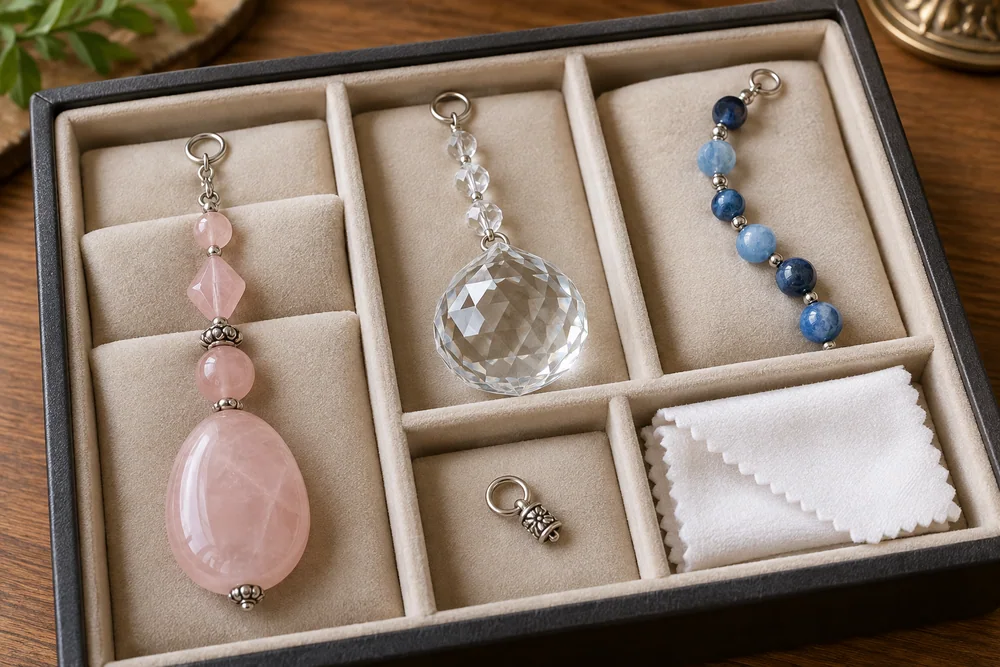
“Gemstone hanging” is a decorative category, not a uniform material specification. One product may contain a quartz point in copper-coloured wire; another has agate chips, lapis beads, a glass prism, wooden spacers and a textile tassel. A third includes a satin spar gypsum wand, black tourmaline and a painted metal frame. Those objects do not deserve identical cleaning instructions simply because the retailer uses the word crystal.
List the components first: mineral or rock species, known treatments, surface coatings, adhesives, metal or wire type, cord, drilled holes, ornamental wood and any bells or glass. If a supplier cannot confirm the stone identity, its dyed or treated state or the metal finish, treat that uncertainty as a reason for conservative care rather than assuming the object is untreated quartz.
GIA's gemstone-care guidance places particular emphasis on knowing the gem and its treatment. Heat, solvents, ultrasonic vibration and steam can damage some stones or treatments; even a durable untreated gem can be unsafe to clean in a fragile setting. For a mixed hanging, the most sensitive component and weakest connection set the practical limit.
2. Inspect the hanging before taking it down
Care starts with an inspection rather than a bottle of cleaner. From a safe position, look for loose rings, stretched loops, frayed cord, visible cracks, rust, unstable mineral surfaces and pieces that collide. A bead with a chipped drill hole may release when handled. A wire-wrapped stone with an opening at the bottom may fall once the top loop is moved.
Choose a suitable working space and lay a padded tray or clean soft towel on a stable table. Support the weight of the whole assembly before releasing its hook; do not pull it down by its lowest bead, the tail of a tassel or a fragile gypsum end. If the hanging is heavy, fixed high or inaccessible without unsafe climbing, seek appropriate assistance rather than attempting to retrieve it while balancing on furniture.
Photograph the front, back and connection layout before disturbing the strands. Note any wear, colour transfer, powdering, loose clapper, cracked glass or sharp wire end. If a support is visibly damaged, keep people clear of the fall zone and arrange safe removal while supporting the full weight. Seek competent help for high or heavy installations; do not rehang until the load-bearing fault has been addressed.
3. A simple dry-cleaning routine for ordinary dust
Dry dusting is the safest general starting point when a mixed item's complete identity and finish are not known. Use a soft clean lint-free cloth, a gentle dry brush or another maker-approved nonabrasive tool. Hold each bead or ornament individually so the cleaning movement does not pull against its cord or wire. A soft brush may reach between sound beads, but avoid rubbing fragile fibrous mineral surfaces repeatedly.
Work from the upper support down through the components, checking that dust is ordinary surface dirt rather than new corrosion or disintegrating mineral. Do not use a stiff toothbrush, abrasive powder, compressed-air blast or vacuum suction that could detach a tiny stone or tassel. For a rough crystal cluster, it may be safer to leave material in a crevice than to scrape at a loose projection.
Dry methods are not universally harmless: a heavily flaking painted surface, powdery pyrite specimen or delaminating gypsum can be damaged by brushing. If material moves, colour transfers or flakes appear unexpectedly, stop. An everyday cleaning routine should not erase the evidence of a condition problem.
4. Material-by-material care matrix
The table below is a first-pass household guide rather than permission to wash a mixed assembly. If the stone has a treatment, glued component, damaged surface, cracked setting or an unknown identity, the more cautious option applies. Manufacturer instructions and relevant qualified advice take priority.
| Material or family | Conservative initial care | Special concern | What not to assume |
|---|---|---|---|
| Clear quartz, rose quartz, amethyst, smoky quartz | Soft dry dusting; limited mild soapy cleaning may suit an identified loose, sound quartz stone | Amethyst may fade in strong light; fractures, treatments and fitted hardware matter | Every quartz hanging is safe for steam, ultrasound or immersion |
| Agate, carnelian, jasper and aventurine | Dry soft cleaning first; follow known treatment and assembly instructions | Dyes, coatings, cracks, porous zones and cord wear | All saturated colours are natural or colourfast |
| Lapis lazuli and sodalite | Gentle dry cleaning, then maker-approved treatment-aware care only | Lapis may be dyed, waxed or impregnated; some blue stones are misidentified | Blue colour guarantees an untreated stable mineral |
| Jadeite and nephrite | Soft dry cloth; targeted mild methods for verified material when maker permits | Dyed or polymer-treated jadeite, wax and thin carvings | All jadeite treatment grades have the same care requirements |
| Labradorite and other feldspars | Soft dry cloth and gentle handling | Cleavage, impact damage and surface scratches | A polished feldspar face tolerates harsh scrubbing or ultrasonic cleaning |
| Tourmaline | Soft dry cleaning for a mixed hanging | Cracked points, rough projections, insecure wrap | Hardness makes the specimen or fixing unbreakable |
| Selenite/satin spar gypsum | Very gentle dry cleaning; avoid soaking | Very soft and slightly water-soluble; may cleave or shed fibres | A white “crystal” can be washed like quartz |
| Pyrite | Keep dry; inspect stable surface; minimise handling when powdering | Some specimens oxidise and deteriorate in humidity | Water or metal polish will halt oxidation |
| Glass prism, Capiz shell, painted ceramic or mixed ornaments | Use the care advice for the exact component and finish, generally dry first | Sharp edges, dyes, brittle glaze, shell or applied coatings | Clear or glossy objects all tolerate one glass cleaner |
GIA's guidance for lapis, quartz and treated gems, together with the Canadian Conservation Institute's mineral collections advice, supports a material-specific approach. A household maintenance article cannot certify the durability or treatment status of individual OmmRudraksha stock without inspecting the actual merchandise.
5. Quartz-family care: amethyst, rose and smoky quartz
Quartz is crystalline silicon dioxide with Mohs hardness near 7. Clear quartz, amethyst, rose quartz and smoky quartz are related materials, and sound untreated loose pieces can often be cared for by gentle methods. But scratch hardness is not a universal cleaning approval: pointed ends chip, fractures weaken a bead and a wire cage or textile strand may be far less durable than the stone.
GIA advises that some amethyst can fade after prolonged intense light and that excessive heat can alter its appearance. Rose quartz is generally stable under ordinary light and heat, but GIA recommends avoiding ultrasonic and steam cleaners. For a suspended combination of these stones, there is little reason to adopt a vibrating or steam-based method when an ordinary clean soft cloth can remove most dust.
If a supplier confirms the exact quartz components are untreated and can be safely separated from vulnerable fittings, a limited warm-water and mild-soap clean may be appropriate to the individual stone. Do not assume the entire hanging should be immersed or left soaking. Avoid unexpected temperature changes, rough handling and pressure on a pointed terminal.
Smoky colour can arise from natural or induced irradiation-related processes, but not every dark piece has the same treatment history. A customer's claim of “natural untouched crystal” requires documentation separately from the advice that quartz is relatively hard.
6. Agate, carnelian, jasper and green aventurine
Agate, carnelian and many jasper materials belong broadly to the fine-grained silica family, while green aventurine commonly contains quartz with reflective inclusions such as fuchsite mica. These stones often receive polish and are used for drilled beads or decorative slices. Their shared silica character does not make every colour treatment or surface finish stable under the same cleaner.
Agate and chalcedony can be dyed. Brightly coloured slices may fade or interact with unsuitable solvents; glues and painted metal frames may be affected separately. When a colour changes after wiping or transfers onto a cleaning cloth, stop using the product and ask the supplier for care guidance. Do not rub more vigorously to “remove excess dye.”
Protect thin agate-slice edges and drilled holes. A dry soft brush can help with light dust on a sound polished surface, but repeated aggressive scrubbing can snag a wire or stress a thin slice. Red jasper bead strands also depend on their holes and knots. Aventurine's soft-looking sparkle is an optical effect of inclusions in the actual material; it does not benefit from abrasive polishing.
A manufactured aventurine-glass component should be described and cared for as glass, not natural aventurine quartz. Similar retail names are not sufficient evidence that one cleaning rule applies across them.
7. Lapis lazuli, sodalite and treated blue stones
Lapis lazuli is a multi-mineral rock frequently containing lazurite, calcite and pyrite. GIA identifies its hardness as approximately 5–6 and documents common dye, wax or oil treatment. This matters for cleaning: chemical solvents, excessive heat or abrasive treatment may affect the finish or colour. A careful household approach begins with a dry soft cloth rather than testing an unknown blue bead with alcohol, acetone or a strong cleaning agent.
Sodalite is a separate blue mineral that can resemble lapis, especially when pale areas are visible. Its name or apparent texture does not prove the material's treatment status. A blue bead sold as lapis should not be cleaned under lapis-specific assumptions until its identity is actually known, and the absence of pyrite flecks is not by itself a reliable diagnostic test.
Where a supplier approves gentle damp cleaning for a verified lapis piece, consider whether the bead is dyed or coated and whether the entire assembly contains adhesives, unstable cord or other stones. The presence of calcite in lapis adds a reason to avoid household acidic solutions. A stone may survive a light wipe yet still be unsuitable for prolonged soaking.
Do not try home solvent-rubbing tests to establish whether blue is dyed. A commercial gemstone description must be based on relevant supplier, gemological or laboratory evidence, not a potentially damaging cleaning experiment.
8. Selenite and satin spar gypsum: the dry-care exception
The white translucent or fibrous pieces sold as “selenite” are often gypsum. Transparent crystals are commonly described as selenite, and many white satin-sheen wands are satin spar gypsum. Gypsum has Mohs hardness near 2, which means it scratches readily, and the University of Minnesota's mineral reference describes its cleavage and water solubility.
For a hanging containing gypsum, avoid soaking, wet brushing, steam and ultrasonic cleaning as default practices. Even an otherwise robust quartz-and-gypsum design must follow the gypsum component's stricter limits. Repeated wetting can affect exposed surfaces, while rubbing may separate fibrous material or dull a soft polished face.
Use minimal-pressure dry dusting of sound areas. Avoid pulling a fragile wand by its end or pressing tightly against a wire setting. If its support is cracked, fibers loosen or the mineral sheds unexpected powder, stop and check whether it remains safe for suspended display.
The name “selenite” has spiritual meanings in contemporary crystal markets, but the mineral's physical limitations remain relevant whatever symbolic importance it has for the owner.
9. Pyrite oxidation: when cleaning should stop completely
Pyrite is iron disulfide (FeS₂) and can oxidise when exposed to oxygen and moisture. Some specimens are particularly vulnerable to a progressive form of deterioration called pyrite decay, which may lead to cracking, powdery products, expansion and loss of integrity. The Canadian Conservation Institute explicitly describes risk for vulnerable pyrite under relatively humid conditions; museum sources stress the importance of stable, appropriately dry storage.
Not every pyrite bead or cube will undergo severe decay. Condition depends on the specimen and environment. Nevertheless, a pyrite-containing hanging should not be soaked in saltwater, washed in acid or placed indefinitely in a damp bathroom or exposed monsoon location. These are poor default maintenance choices even if a nearby red jasper bead is stable.
When an otherwise sound pyrite object has only ordinary dust, very gentle dry care may be reasonable. But if it shows new white or yellowish crusts, rust-like changes, cracking or progressive powdering, do not vigorously brush the material away or attempt chemical neutralisation at home. Arrange safe removal without disturbing loose material, isolate it appropriately from other collectibles and consult a suitable mineral-conservation specialist or knowledgeable supplier.
A coating, incense smoke, perfume or symbolic salt treatment is not proven to stabilise pyrite oxidation. Cleaning must never disguise deterioration in a load-bearing mineral component.
10. Treatments, coatings and gemstone identification change the rules
Gemstones may be heated, irradiated, dyed, coated, impregnated with wax or resin, fracture-filled or assembled as composites. These procedures affect the gem's value, appearance and sometimes care. GIA advises identifying treatments before cleaning because solvents, heat and mechanical cleaners can damage materials used in enhancement.
For example, dyed agate and some dyed lapis may lose colour under unsuitable chemicals. Waxed or resin-impregnated stones may be sensitive to heat or solvents. Surface coatings can be scratched or removed by a cleaner that is harmless to the underlying mineral. An unknown commercial trade name such as “crystal jade” or “natural rainbow stone” does not resolve these questions.
Certification claims must be tied to the particular stone or appropriately traceable lot. A report about one gemstone is not automatically evidence for every bead in a hanging. When treatment status is unavailable, state the limitation plainly and choose conservative care rather than guaranteeing complete natural untreated quality.
A useful customer-care note can say: For unknown treatments or mixed-material constructions, use gentle dry dusting and contact the seller before applying liquids. This communicates practical information without inventing test results for the stock.
11. Glass, shells, ceramic and polished metal accents
Some gemstone hangings contain clear glass prisms, Capiz-shell discs, painted terracotta pieces or metal bells. Their care is not determined by the gemstone in the same frame. A glass prism can chip at a facet or drilled hole, fragile shell can crack along a fine edge and a painted ceramic component may lose finish if scrubbed or immersed.
Do not assume that an off-the-shelf window cleaner is suitable because the assembly includes glass. It may also touch dyed agate, plated chains, painted wood, adhesives or fragile mineral beads. If a glass prism can be detached safely without disturbing a load-bearing connection and the maker approves a particular care method, clean that component according to its own specification.
Similarly, an old metal bell may have lacquer, patina or plating that is intentionally preserved. Abrasive metal polish, vinegar or strong acid may change its appearance or contaminate nearby stones. A polished copper-coloured surface is not proof that the entire part is solid copper, nor a reason to use household copper cleaner on the whole ornament.
When parts contact one another during airflow, examine for impact marks as well as surface dirt. Prevent hard quartz points or metal clappers from repeatedly striking softer gemstone, shell or ceramic pieces.
12. Caring for thread, wire cages, beads and hanging hooks
Suspension hardware is a safety component, not just decoration. A heavy quartz point in an elegant loose spiral can slide out if its lower cage is open. A drilled bead can break at the hole, a jump ring can widen and a cord can fray where it rubs against a sharp stone edge. Cleaning can expose these weaknesses, especially if the hanging is lifted by a low strand.
Inspect from the top support down. Check mounting hook, upper loop, frame, chains, metal rings, crimps, knots, connecting wire, bead holes and the lowest pendant. A fitting may look bright yet be corroded internally or structurally weakened. If there are loose ends or sharp wire cuts, stop use until properly repaired; do not simply twist the same work-hardened wire back and forth until it feels tight.
Textile, nylon or polyester cords can be affected by UV exposure, moisture, abrasion and repeated movement. A line that worked for a stationary interior ornament is not automatically suitable for a moving balcony hanging. Woodstock Chimes' care guide notes that string life depends on sunlight and wind conditions for its products—a useful reminder that even apparently weather-resistant hanging materials require inspection.
Do not substitute unverified household glue for a structural crimp or damaged anchor. If the complete load, mounting surface or repair method is uncertain, get competent assistance and keep the object off overhead display until it is safe.
13. Is mild soapy water ever appropriate?
For some individually identified, sound, untreated gemstones, warm water with a small amount of mild detergent and a soft cloth or brush is an established jewellery-care approach. GIA and gem trade care guidance discuss such methods for many suitable materials. The important limitation is that a mixed hanging might include a stone, treatment or fastening that cannot tolerate the same process.
Before even a controlled damp clean, establish all components, their finishes and the maker's instructions. If permitted, use minimal moisture and gentle contact while the piece is fully supported. Do not soak an unknown frame, leave water trapped in bead holes or allow wet textile cords to support a heavy stone while being manipulated.
Allow safe drying according to the product's instructions, inspecting hidden rings, knots and adhesives before reinstalling. If the identity or treatment is unknown, a safe decision may simply be to remain with dry dusting. Avoid inventing a universally safe soaking duration, soap concentration or drying-temperature specification for every gemstone family.
Ultrasonic cleaners and steamers are not appropriate default tools for a multi-stone decorative hanging. Even when professional jewelers use them for selected pieces, GIA warns about risks to certain gemstones, fractures, treatments and settings. Their use requires informed identification and assessment.
14. Cleaning and maintenance during the Indian monsoon
Humidity, dust and wind-driven rain create different stresses on stone, metal and cords. A covered veranda can still become wet during a storm; a living room near a damp wall may also expose a mineral to condensation. Pyrite is a special concern where humidity is persistently high, while gypsum should be protected from liquid water and abrasion.
Before monsoon weather begins, confirm whether the maker rated the entire assembly for its current location, not just the largest stone. Inspect the hook, cord and accessible rings while conditions are calm. Move a vulnerable or unverified hanging indoors before severe weather, without leaning over a balcony or using unstable furniture during storms.
After exposure, inspect for discoloration, water stains, splitting, swelling wood, flaking paint, mineral powder, rust, loosened glue and frayed strands. Drying an object does not necessarily restore a compromised connection. If an iron or pyrite component has active deterioration, do not conceal it under polish or new paint.
A seasonal visual inspection is more useful than claiming that a decorative object needs a fixed “re-energising” interval. The actual inspection frequency should depend on exposure, observed wear and maker guidance, rather than an unsupported promise that every material lasts a specific number of years.
15. Preventive care: placement is easier than repeated cleaning
The best maintenance starts before dust builds up. Position the hanging where it will not collide with a door, window glass, fan, rail or adjacent decoration. Keep heavy or sharp objects away from cots, occupied seating, busy walkways and places where children or pets can tug on cords. Avoid hot lamps, candles, open diya flames and incense embers that can affect delicate finishes or create fire risk.
Choose display light appropriate to the stones. Some amethyst can fade in intense prolonged sunlight, and dyed materials may have their own sensitivities. A mixed hanging should not be positioned in continuous direct light simply because someone associates light with symbolic cleansing. Look for an attractive place with stable support and suitable material exposure.
For a glass-prism or suncatcher addition, avoid positions where curved transparent objects might concentrate sunlight onto combustible curtains, papers or furnishings. The optical behaviour of an actual model should guide placement. A pleasant rainbow effect is not worth a preventable safety problem.
In apartment buildings, consider neighbours' tolerance for sound and the risk of anything falling from high balconies. A gemstone-only hanging is commonly silent, but a mixed ornament containing bells may ring in the breeze. Inspect movement and sound under real conditions.
16. Transport, storage and repair decisions
Before packing, photograph complex bead patterns and any seven-chakra colour order so that reassembly does not change the arrangement. Support each stone separately. Hard quartz points should not rest against softer gypsum, dyed-coated beads, shells or glass facets. Use clean nonabrasive separators and a suitably rigid protective container.
Keep dry materials dry and do not seal a damp textile strand into a bag with mineral and metal components. Avoid stacking heavy stones onto a thin agate slice or placing a metal frame against a fragile crystal tip. Protect the original wire cage shape and prevent tangles. Reinspect after transit because a dropped box may damage a drilled hole without leaving obvious marks on the polished face.
Some repairs are cosmetic, such as correcting a loose nonstructural decoration. Others are load-bearing, such as replacing a cracked bail, worn cord, broken crimp or damaged drilled bead. The latter require careful material-specific work. A visually neat glue line is not proof of restored mechanical strength, especially for a stone suspended above people.
If a gemstone has begun shedding material or a support cannot be repaired reliably, replacing the vulnerable component or retiring the hanging from overhead display is often safer than repeated improvisation.
17. Spiritual cleansing and physical care are different subjects
Indian traditions include the concepts of śuddhi (purification), devotional preparation, mantra, japa and practices connected with sacred objects. Modern crystal traditions may also describe “cleansing,” “charging” or symbolic renewal. These are meaningful terms in particular interpretive contexts; they should not be conflated with removing dirt, checking wires or preserving the mineral from chemical damage.
A suggestion to immerse stones in saltwater, leave them in full sunlight or apply fragrant oils may have symbolic importance to some people, but it is not automatically a physically safe maintenance method for gypsum, pyrite, dyed lapis, treated jade, plated wires or glued parts. A family can respect its personal ritual practice while choosing a non-damaging way to keep an object clean and structurally sound.
Traditional Vastu Shastra concerns spatial arrangement, orientation, circulation and architecture, not a universally fixed household cleaning chemistry for modern decorative bead strands. Chinese Feng Shui crystal-care conventions come from a separate framework and should not be presented as identical to Sanskrit textual instruction.
For context, see Vastu Shastra and the Vastu collection. None of the cleaning methods described here guarantees a medical, financial or planetary outcome; they are intended to protect actual materials and make physical display safer.
18. Practical maintenance checklist
- Identify each part: Record real stones, glass, shells, finishes, cord, hardware and any known treatments.
- Assess before moving: Look for cracked holes, loose settings, rust, mineral powder, sharp edges and fraying.
- Support the assembly: Work on a soft padded surface; take down safely without pulling fragile pieces.
- Start dry: Use a gentle soft cloth or brush, stopping if surfaces flake or colours transfer.
- Choose the strictest limit: Gypsum, deteriorating pyrite, dye, wax, resin or damaged fittings may prohibit water or cleaning.
- Use liquids only when established safe: Confirm both gem and full assembly permit the method; avoid general soaking.
- Inspect every connection: Check top hook, rings, crimps, wire cage, knots, beads, holes and actual weight.
- Prevent collision and weather damage: Keep away from glass, walls, fans, damp spots and severe winds.
- Store with separators: Protect soft minerals and hard points, avoid moisture and keep the original arrangement recorded.
- Document any defect: Take photographs, consult supplier or skilled repairer and retire unsafe components from overhead use.
Frequently asked questions
Can every gemstone hanging be washed with soap and water?
No. A complete hanging may contain gypsum, unstable pyrite, dyed stones, coatings, glues and vulnerable threads. Gentle dry care is a safer starting point until the actual materials are confirmed.
Can I use an ultrasonic jewellery cleaner on a mixed crystal hanging?
Do not use it as a default. GIA warns about risks for particular gemstones, treatments, fractures and settings. A mixed hanging requires specialised assessment before any mechanical cleaning.
How should a selenite or satin spar component be cleaned?
It is gypsum, a very soft mineral that is slightly soluble in water. Use very gentle dry cleaning on sound surfaces, avoid immersion and inspect for splitting or powdering.
Will saltwater remove stains safely from pyrite?
No general recommendation supports this. Some pyrite is vulnerable to moisture-related oxidation, and saltwater or chemical treatments may worsen problems. Keep it suitably dry and seek advice for active deterioration.
Can I polish dyed agate or lapis lazuli with alcohol?
Not as a universal method. Dyes, waxes, oils and coatings can be harmed by solvents. Determine treatment status and follow the maker's guidance before using any chemical cleaner.
Does Mohs hardness 7 mean quartz cannot be damaged?
No. Mohs hardness addresses scratching. Quartz can still chip, fracture at a drilled hole or fall from a failed wire setting.
What if a gemstone hanging sheds white powder or a bead colour rubs off?
Stop cleaning, keep people clear of the fall zone if the assembly is unstable and arrange safe removal. Check for mineral deterioration, unstable coating or dye and seek appropriate supplier or specialist advice rather than rubbing harder.
How often should I inspect hooks and cords?
Inspect before cleaning or rehanging and after significant movement, weather exposure or impact. The necessary frequency depends on material, load and conditions; no one fixed interval fits every hanging.
Does spiritual cleansing with sunlight or salt replace physical cleaning?
No. Spiritual practices have their own meanings, but they do not replace material identification, safe cleaning and inspection. Sun, water and salt may damage some stones and fittings.
Explore and maintain OmmRudraksha gemstone hangings
Browse the Crystal & Gemstone Hangings category and the parent Hangings & Chimes collection for specific designs. For traditional spatial context, read Vastu Shastra. Confirm the actual materials and model-specific care instructions before buying or cleaning an individual hanging.


