

A gemstone hanging is both a decorative material and a mechanical assembly. Its polished stone might be quartz, feldspar, agate, jasper, lapis lazuli or another mineral or rock, but it stays safely displayed only because a cord, wire cradle, drilled hole, setting and upper fixing hold it in place. The most attractive colour or an impressive stone name cannot compensate for a loose loop, damaged bead or poorly secured point.
This guide explains how to distinguish actual gem materials from glass and coated substitutes; compare points, beads, chips and slices; examine wire wrapping, drilling and suspension; understand treatments; and choose appropriate light, placement and cleaning. It also identifies where the traditional language of ratna, Jyotisha and Vastu should be kept distinct from claims made about a modern ornamental hanging.
1. What counts as a gemstone hanging?
A gemstone hanging is a suspended decorative object containing one or more gemstone, ornamental-rock or mineral components. It might be a wire-wrapped crystal point, a polished pendant, a vertical strand of drilled beads, a group of smaller chips, a carved motif, an agate slice or a combined mineral-and-bell arrangement. Some pieces also include glass beads, wooden spacers, Rudraksha, metal charms or fabric tassels.
Not every gemstone hanging is a wind chime. A single suspended stone does not have a musical mechanism merely because it moves in a breeze. A design intended to ring needs a sounding element and a way to strike it. If the object is principally a stationary gem ornament, describe it as a hanging or mobile; if it includes a separate metal bell, identify which element makes the sound.
The word “crystal” can mean a mineral crystal in a scientific context, while retail decoration uses it for natural quartz, faceted glass or manufactured transparent components. Avoid treating these as interchangeable. A “seven-colour crystal hanging” describes an appearance unless the exact individual stones and their treatment have been identified.
2. Mineral, rock, glass and composite: four different categories
Gemstone labels need to reflect actual composition. A mineral is a naturally occurring solid with a defined chemical structure within mineralogical conventions; a rock is usually an aggregate of minerals; manufactured glass is an amorphous material; and a composite or imitation may combine different pieces or ingredients. Each category can produce beautiful home decoration, but buyers deserve the right name.
For example, quartz has the composition silicon dioxide. Amethyst, rose quartz and smoky quartz are quartz varieties with different colours and sometimes different origins of colour. Labradorite is a feldspar, not a quartz. Lapis lazuli is a rock composed mainly of lazurite with other minerals such as calcite and pyrite. A clear faceted glass drop should not automatically be sold as natural clear quartz.
| Retail gem family | Material distinction | Useful buyer question |
|---|---|---|
| Amethyst, rose quartz, smoky quartz, clear quartz | Different varieties or appearances of quartz | Is this natural quartz? What colour or other treatments are disclosed? |
| Agate, chalcedony, jasper | Commonly fine-grained silica materials, varying in patterns and opacity | Has the slice or bead been dyed, heated, coated or assembled? |
| Labradorite | Feldspar displaying colour flashes in suitable specimens | Is the photographed flash representative of the actual stone and angle? |
| Lapis lazuli | A rock containing several minerals, commonly including lazurite, calcite and pyrite | Is the blue natural or dyed; is there wax or other impregnation? |
| Jade | Commonly jadeite or nephrite, not one interchangeable green stone | Which material was tested, and are any treatments known? |
| Pyrite, tourmaline, gypsum/selenite | Different mineral families with different sensitivity to impact and moisture | How is the stone mounted and what care has been verified? |
| “Crystal” glass or resin | May be a manufactured decorative material rather than mined gemstone | What is the actual optical or decorative material? |
These distinctions are supported by the US Geological Survey's gem-material references and GIA's gem and treatment guidance. A product name alone is not laboratory proof, and the presence of one natural stone does not make every bead in a mixed hanging natural.
3. Quartz-family hangings: what the colours do and do not prove
Amethyst is purple quartz, rose quartz commonly ranges from translucent pale pink to stronger pink, and smoky quartz ranges from greyish to deep brown or nearly black. Clear quartz is colourless when sufficiently free of visible colour-causing features. All can be cut as points, beads or polished shapes, but a product's actual colour and clarity vary from the idealised examples in a catalogue.
Natural mineral colour may be influenced by defects, trace elements and irradiation history. Some quartz materials are treated to change or improve colour; GIA documents heat, irradiation and other common treatment methods. This does not mean every purple or smoky stone is treated, only that authenticity and treatment must not be inferred from saturation or appearance alone.
Wire-wrapped points are often made from quartz because its hardness and range of forms are convenient for display, but quartz is not unbreakable. A sharply pointed terminal can chip, and a thin drill hole or poorly bent wire can fail. A larger piece also has significant weight, which needs a secure loop and compatible mounting.
For comparing colours and forms, the Crystal & Gemstone Hangings collection is a useful category starting point. Actual product specifications for amethyst, rose quartz, smoky quartz and clear quartz must be checked separately from the general mineral descriptions.
4. Labradorite, blue stones and mineral identification
Labradorite belongs to the plagioclase feldspar series. Certain polished faces display dramatic blue, green, gold or other colour flashes called labradorescence. The effect depends on the crystal's internal structure and its orientation relative to the light and viewer. A real labradorite hanging may look grey from one direction and vivid from another; a single highly angled listing photograph does not show every everyday viewing condition.
Lapis lazuli and sodalite can both appear blue but are not the same material. Lapis is a multi-mineral rock that may contain golden-looking pyrite flecks and white calcite. Sodalite is a mineral that may appear blue with lighter patches. Neither should be identified merely by colour, and dyed alternatives, composite material and glass can imitate their appearance.
Gemological references describe lapis as a rock containing multiple minerals, not a single pure-blue mineral. GIA also notes that lapis can be dyed or waxed and that its care differs from that of hard, untreated quartz. A stone's type and treatment should guide cleaning as much as the quality of the metal wire holding it.
Choose labradorite primarily for the actual optical play of its specific piece, and blue stones for the natural patterns you prefer, while requesting appropriate material evidence when a higher-priced or certified origin claim is used.
5. Green, black, metallic and soft white stones
Green-coloured hangings can contain green aventurine quartz, jadeite, nephrite, dyed stone or glass. A retail phrase such as “green jade” is not enough to establish jadeite or nephrite. GIA treats jadeite and nephrite as distinct gem materials, with different characteristics and possible treatments. Green aventurine is not automatically jade merely because of colour.
Black tourmaline is often associated in commerce with schorl, a dark tourmaline variety. Its columnar crystal form can be visually attractive in a wire setting, but naturally uneven edges and existing fractures may demand a secure cage rather than a loose decorative spiral. Ask for documentation of the precise species and treatment when these are claimed.
Pyrite is an iron sulfide with a metallic, brassy appearance. It should not be described as real gold or copper. Its appearance can make it an attractive ornament, but the weight of a solid piece and its sensitivity to some environmental conditions mean both attachment and care deserve attention. A polished pyrite-looking bead may also be another material or coating until checked.
Selenite is a transparent or translucent crystalline form of gypsum in mineralogical usage. Gypsum is much softer than quartz and should be treated gently, especially near abrasion, moisture or repeated collision. “Selenite” is sometimes used loosely in retail listings for satin-spar gypsum; if that distinction matters to the product, identify the actual material. Never apply quartz cleaning assumptions to a mixed black-tourmaline-and-gypsum hanging.
6. Shape matters: point, bead, chip, slice and carving
Shape affects appearance, weight distribution, the method of attachment and how the hanging interacts with light. A long quartz point may be suspended vertically, while a polished cabochon may need a wire cage or a purpose-made setting. A flat agate slice can be drilled or held around its edge, and beads can be threaded in strands or patterns. Each design has different points of potential failure.
| Form | Typical construction | Main inspection concern |
|---|---|---|
| Single crystal point | Fully enclosing wire cage, drilled top or suitable fitted holder | Tip chips, taper slipping through wire, loop strength and balance |
| Drilled round or faceted bead | Thread, wire or cord through a prepared hole | Hole cracks, sharp edges, knot or crimp reliability, strand abrasion |
| Small polished chips | Many drilled or wired pieces in a strand or frame | Numerous connections, loose small parts and entanglement |
| Agate or mineral slice | Drilled hole, protective edge wrapping or fitted frame | Thin edges, fracture lines, heavier off-centre loads and glass contact |
| Polished carving or cabochon | Basket, prong, wire enclosure, bail or integrated fitting | Whether the setting retains the object under gravity and movement |
| Faceted glass prism | Purpose-made bore, bail or secure suspension fitting | Actual glass identity, sharp edges, mounting and light direction |
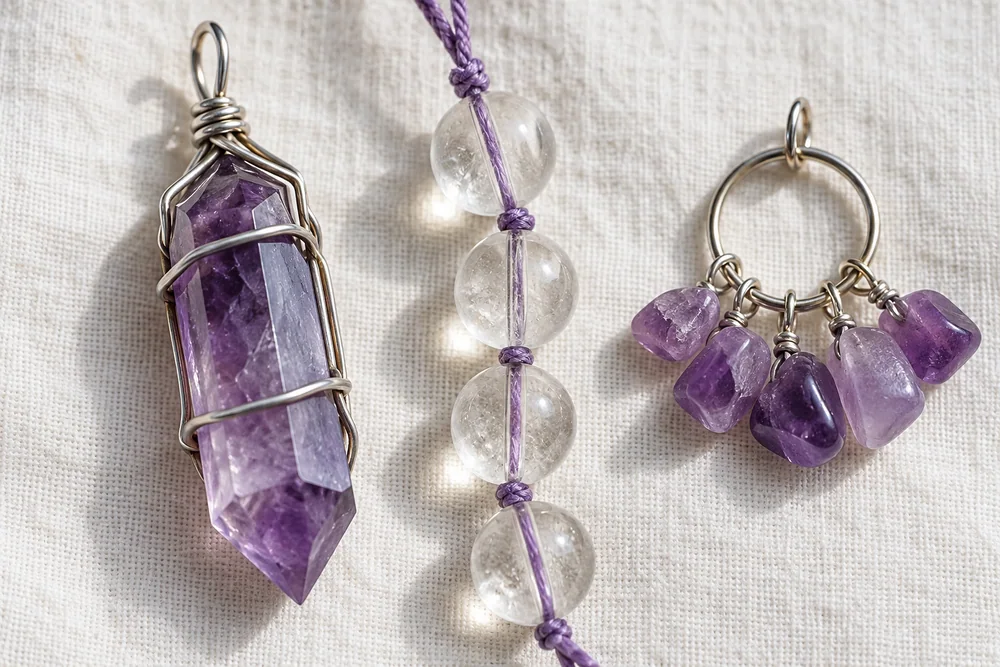
Any figure or illustration showing wire around a stone is educational unless it depicts the actual product. A visually attractive flourish is not itself evidence that the wrapping is structurally secure. The real hanger should be inspected from all sides, including the bottom of a tapered point and the upper loop.
7. Wire wrapping: secure retention versus ornament
A wire-wrapped stone may be held by a basket, cage, crossing wires, a formed cradle or a fitted bail. The essential engineering question is whether the enclosure prevents the stone from escaping when gravity, normal handling or modest movement acts on it. A decorative wire spiral that merely rests against a smooth tapered point can look elaborate while failing to retain the stone if the loop loosens.
Look for a secure connection between the stone cradle and the top hanging loop. Check whether the wire is kinked, cracked, excessively work-hardened, sharply bent or left with exposed cut ends. These defects may snag fabric or scratch people. Jewelers Mutual's wire-wrapping guidance advises tucking cut ends to avoid sharp points, a relevant general principle for decorative hangings as well.
Metal-colour names do not establish metal composition. “Copper wire,” “silver-tone,” “brass finish” and “gold colour” can refer to different base metals and coatings. If a user needs a particular metal due to wear, care or religious preference, verify the composition of the actual stock instead of inferring it from photographs.
Do not suspend a heavy stone above a seating area, doorway or walkway on an improvised wrap. If the enclosure cannot be assessed or the stone is already slipping, keep people clear of the fall zone and arrange safe removal. Support the assembly, use stable access and seek qualified assistance for a high or heavy hanging.
8. Drilled beads, strands, loops and crimp connections
Beaded hangings place load on the cord or wire and around the edges of each drilled hole. Small mineral chips can have irregular holes that abrade thread, while a heavy polished bead may stress its neighbour or a badly made crimp. Check the complete strand, not just whether the main stone looks clean.
Key points include an adequately secured end connection, sound rings, a suitable top loop, correctly fitted crimps where used, and a knot or other termination appropriate to the actual strand material. Synthetic cord, metal wire and natural fibres behave differently under repeated bending, moisture and sunlight. A seller should not provide a universal strength claim for all cords simply because they appear thick.
Photograph the original order of a complex piece before disassembly, especially if it includes several colours or symbols. Never rely on glue alone to replace an unknown load-bearing crimp or hide a cracked drilled hole. The strength and safety of repairs must be checked before the piece is returned overhead.
9. Light effects: transparency is not a rainbow guarantee
Opaque gemstones such as many jasper pieces display colour and pattern chiefly by reflection. Translucent rose quartz or agate may glow when light passes through thin regions. Transparent quartz can transmit light, and labradorite can show an angle-dependent flash even when not transparent. A correctly shaped glass prism may refract and disperse direct sunlight into coloured patches, but a rough mineral point cannot be assumed to behave like an optical prism.
Ask for photographs in both natural diffuse light and appropriate direct illumination when optical effects are part of the selling claim. A vivid labradorite flash can disappear as the viewing angle changes; a dyed agate slice may look different with light behind it; and a faceted manufactured glass pendant may produce a more predictable rainbow under a suitable sun angle.
Position light-catching objects with care. Avoid moving stone or glass pieces that can strike a window, and check for annoying glare on screens or into neighbours' rooms. Do not make a universal promise that every stone will create a rainbow or brighten a room in all seasons.
10. Safe placement and fixing in Indian homes
The weight and movement of the entire assembly matter. Even a small polished stone may be relatively dense, and several beads or a thick agate slice can add significant load to a narrow loop. A hanging in an entrance needs door-swing and headroom checks; a glass-adjacent suncatcher needs impact clearance; an outdoor balcony requires secure structural fixing and a realistic weather assessment.
Consider whether the hanging will remain mostly stationary or move in natural airflow. A cord that holds a stationary pendant indoors may be less suitable outdoors under repeated gusts. Do not assume an adhesive picture hook is approved for overhead, moving or exposed applications. Follow the fixing manufacturer's substrate, load and orientation instructions and obtain competent installation help for uncertain or heavy positions.
Do not suspend heavy stones, sharp points or fragile glass directly above cots, busy corridors or frequently occupied seats where a failure would be hazardous. Keep dangling cords, detachable beads and metal parts beyond children's reach. In apartment buildings, account for shared access, balcony rules and possible objects falling to lower floors.
For related decoration, browse Hangings & Chimes. Physical safety remains relevant even when a family follows a traditional or contemporary decorative placement preference.
11. Cleaning by the most sensitive component
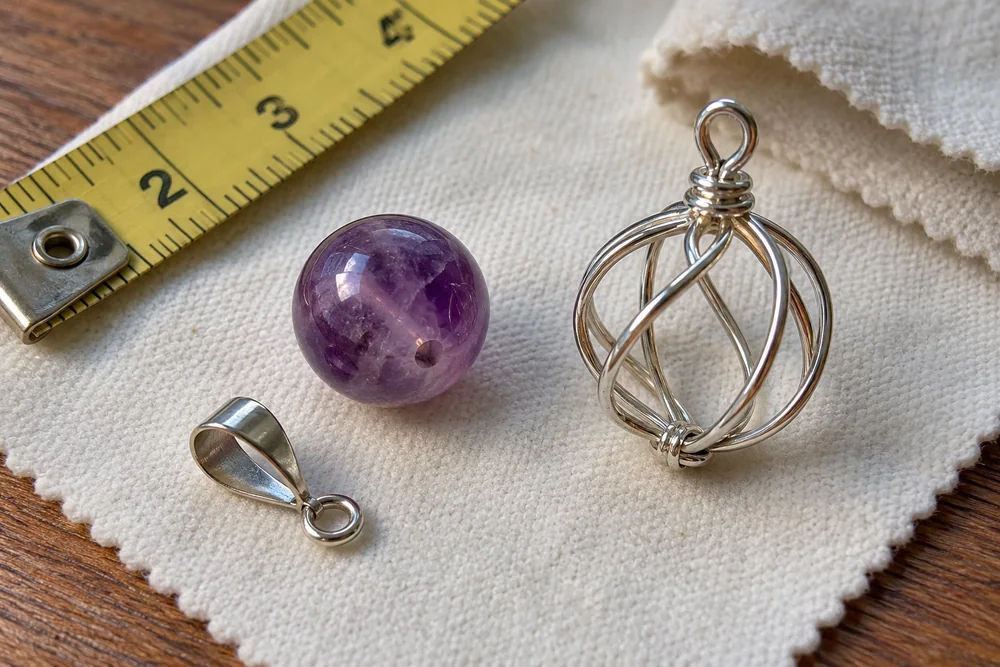
There is no single cleaning solution suitable for every mineral, treatment, wire, paint, wooden spacer and cord in a combined hanging. Start by identifying all parts, inspecting structural condition and dusting gently with a clean, soft dry cloth. Support the stone over a padded surface; do not pull on one small bead or loosely wrapped point to lift the assembly.
GIA's gem care guidance notes that treatments can change cleaning suitability. Lapis lazuli can be porous and dyed or impregnated; some stones are sensitive to heat or chemicals. Coated, dyed or waxed components should not be put into an ultrasonic cleaner merely because a nearby quartz bead is relatively hard. Avoid broad claims that all stones are “water safe” or that soaking in saltwater is beneficial.
Gypsum/selenite requires particularly cautious handling due to its softness and potential damage from prolonged moisture. Pyrite should not be left wet without verified material guidance. Feldspar, quartz, lapis and beads joined by adhesives require differing treatment. When identity or the construction is uncertain, conservative dry cleaning and maker-specific instructions are preferable.
If an ornament is used in a devotional context, distinguishing symbolic cleansing practices from physical care helps prevent accidental damage. A ritual preference for immersion, salt or sunlight should not be imposed on an unknown mixed-material product whose parts could be harmed.
12. Storage, transport and damage inspection
Before storage, inspect for loose wire, opening rings, cracked stone holes, coating loss, damaged cords and pieces that can strike one another. Make sure any permitted damp-cleaned components are fully dry. Separate hard stones and glass with soft clean packing so they cannot chip nearby softer minerals or scratch applied surfaces.
For points, protect the tip and maintain the wire cradle shape without compressing or twisting it. For drilled beads, avoid winding the strand into a tight knot. For an agate slice, support the flat surface and prevent hard objects from pressing on thin edges. For a hanging with several pieces, keep an accurate photo of the layout before disassembly or repacking.
Store away from dripping water, excessive heat and prolonged direct sunlight when colour, coatings or cords might be affected. Before rehanging, examine both the ornament and the ceiling or wall fixing. Polishing a stone cannot make a weakened upper ring or failing string safe.
13. Traditional ratna, Jyotisha, chakra colours and Vastu
Indian traditions contain rich uses of ratna (gem), navaratna arrangements and the symbolic or astrological associations of particular gemstones. Classical and later Jyotisha approaches to worn gemstones are not equivalent to claims about every modern home-decoration hanging. An amethyst-coloured bead is not necessarily natural amethyst, and an ornament containing nine colours is not automatically a prescribed, authenticated navaratna arrangement.
Contemporary seven-chakra gemstone hangings commonly use coloured beads to represent a sequence of chakras. The chakra traditions of Indian yoga and Tantra should not be reduced to an assertion that any seven retail colours constitute a classical list of seven verified mineral species. A seller should state the actual material names rather than treating colour correspondence as scientific authentication or a guaranteed physiological effect.
Vastu Shastra addresses spatial design, orientation, entrance, light, circulation and wider ideas such as the Vastu Purusha Mandala and Pancha Mahabhuta. Families may choose gemstone décor for beauty, devotion or personal symbolism; however, no universal classical Vastu rule makes every mineral hanging necessary for a building. Modern Feng Shui crystal-placement practices have a different Chinese conceptual history and should not be presented as identical to Indian Vastu.
For context see Vastu Shastra and the wider Vastu collection. Spiritual and cultural meanings can be described respectfully without promises that a particular hanging will cure an illness, create wealth or correct an astrological condition automatically.
14. Buying checklist: material, craftsmanship and commercial accuracy
- Name each stone correctly. Separate mineral, multi-mineral rock, dyed stone, glass, resin and other components; request identification evidence where appropriate.
- Disclose treatments. Ask about dye, heat, irradiation, wax, impregnation, coatings, composites and any tests or certificates claimed.
- Match the photograph to stock. Natural stones vary; request real photographs or an honest representative-item policy.
- Check construction type. Determine whether the point is in a secure cage, a bead is drilled or a slice has a suitable frame.
- Inspect load-bearing points. Check hanging loop, wire ends, crimps, knots, drilled holes and sharp edges.
- Measure correctly. Include full hanging height, stone dimensions, maximum width, total weight and any detachable ornaments.
- Plan for light. Confirm whether the design is opaque, translucent, reflective, labradorescent or a genuine prism.
- Check suitability. Determine whether the full assembly is intended for interior, sheltered outdoor or exposed use.
- Verify claims. Do not substitute a generic “certified gemstone” line for an actual item-specific report or verified material identity.
- Confirm the listing. Ensure price, stock, SKU, product images, included fittings, care advice and return terms describe the actual merchandise.
Frequently asked questions
Is a crystal hanging always made from natural quartz?
No. “Crystal” is used broadly in decoration for quartz, other minerals, manufactured glass and sometimes resin. Check the actual material declaration.
Can I identify a gemstone from its colour in a photograph?
No. Different minerals, dyed materials, glass and coatings can appear similar. Material identity and treatments require suitable documentation or testing.
Is lapis lazuli a single mineral?
No. Lapis lazuli is a rock made up of several minerals, commonly including lazurite with variable calcite and pyrite.
Does every green stone called jade contain jadeite?
No. Jadeite and nephrite are distinct materials under the jade name, and lookalikes or other green stones may be incorrectly labelled jade.
Is wire wrapping automatically safe for a heavy crystal point?
No. The wrap must actually retain the stone, with a secure top loop and appropriate load-bearing connections. A decorative spiral alone is not proof of secure mounting.
Should a gemstone hanging make a musical sound?
Usually the main function is visual decoration. Call it a chime only if its actual construction includes a deliberate working sounding mechanism.
Will every clear quartz or agate hanging create rainbows?
No. Light effects depend on material, cut, transparency, angle and illumination. A suitable faceted prism may disperse sunlight differently from a rough stone or opaque bead.
Can I soak all gemstone hangings in water or saltwater?
No. Soft minerals, coatings, dyes, cords, metal settings and adhesives can be harmed. Follow the actual maker's material-specific care advice; conservative dry dusting is a safer starting point when unknown.
Does Vastu require a particular gemstone hanging in every house?
No universal classical requirement applies to all homes. Traditional and contemporary practices vary; gemstone identification and physical installation remain separate factual questions.
Explore gemstone hangings from OmmRudraksha
Explore the Crystal & Gemstone Hangings collection for individual stones and mixed decorative forms, or the parent Hangings & Chimes for other styles. Read Vastu Shastra for traditional architecture and the Vastu collection for wider home décor. Before ordering, confirm the actual material, dimensions, price, availability and mounting requirements of the specific hanging.


