

The best hanging is not necessarily the one with the most attractive photograph or the longest list of spiritual claims. A wind chime should be evaluated for real sound, movement and weather suitability. A gemstone hanging should be assessed for actual mineral identity, treatment, secure construction and care. A Rudraksha ornament should disclose the genuine botanical bead, any claimed Mukhi count, its intended devotional role and the fittings that hold it safely.
This OmmRudraksha buying checklist helps you ask the right questions before choosing among these three families. It also includes traditional textile torans, bells and mixed-material designs where relevant. Use the selection and verification tables, installation and price checks, ten-point final checklist and nine FAQs to turn an attractive product description into a practical, supportable purchase decision.
1. First decide what you want the object to do
Three different purposes can sit behind the same general shopping term, “hanging.” Audible decoration is the principal purpose of many wind chimes: wind moves a sail, clapper or suspended tubes and causes sound. Visual decoration is the main purpose of gemstone and glass mobiles, embroidered torans and some bell-shaped charms. Devotional or symbolic display may be important when the arrangement uses Rudraksha, Om, a triśūla or another sacred motif.
These purposes can overlap. A Rudraksha strand may have a real metal bell; a wind chime may include agate accents; a gemstone hanging may carry symbolic colours. Yet the underlying function must be accurately described. A group of hanging beads without a striker is not automatically an audible wind chime, and a glass prism that makes attractive reflections is not necessarily a natural quartz gemstone.
Start by asking: Do I want to hear something, see something or express a particular cultural and devotional significance? If the answer is “all three,” expect additional material, structural and care checks for the mixed assembly. If one purpose matters most, select the product type that genuinely delivers it rather than relying on category labels.
2. Compare the three core buying choices
| Main question | Wind chime | Gemstone hanging | Rudraksha ornament |
|---|---|---|---|
| Primary attraction | Sound activated by breeze or another movement | Colour, mineral pattern, transparency, structure | Traditional sacred-bead symbolism and natural texture |
| Core material evidence | Tube/bell body material, striker, tuning or sound sample | Correct mineral or rock identity, treatment, genuine vs glass | Natural Elaeocarpus fruit stone, actual Mukhi if claimed |
| Typical special requirement | Airflow and freedom to swing without collisions | Care for drilled stone, finishes, wire and fragile edges | Sound drilling, knots, organic material care and authentic face description |
| Sound expectation | Only if its working sound mechanism moves | Usually silent unless bells or other sound parts are added | Usually silent unless a bell or chime is incorporated |
| Common uncertainty | Whether a claimed note/scale, metal or weather rating is genuine | Whether colour is dyed, stone is authentic or glass is mislabelled as quartz | Whether lines are natural, premium Mukhi or origin is verified |
| Where to begin | Real model sound, full drop, wind location and support | Actual bead images, names, treatments and total weight | Actual-bead photos, specimen documentation and safe hanging design |
No column guarantees superior spiritual value or product quality. The right choice depends on intended use and whether the seller can establish the specific facts that matter for that type of object.
3. Wind chime checklist: prove there is a functioning sound mechanism
A chime may contain suspended metal tubes, bells, bamboo tubes, ceramic pieces or other sounding parts. Its sound usually arises when a central striker or another moving element contacts them. The lower sail may help the wind move the striker. A decorative mobile without a working impact mechanism may sway silently even if a catalogue calls it a wind chime.
Inspect the product description for the number of sounding elements, their material, the striker or clapper, the upper hanger and any sail. Does the model need a moderate breeze? Can it ring from a door's motion? Are the hanging tubes free to move, or are they bound tightly into a purely decorative bundle? These are better questions than asking whether a product has “positive vibrations.”
Woodstock Chimes' manufacturer's guidance recommends choosing by sound, chime size and placement, and explains that suitable airflow and movement matter. A recorded sample of a specific model helps, but no recording can guarantee the same loudness or timbre in every room, especially after phone compression or playback through different speakers.
Do not assume that five pipes mean five precisely tuned notes. Musical pitch depends on an instrument's actual geometry and tuning; if a retailer claims a scale, melody, frequency or particular raga, it should identify the tested model and source of that statement.
4. Metal chimes: base alloy and finish are separate facts
A silver-coloured tube may be aluminium, steel, plated alloy or another metal. A bronze-coloured surface may be an applied finish rather than cast bronze. Brass is principally a copper–zinc alloy; bronze is a different copper-based alloy family, often with tin. The term bell metal has its own craft associations and does not prove one universal exact composition for every decorative bell.
Rustic copper-coloured Kutch Ghantadi bells can be made from formed iron sheet with a copper-rich surface treatment, rather than solid copper. A product labelled “handmade in Kutch” should have corresponding supplier or artisan provenance. Its wooden or metal clapper, seam, tuning and protective coating also need to be identified before specific sound or material promises are made.
Ask whether the maker specifies the actual structural body, decorative finish, weather recommendation and replacement-part availability. Copper-coloured plating can wear, exposing a different base metal; iron may rust in persistent dampness; wooden components can change in humidity. A real maker's care guide is more useful than “rustproof forever” written under a studio photograph.
Where buying for a quiet apartment, real sound behaviour may matter more than the price or alloy name. A light iron bell can ring frequently; a larger but carefully placed chime might sound only occasionally. Evaluate the model as an assembled instrument.
5. Bamboo, wood, ceramic and shell: material affects use and care
Natural bamboo tubes can give a hollow, woody timbre that differs from metallic ringing. Yet “wooden chime” is not a complete specification. Bamboo, solid wood, stained wood, natural shell, ceramic and glass react differently to moisture, impacts, sunlight and physical wear. Their construction may combine several materials with different maintenance needs.
Some bamboo or wooden products are suitable for a sheltered porch under the maker's conditions; others are intended only for protected interior use. A product pictured in a garden is not automatically suitable for sustained monsoon rain, severe wind or direct sun. For shell and ceramic parts, chipped edges or cracked holes can create hazards even when the chime looks attractive from the front.
Ask how the individual pieces are tied, what moves them, whether they can strike one another safely and how to replace worn cord. A chime that hangs from one decorative knot should not be assumed to have the same load tolerance as a properly engineered outdoor model with durable fittings.
If the buyer wants predictable musical notes, request actual tuning information. Organic and handcrafted instruments can vary from one another, and a claim of specific pitch needs evidence rather than the belief that all bamboo makes the same soothing sound.
6. Gemstone hanging checklist: identify real stone, not just a colour
A purple bead could be natural amethyst, synthetic or coloured glass, dyed quartz or another material. A blue bead might be lapis lazuli, sodalite, dyed howlite or glass. A green stone could be green aventurine, jadeite, nephrite, serpentine or a substitute. A close-up photograph of colour does not establish a gemological identity.
When shopping for clear quartz or Sphatik, remember that rock crystal is genuine crystalline quartz. In contrast, commercial “crystal glass,” K9 optical glass or a faceted glass prism is manufactured glass, not naturally formed quartz. Both can be attractive decorations, but they are materially different and should be named accurately.
GIA's gemstone-treatment reference describes common methods such as dyeing, heat treatment, coatings, impregnation and filling. Treatments are not automatically defects, but disclosure can matter to the stone's value and cleaning requirements. For example, bright agate can be dyed, and lapis or jadeite may have treatments that change the appropriate care method.
Ask what is known about each distinct mineral in a mixed hanging. One verified quartz point does not certify all accompanying beads. A generic “natural certified crystal hanging” tag is less informative than an exact list of materials, any treatments, actual counts and the test methods supporting premium claims.
7. Rudraksha checklist: a natural fruit stone and its Mukhi
Rudraksha comes from the hard endocarp of an Elaeocarpus fruit. The name Elaeocarpus ganitrus is common in Indian commerce; Kew's medicinal plant names database recognises its taxonomic relationship with accepted Elaeocarpus sphaericus. It is an organic sacred bead, not a mined gemstone or a generic brown wooden sphere.
The Mukhi classification concerns natural longitudinal face divisions of the actual bead. An ordinary drilled stringing hole is not an additional face, and scratches or carved lines should not be counted as genuine natural divisions. A front-facing product photograph may not show the complete number; ask for clear views around the entire specimen and the poles.
Five-Mukhi beads are widely used in common strands. Higher-Mukhi claims and special named forms such as Gauri Shankar may carry greater commercial significance and therefore deserve specimen-specific examination. Natural joined forms should not be confused with two separate beads glued together. An X-ray may assist morphological examination when appropriate, but it does not prove a growing region or spiritual effect.
If a premium bead comes with a laboratory report, confirm that the photograph, number, relevant measurements and stated conclusion match the physical specimen being purchased. A generic lab logo or an unrelated example report is not proof of certification. Do not assume every Rudraksha on an assembled hanging has been examined merely because one focal bead has a report.
8. Claims and evidence: what should a buyer actually request?
Words such as authentic, natural, handmade, certified, waterproof or tuned each make different assertions. A trustworthy seller distinguishes the evidence appropriate to each. A gemstone report may support a mineral identification; a maker record may support an artisan-origin statement; a sound recording may demonstrate the model's pitch but not its metal composition.
| Claim on a listing | Useful verification | What does not prove it |
|---|---|---|
| “Five-Mukhi Rudraksha” | Actual complete bead views; suitable specimen examination where important | One-side glamour image, float test, generic brown bead colour |
| “Natural rare higher-Mukhi” | Traceable specimen, natural groove examination and relevant documented lab method | Large price, marketing adjective or unrelated certificate image |
| “Natural clear Sphatik” | Material evidence for quartz and natural-source claim | Transparency alone; “crystal glass” trade name |
| “Untreated agate/jade/lapis” | Appropriate supplier disclosure or qualified treatment assessment | Colour, shine or seller assurance without supporting records |
| “Solid brass or bronze” | Maker specification and reliable material documentation | Gold or copper-coloured coating |
| “Handmade Kutch bell” | Credible maker or artisan-supply record for the actual item | Rustic appearance or generic regional photograph |
| “Precisely tuned chime” | Specific model's tuning specification and relevant sound demonstration | Number of tubes or subjective “healing frequency” language |
| “Outdoor safe” | Model-specific manufacturer environmental and mounting guidance | A promotional photograph taken outside |
| “Certificate covers whole hanging” | Report clearly listing actual covered components and test scope | Certificate for a single focal bead or gemstone |
Evidence should be proportional to the claim. Ordinary decorative glass can be sold straightforwardly as glass without unnecessary laboratory expense; an expensive rare natural Rudraksha or purported untreated premium jadeite warrants greater documentation. The decision is about honest product description, not automatic suspicion of every handcrafted article.
9. Real photographs, diagrams and representative illustrations
A buying page should explain what its photographs represent. A hero image of one natural agate slice cannot guarantee identical banding in every stone shipped. An educational illustration of a properly mounted hanging demonstrates a concept, but it does not prove that the actual merchandise has the same hook, connector, bead identity or finish.
Request real-stock views showing the complete item, back, upper hook, drilled holes, bell clapper and any lower sail. For gemstone pieces, a close-up of colour and surface helps; for Rudraksha, the full circumference and Mukhi lines are more informative than one front view. For a premium individually selected specimen, the exact-item photograph should match the invoice and any report.
Photographs should also use an understandable scale. A close-up can make a tiny bell look enormous or a heavy hanging appear lightweight. Exact measured dimensions and mass remain necessary. Where handmade pieces vary, the seller should distinguish expected variation from a different material or construction being substituted.
A seller who offers a clear explanation of what is verified and what remains unconfirmed can be more reliable than one who provides hundreds of polished images without a material specification.
10. Measure the complete product, not only the central decoration
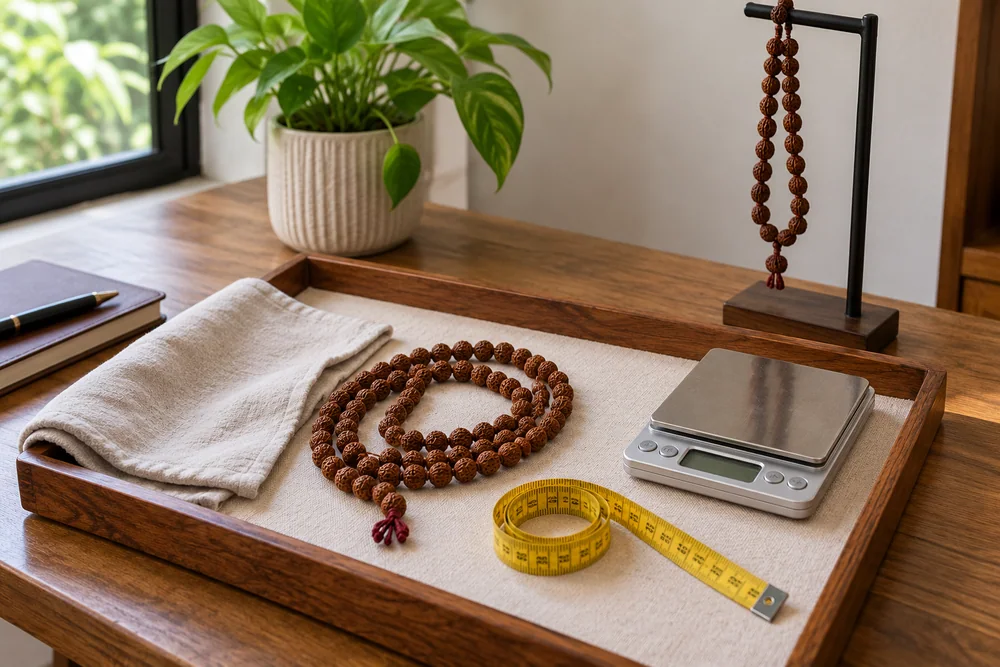
Always request total hanging height, including the top loop or chain, body, clapper, sail, tassel and any drop below the lowest bead. Record maximum width, individual bell or stone dimensions where relevant and the complete weight. A listed “20 cm” might refer to a tube or toran panel and omit the extra cord that determines whether the item fits the doorway.
At a door, the ornament must not obstruct the full swing, latch, handle, closer or usable passage. At a window, check that moving components cannot strike the glass. On a balcony, think about wind-driven motion and the consequences of a falling heavy metal or gemstone object. Never assume a lightweight adhesive picture hook is suitable for a moving chime simply because it held a still photograph frame.
The complete mounting plan depends on the real substrate—wood, plasterboard, concrete, masonry or a metal fixture—and the manufacturer's instructions. A renter may not be allowed to drill a wall or door frame. Do not attach ornaments to a fire-rated door or required exit in a way that interferes with its certified operation.
If there is no safe location for the product, choose a different size, a fixed silent design or a freestanding alternative rather than accepting an unsuitable installation.
11. Inspect the complete load path before paying
Find the exact path by which the assembly hangs: wall or ceiling fixture, top loop, connecting ring, cord or chain, knots or crimps, bead holes, metal cage and the lowest component. A strong stone or heavy cast bell is not the same as a strong total assembly; a thin cord or open ring can fail before the visible main object does.
For metal chimes, inspect where each tube and sail is attached and whether a striker can repeatedly contact those parts without cutting the supporting string. For gemstone designs, check sharp drilled edges, delicate points and wire cages that must actually retain tapered stones. For Rudraksha, inspect the endocarp's drill holes, natural projections, knots and any caps that may hide cracks or claimed Mukhi lines.
Ask whether the maker provides assembly or care instructions and whether any hardware is included. Do not assume a product includes a screw, wall plug, hook or bracket because the photograph shows it installed. The suitability of supplied hardware for a particular Indian apartment wall still requires assessment.
Visible damage, spreading rings or a loose lower cage should be resolved before a product is installed overhead. A decorative glue joint is not necessarily an adequate structural repair for a heavy pendant.
12. Indoors, sheltered balcony or outdoors: choose by actual exposure
Wind chimes need air movement if their principal appeal is sound, but that does not automatically make every chime suitable for all weather. A sheltered veranda may receive rain during a monsoon. Coastal humidity, sun, dust and strong gusts affect wood, natural fibres, metal coatings, iron components and adhesives differently. Woodstock's product-care material notes that outdoor conditions and cord wear matter to long-term performance.
Gemstone designs can have additional sensitivities. Some purple amethyst may fade in prolonged intense sunlight; dyed stones or surface-coated pieces may require care; gypsum sold as selenite is very soft and sensitive to water. Some pyrite specimens deteriorate in sustained damp conditions. An organic Rudraksha-and-bell assembly can have a cord or finish that needs more protection than its largest stone.
Choose the safest suitable location for the full collection of components, not only its most durable material. If the exact environmental rating is unknown, a protected interior location is the conservative default. Do not describe a mixed hanging as weatherproof because one metal tube resists rust.
A glass-prism suncatcher is a separate optical concern. Some curved transparent glass objects concentrate sunlight onto combustible surfaces, and fire services have warned about such incidents. Check the actual shape and position: a dispersive prism and a curved magnifying ornament are not identical, yet mixed designs can contain both. Keep any object capable of concentrating sunlight away from direct sun and combustible material.
13. Cleaning requirements can eliminate an otherwise attractive option
Before buying, ask how the entire assembly should be cleaned. GIA's gem-care guidance cautions that light, heat, solvents and mechanical cleaning can affect particular stones and treatments. Cleaning a loose known quartz crystal is different from immersing a combined strand containing dyed lapis, gypsum, pyrite, textile cord, plated metal and glued components.
Start with a manufacturer's actual care card. Where material identity or treatment is uncertain, gentle dry dusting while supporting the object is a safer starting point than saltwater immersion, vinegar, bleaching, steam or ultrasonic cleaning. A polished metal bell may have intentional patina or lacquer that should not be removed with abrasive metal polish.
If the recipient wants minimal maintenance, a delicate multi-mineral hanging in a humid open balcony may be a poor match. A simpler textile ornament in a protected room or a chime with genuine model-specific outdoor instructions may require less uncertainty. Maintenance effort is a legitimate buying factor, not a sign that the owner lacks spiritual appreciation.
Ask what to do if the cord frays, a clapper comes loose or a stone chips. A product's realistic longevity depends on replaceable parts, environment and actual construction; do not rely on generic “lifetime durability” language unsupported by warranty terms.
14. Sound, neighbours and children: a household compatibility test
A pleasant chime in a garden can be intrusive when placed near another person's bedroom, a shared apartment corridor or an office desk. Its frequency of ringing depends on local airflow, placement and actual sound design. A buyer may prefer a sound sample, a way to temporarily silence or move the item, and confirmation that the ornament can be installed without disturbing neighbours.
Long dangling cords, detachable small beads, heavy bells and sharp glass deserve caution around children and pets. The U.S. Consumer Product Safety Commission's warnings about accessible window-covering cords illustrate the severity of entanglement hazards, though the exact window-covering standards should not be indiscriminately applied as legal rules for every home ornament. The sensible lesson is to keep decorative loops and small parts out of reach.
Do not place a moving chime or heavy mineral point above a cot, bed, sofa or busy walkway. Check that a bell's swinging parts cannot hit a person's head or hand, and that an entrance decoration leaves room for visitors and mobility aids. A beautiful design is not suitable if the household cannot use it safely.
For a family with very young children, a shorter secure fabric toran or another non-hanging gift can be preferable to a long bead strand. A product designed for adults should not be marketed as a child-safe toy without appropriate evidence.
15. Handmade, regional and origin claims: verify the story
Traditional textile torans and Indian metal bell craft deserve accurate attribution. Museum collections document embroidered and mirror-work Gujarati torans used as welcoming doorway friezes. Kutch has distinctive hand-forged bell-making practices; other regions and crafts use different metals, methods and motifs. The seller should connect a specific maker or origin story to the specific merchandise.
An item made by a machine can still be attractive, but “hand-embroidered Kutch heritage piece” is an assertion about labour and provenance. A copper-coloured imported bell is not automatically a handmade Ghantadi, and a Rudraksha from an unknown supply chain should not receive a claimed Nepal origin because of its size. Separate material, design inspiration, exact artisan attribution and geographic source.
Buyers may choose a regional craft to support artisans; such motivation makes transparency more important, not less. Look for the maker or credible supplier where supplied, actual stock images, sensible descriptions of natural variation and a realistic explanation of repair and care.
Traditional symbolism can be discussed in the product's narrative, but it does not replace measured dimensions, complete component materials or the evidence supporting an expensive rarity claim.
16. Compare the real cost, not only the displayed price
A low-cost item may require a new bracket, special packaging or separate delivery charge. A more expensive piece may include documented material identity, a maker history, carefully finished hardware or replacement components. Without live verified product data, no specific current rupee price or ranking can be responsibly inserted into a general buying guide.
Before checkout, check actual selling price, taxes, shipping or handling, expected delivery conditions, mounting hardware, any customisation and the seller's stated return-shipping arrangements. For individually selected higher-Mukhi Rudraksha or verified gemstone material, ask which specimen and documentation are included rather than treating a generic category price as proof of value.
For a gift, installation effort is also a real cost. An unplanned heavy hanging may need professional fixing; a fresh botanical toran may require local delivery; a tuned chime may need a quiet placement or occasional restringing. A product that fits the recipient's situation can offer better practical value than a visually impressive object that remains boxed.
Indian consumer guidance emphasises clear pre-purchase information. Always consult the seller's live terms and applicable rules; do not rely on an article's date to infer the current legal status of every regulation or a particular merchant's obligations.
17. Product availability, photographs, returns and fulfilment
A complete listing should identify the offered SKU or variant, accurate materials, size, full weight, how much variation is expected, actual stock availability and the terms governing delivery and returns. The seller should make clear whether a photograph shows the exact natural stone or a representative design. A source illustration is educational, not evidence of stock tested or available to ship.
Ask for the return or exchange window, whether personalised or perishable items have distinct conditions, and what the buyer should do if a bell, gemstone or fitting arrives damaged. The answer must come from the seller's actual published policy or a confirmed transaction, not from a general article that invents conditions on the retailer's behalf.
For fresh mango leaves and marigold arrangements, fulfilment is especially timing-sensitive. Confirm a verified local source, freshness handling and delivery window that matches the actual ceremony. Do not assume an ordinary long-distance parcel can deliver a live botanical garland in an ideal condition.
Confirm that the actual item is available, that its specifications match the listing, and that the delivery and return terms suit your purchase.
18. Traditional significance without confusing distinct systems
Rudrākṣa has significant associations with Rudra–Śiva and with devotional practice, while Indian gemstone and ratna traditions have their own history in ornamentation and Jyotisha. A toran may communicate welcome at a threshold; metal bells are used in many forms of worship. These traditions deserve real description rather than being reduced to an interchangeable label of “energy décor.”
Vastu Shastra concerns design and arrangement of built space, including orientation, proportion, entrances and spatial order. Some contemporary practitioners offer particular decorative suggestions, but there is no universal classical requirement that every home must have exactly one five-tube metal chime, one gemstone hanging or one specified Mukhi over every entrance. The cultural context of a choice should be attributed to the relevant tradition or lineage.
Chinese Feng Shui systems also contain ideas about bells, wind and elements, but they are not simply another name for Indian Vastu or Śaiva Rudraksha practice. If the product includes mixed symbols or a modern colour scheme, describe its source honestly instead of presenting every association as a uniform ancient textual rule.
Respectful spiritual and personal choice can coexist with evidence-based product claims. A hanging can be offered as a gesture of auspiciousness or devotion without guaranteeing the treatment of illness, assured financial gain, a change in planetary conditions or measurable removal of undesirable “energy.”
19. Walk through three real-world buying scenarios
Scenario A: quiet city apartment. The buyer wants a welcoming decoration for an internal entrance. The doorway has a moving fire-rated front door and neighbours nearby. A compact embroidered toran fixed only at an approved safe position, or a quiet adjacent-wall ornament, may be more suitable than a constantly sounding chime. Check building permission, door operation, accessible cords and exact dimensions before selecting anything.
Scenario B: sheltered garden where the owner loves sound. Here a manufacturer-documented metal or bamboo chime may be the better choice. Ask to hear the actual model, inspect the full drop and sail, assess its mounting point and review weather care. A visually similar string of decorative bells might sound very differently. Do not rely on tube count or a claimed musical scale without real specifications.
Scenario C: devotional household seeking Rudraksha décor. An accurately identified five-Mukhi ornament may suit the owner's preferences. The questions are whether the actual beads are natural, how many are included, whether special forms are genuinely verified, and whether the full fitting is safe. A gemstone addition changes care and authenticity questions; a bell addition creates sound and additional load.
For any scenario, unresolved evidence is a reason to ask for facts or choose a simpler verified alternative. It does not require declaring the entire material category unsuitable.
20. When to choose another product or delay a purchase
Some red flags are practical rather than gemological. If the seller cannot state the complete hanging length, there is no way to assess a narrow door. If the metal chime has no working striker, it cannot be assumed to perform as advertised. If a rare bead has no exact-item image, the buyer cannot match it to a generic certificate. If the advertised “natural quartz” is actually crystal glass, the price and description need reconsideration.
Other concerns include no clear method of mounting, broken rings visible in photographs, unsupported all-weather claims for mixed organic material, vague gemstone treatment disclosures and a shipping promise not supported by the seller's terms. The response need not be immediate rejection: a clear answer, corrected description or suitable alternative may resolve the issue.
A buyer should be particularly cautious where marketing depends on dramatic guaranteed results instead of relevant product facts. Respect for traditional devotional meanings does not justify medical cure, guaranteed protection or wealth promises on an ordinary decorative item.
Choose the product once its identity, intended function, dimensions, condition, safe placement and purchase terms are understandable. A modest accurately described decoration is generally easier to own and give than an expensive one whose actual materials and installation remain unknown.
21. Final ten-point pre-purchase checklist
- Choose the intended function. Decide whether you want sound, visual light and colour, textile welcome or devotional Rudraksha symbolism.
- Check actual construction. Look for tubes, bells, striker or clapper, sail, bead arrangement, frame and all upper and lower connections.
- Verify material identities. Distinguish aluminium, brass, coated iron, natural gemstone, dyed stone, glass, organic Rudraksha and artificial substitutes.
- Examine premium claims. Confirm model tuning, artisan origin, natural untreated gemstones, actual Mukhi counts and specimen-linked reports when advertised.
- Get complete dimensions. Total drop, width, full weight, component measurements and swing clearance—not just central decorative size.
- Plan suitable placement. Confirm wall or doorway fit, airflow, safe hook or bracket, weather limits, neighbour sound and no interference with exits.
- Protect household members. Avoid accessible cord loops, loose small beads, sharp glass, overhead heavy pieces and unsafe window-sunlight effects.
- Confirm maintenance needs. Read cleaning advice for the most sensitive component, cords, metals, gemstone treatments and seasonal storage.
- Understand the total purchase. Check actual SKU, stock, price, taxes, shipping, mounting inclusions, delivery and returns from the live seller.
- Save the evidence. Keep exact stock photographs, any report identifier, invoice, care instructions and product description for future reference.
Frequently asked questions
Should I choose a wind chime or a gemstone hanging for a quiet room?
A gemstone or textile hanging is commonly a better starting point if silence is essential. A wind chime is appropriate where its sound is genuinely desired and its moving parts can be positioned safely.
Do more wind-chime tubes mean better sound?
Not necessarily. Sound depends on materials, tuning, dimensions, striker, suspension and actual airflow. A higher tube count is not automatic proof of musical quality.
Does a clear bead sold as Sphatik always mean natural quartz?
No. Sphatik commonly refers to rock-crystal quartz, but glass and other clear materials may look similar. Check genuine material identity and any natural-origin claim.
Are dyed agate or treated gemstone hangings unsuitable?
Not automatically. Treatments may be acceptable when accurately disclosed and priced, with suitable care instructions. Misrepresenting a treated stone as untreated is the concern.
How can I verify the Mukhi of a Rudraksha hanging?
Assess the actual bead's natural grooves around its entire surface and review competent specimen-specific examination where a special claim matters. A front image or water-sinking test is insufficient.
Can a bell with a copper-coloured finish be described as solid copper?
Only if its body really is solid copper and the claim has support. Coated iron, plated steel and copper-based alloys are distinct constructions and should be named correctly.
Will an outdoor-looking product survive Indian monsoon weather?
Not necessarily. Check the entire maker-approved design, including cords, wood, metal finishes, adhesives and any gemstones. A photograph outdoors is not a weather rating.
What measurements should I request before buying?
Ask for the full hanging height including suspension and tails, maximum width, complete weight, component sizes where relevant and any movement clearance needed for its installation.
Does Vastu require one particular chime or Rudraksha hanging in every house?
No universal classical requirement applies to every house. Tradition-specific symbolism may inform a family's choice, but safe mounting and accurate physical product description are still essential.
Continue with verified OmmRudraksha collections
Browse the Hangings & Chimes category, compare Crystal & Gemstone Hangings, and read the existing Vastu collection and Vastu Shastra overview. Confirm the dimensions, availability and specifications of your chosen item before placing an order.


